Sticky Fingers Vinyl LP Record The Rolling Stones 77 Release COC 39105 Near Mint
$
38



Favourite Auctions
To save auctions to your favourites, please login
If you don't have an account, please register
Description
Sticky Fingers
The Rolling Stones 1977 Release COC 39105
Sticky Fingers is listed as No. 63 on Rolling Stone magazine's list of The 500 Greatest Albums of All Time
The Album: Sticky Fingers is the ninth British and 11th American studio album by English rock band The Rolling Stones, released in April 1971. It is the band's first album of the 1970s and its first release on the band's newly formed label, Rolling Stones Records, after having been contracted since 1963 with Decca Records in the UK and London Records in the US. It is also Mick Taylor's first full-length appearance on a Rolling Stones album, the first Rolling Stones album not to feature any contributions from guitarist and founder Brian Jones and the first one on which Mick Jagger is credited with playing guitar.
The album is often regarded as one of the Stones' best, containing songs such as the chart-topping "Brown Sugar" and the country ballad" Wild Horses", along with the 2 part, Latin-inspired, "Can't You Hear Me Knocking" and achieving triple platinum certification in the US.
With the end of their Decca/London association at hand, The Rolling Stones would finally be free to release their albums (cover art and all) as they pleased. However, their leaving manager Allen Klein dealt the group a major blow when they discovered that they had inadvertently signed over their entire 1960s copyrights to Klein and his company ABKCO, which is how all of their material from 1963's "Come On" to Get Yer Ya-Ya's Out! The Rolling Stones in Concert has since come to be released by ABKCO Records. The band would remain incensed with Klein for decades over the act. When Decca informed The Rolling Stones that they were owed one more single, they cheekily submitted a track called "Cocksucker Blues", which was guaranteed to be refused. Instead, Decca released the two-year-old Beggars Banquet track "Street Fighting Man" while Klein would have dual copyright ownership, with The Rolling Stones, of "Brown Sugar" and "Wild Horses".
Although sessions for Sticky Fingers began in earnest in March 1970, The Rolling Stones had recorded at Muscle Shoals Studios in Alabama in December 1969 and "Sister Morphine", cut during Let It Bleed's sessions earlier in March of that year, was held over for this release. Much of the recording for Sticky Fingers was made with The Rolling Stones' mobile studio unit in Stargroves during the summer and autumn of 1970. Early versions of songs that would appear on Exile on Main St. were also rehearsed during these sessions.Sticky Fingers hit the number one spot on the British charts in May 1971, remaining there for four weeks before returning at number one for a further week in mid June. In the US, the album hit number one within days of release, and stayed there for four weeks. In Germany it was one of only two non-German albums to reach number one in 1971.
In a contemporary review for the Los Angeles Times, music critic Robert Hilburn said that although Sticky Fingers is one of the best rock albums of the year, it is only "modest" by the Rolling Stones' standards and succeeds on the strength of songs such as "Bitch" and "Dead Flowers", which recall the band's previously uninhibited, furious style. Jon Landau, writing in Rolling Stone, felt that it lacks the spirit and spontaneity of the Rolling Stones' previous two albums and, apart from "Moonlight Mile", is full of "forced attempts at style and control" in which the band sounds disinterested, particularly on formally correct songs such as "Brown Sugar". In a positive review, Lynn Van Matre of the Chicago Tribune viewed the album as the band "at their raunchy best" and wrote that, although it is "hardly innovative", it is consistent enough to be one of the year's best albums.
Sticky Fingers was voted the second best album of the year in The Village Voice's annual Pazz & Jop critics poll for 1971. Lester Bangs voted it number one in the poll and said that it was his most played album of the year. Robert Christgau, the poll's creator, ranked the album seventeenth on his own year-end list. In a 1975 article for The Village Voice, Christgau mused that the decadent album may ultimately be the Rolling Stones' best album, approached only by Exile on Main St. (1972). In his 1980 review of the album, he wrote that it reflected how unapologetic the band was after the Altamont Free Concert and that, despite the concession to sincerity with "Wild Horses", songs such as "Can't You Hear Me Knocking" and "I Got the Blues" are as "soulful" as "Good Times", and their cover of "You Gotta Move" is on-par with their previous covers of "Prodigal Son" and "Love in Vain".
In a retrospective review, Q magazine said that the album was "the Stones at their assured, showboating peak ... A magic formula of heavy soul, junkie blues and macho rock". NME (New Musical Express) wrote that it "captures the Stones bluesy swagger" in a "dark-land where few dare to tread". Record Collector magazine said that it showcases Jagger and Richards as they "delve even further back to the primitive blues that first inspired them and step up their investigations into another great American form, country." In his review for Goldmine magazine, Dave Thompson wrote that the album still is superior to "most of The Rolling Stones’ catalog". In 2003, Sticky Fingers was listed as No. 63 on Rolling Stone magazine's list of The 500 Greatest Albums of All Time.
In 1994 Sticky Fingers was remastered and reissued by Virgin Records, again in 2009 by Universal Music Enterprises, and once more in 2011 by Universal Music Enterprises in a Japanese-only SHM-SACD version.
Year Album Chart Peak 1971 Sticky Fingers The Billboard 200 1 Year Single Chart Peak 1971 Brown Sugar The Billboard Hot 100 1 1971 Wild Horses The Billboard Hot 100 28The Artists: It's hard to overestimate the importance of the Rolling Stones in rock & roll history. The group, which formed in London in 1962, distilled so much of the music that had come before it and has exerted a decisive influence on so much that has come after. Only a handful of musicians in any genre achieve that stature, and the Stones stand proudly among them. Every album the group released through the early Seventies - from The Rolling Stones in 1964 to Goats Head Soup in 1973 -- is essential not simply to an understanding of the music of that era, but to an understanding of the era itself. In their intense interest in blues and R&B, the Stones connected a young American audience to music that was unknown to the vast majority of white Americans. Though the Stones were not overtly political in their early years, their obsession with African American music - from Robert Johnson, Muddy Waters and Howlin' Wolf to Chuck Berry, Marvin Gaye and Don Covay - struck a chord that resonated with the goals of the civil rights movement. If the Stones had never made an album after 1965 they would still be legendary. Soon, of course, the Stones - singer Mick Jagger, guitarists Keith Richards and Brian Jones, bassist Bill Wyman and drummer Charlie Watts, in those days - became synonymous with the rebellious attitude of that era. Songs like "(I Can't Get No) Satisfaction," "Street Fighting Man," "Sympathy for the Devil" and "Gimme Shelter" captured the violence, frustration and chaos of that era. For the Stones, the Sixties were not a time of peace and love; in many ways, the band found psychedelia and wide-eyed utopianism confusing and silly. The Stones always were - and continue to be - tough pragmatists. Against the endless promises of Sixties idealism the Stones understood that "You Can't Always Get What You Want." You simply want to Let It Be? Why not Let It Bleed? For those reasons, as the Sixties drained into the Seventies, the Stones went on a creative run that rivals any in popular music. Beggars Banquet (1968), Let It Bleed (1969), Sticky Fingers (1971) and Exile on Main Street (1972) routinely turn up on lists of the greatest albums of all time, and deservedly so. All done with American producer Jimmy Miller - "in incredible rhythm man," in Richards' terse description - those records shake like the culture itself was shaking. As the Stones were working on Let It Bleed, Brian Jones died, and the band replaced him with Mick Taylor, a guitarist whose lyricism and melodic flair counterbalanced Richards' insistent, irreducible rhythmic drive, adding an element to the band's sound that hadn't been there before, and opening fertile new musical directions. After that, the Stones were an indomitable force on the music scene, and they have continued to be to this day.
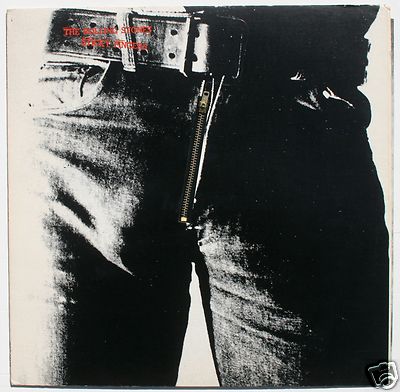
Artwork: The album's artwork emphasizes the suggestive innuendo of the Sticky Fingers title, showing a close-up of a jeans-clad male crotch with the visible outline of a large penis; the cover of the original (vinyl) release features a working zipper and mock belt buckle that opened to reveal cotton briefs. The vinyl release displayed the band's name and album title along the image of the belt; behind the zipper the white briefs were seemingly rubber stamped in gold with the name of American pop artist Andy Warhol, below which read "THIS PHOTOGRAPH MAY NOT BE—ETC." While the artwork was conceived by Warhol, photography was by Billy Name and design by Craig Braun.The cover photo of a male model's crotch clad in tight blue jeans was assumed by many fans to be an image of Mick Jagger, but the people actually involved at the time of the photo shoot claim that Warhol had several different men photographed (Jagger was not among them) and never revealed which shots he used. Among the candidates, Jed Johnson, Warhol's lover at the time, denied it was his likeness, although his twin brother Jay is a possibility. Those closest to the shoot, and subsequent design, name Factory artist and designer Corey Tippin as the likeliest candidate. Warhol "superstar" Joe Dallesandro claims to have been the model.
After retailers complained that the zipper was causing damage to the vinyl (from stacked shipments of the record), the zipper was "unzipped" slightly to the middle of the record, where damage would be minimized.
The album features the first usage of the band's "tongue & lips" logo, which was originally designed by Ernie Cefalu. Although Ernie's version was used for much of the merchandising and was the design originally shown to the band by Craig Braun, the design used for the album was illustrated by John Pasche. In 2003, the TV network VH1 named Sticky Fingers the "No. 1 Greatest Album Cover" of all time.
In Spain, the original cover was censored and replaced with a "Can of fingers" cover, and "Sister Morphine" was replaced by a live version of Chuck Berry's "Let It Rock". This version was released on the compilation album Rarities 1971–2003 in 2005.
In 1992, the LP release of the album in Russia featured a similar treatment as the original cover; but with Cyrillic lettering for the band name and album name, a colorized photograph of blue jeans with a zipper, and a Soviet Army uniform belt buckle that shows a hammer and sickle inscribed in a star. The model appears to be female.
Labels: The Rolling Stones came to Atlantic after eight years with the British Decca and the American London labels. In 1971, they announced their intention to form their own label and were bombarded with offers from various record labels for distribution. No one knows what thought process the Stones went through to make their pick but they eventually appointed Atlantic as their label's distributor and made Marshall Chess the label's Manager.
The longest running Rolling Stones album label is the one first appearing on the 1971's Sticky Fingers, and ending its run with the Rewind album in 1984. The clearly recognizable Tongue & Lip design is present on the left side, while the catalog number appearing above their name. On many of the early editions, the word E A S T can be spotted circling the inner-most vinyl of side two, and penetrating the label in that area.
Vinyl LP Album Details:
Original Release Date US: April 23, 1971
Recorded At:
December 2-4, 1969, Muscle Shoals Sound Studio, Sheffield, Alabama;
February 17, March – May, June 16-27, July 17-31, October 1970, and January 1971, Olympic Studios, London, UK;
except "Sister Morphine", begun March 22-31, 1969
Country: USA
Style: Blues Rock, Classic Rock
Catalog Number: COC 39105
Format: Stereo
Speed: 33-1/3
Binding: Vinyl
Time: 46:06
Language: English
Media: LP
Distributed By: Atlantic Recording Company
Original label: Rolling Stones Records
Run Out Groove Side 1: Hand Etched: Rolling Stones Records ST-RS-712189-BB 1-11-1Run Out Groove Side 2: Hand Etched: Rolling Stones Records ST-RS-712190-AAA 1-11
Pressed at: PRC (formerly Philips) Recording Corp., Richmond, IN ("RI"-suffix matrix numbers on labels)
Credits:
Acoustic Guitar – Keith Richards (tracks: A1)
Bass: Bill Wyman (tracks: A1 to A4, B1 to B5)
Congas: Rocky Dijon (tracks: A4)
Cover [Concept], Photography By: Andy Warhol
Design [Album], Graphics: Craigbrauninc
Drums: Charlie Watts
Electric Piano: Bill Wyman (tracks: A5)
Engineer: Andy Johns, Chris Kimsey, Glyn Johns, Jimmy Johnson
Guitar: Keith Richards (tracks: A1, A3 to A5, B1 to B4), Mick Jagger (tracks: A2, B4, B5), Mick Taylor (tracks: A1 to A5, B1, B2, B4, B5), Ry Cooder (tracks: B3)
Organ: Billy Preston (tracks: A4, B2)
Other [Jackets, Sleeves]: Sound Packaging Corp.
Percussion: Jimmy Miller (tracks: A4, B1), Mick Jagger (tracks: A1)
Piano: Ian Stewart (tracks: A1,B4), Jack Nitzche (tracks: B3), Jim Dickinson (tracks: A3), Jim Price (tracks: B5), Nicky Hopkins (tracks: A2)
Producer: Jimmy Miller
Saxophone: Bobby Keyes (tracks: A4, B1, B2)
Strings: Paul Buckmaster (tracks: A2, B5)
Trumpet: Jim Price (tracks: B1, B2)
Vocals: Keith Richards (tracks: A2 to A5, B1, B2, B4), Mick Jagger
Written-By: Mick Jagger-Keith Richards (tracks: A1 to A4, B1 to B5)
Tracks:
Side One:
A1 Brown Sugar 3:50
A2 Sway 3:45
A3 Wild Horses 5:41
A4 Can't You Hear Me Knocking 7:17
A5 You Gotta Move
Written-By – Fred McDowell 2:32
Side Two:
B1 Bitch 3:42
B2 I Got The Blues 4:00
B3 Sister Morphine 5:34
B4 Dead Flowers 4:05
B5 Moonlight Mile 5:56
The Rolling Stones - Can't You Hear Me Knockin' Side 1 Track 4
Album Condition: The album in this auction is an original cover. The album cover is in excellent condition showing a tiny bit wear along the edges. The mock belt buckle that opens to reveal cotton briefs that reveal white underwear with the Rolling Stones' tongue logo on it has never been opened (see stock image). The original album liner is included, and has only some minor creases and a two inch tear at the top of the reverse side. The vinyl is pristine and is in near mint condition. It has only been played only a few times. Under an incandescent light bulb there appears to be no scratches on either side of the vinyl. The record labels are clear and crisp with no writing, markings or spindle wear. This album is an original heavy duty pressing. This album is not a an import or a counterfeit pressing. It has the original, thick cardboard cover (American style). There are no barcodes, cut out holes or saw marks.
The Auction: This is a No Reserve Auction. Your album will be shipped in a 200 lbs test corrugated cardboard mailer box with a 32 lb. edge crush rating. The buyer pays for handling, packaging and shipping in the US by USPS Media Mail at a flat rate of $4.00. PayPal, Cashiers Checks, and Personal Checks accepted as payment. Payment is expected within five days from the close of the auction. Please allow up to seven days for personal checks to clear. Shipping and Handling charges will include Parcel Tracking and Delivery Confirmation services via the internet. Please see the below chart for international mailing rates and USPS Priority Mail if requested. This item is guaranteed to be as described above. If you do not agree with my description then you may return these items for a refund (less fees, shipping and handling) by providing us notice of your intent within 14 days. No return if the album cover, liner or the record has been damaged in any way beyond the existing condition.
price rating