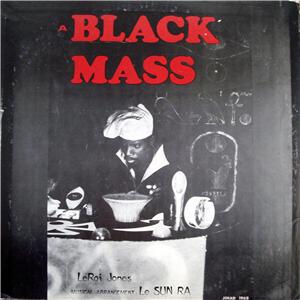
Sun Ra's Arkestra/LeRoi Jones:Black mass,Rare 1st press
£
95
$
126


Favourite Auctions
To save auctions to your favourites, please login
If you don't have an account, please register
Description
therealgaryhill Store
Sun Ra's Arkestra/LeRoi Jones:Black mass,Rare 1st press Prev Stop Play Next
A Black Mass by Leroi Jones (Amiri Baraka) featuring Sun Ra & the Myth-Science Orchestra Jihad 1968 original pressing This is the incredibly rare recording of Amiri Baraka’s 1965 play “A Black Mass,” featuring musical accompaniment by Sun Ra and the Myth-Science Arkestra. It is the original pressing with the colored cover (it was also later released with a black and white cover). It is one of the hardest Sun Ra recordings to find in it's extremely limited original pressing. The record is visually graded as VG+. It has a few scuffs, but none of them can be felt by touching the surface (there are a few light crackles during quiet passages, but it’s nothing that detracts from the overall listening experience). I have listened to the album all the way through from beginning to end, and I will say that the record is very listenable in terms of sound quality. The cover is VG+, with a couple of minor chippings to the edges on the paste-on front (see pic). There is no ringwear at all. The following is a quote from Amiri Baraka regarding A Black Mass: “The play A Black Mass was written in Harlem in 1965, much of it probably at my desk at The Black Arts Repertory Theater School at West 130th Street and Lenox (now Malcolm X. Blvd.). It was first performed at the RKO Proctors Theater, Newark as a companion piece to J-E-L-L-O, a satire on the Jack Benny show where Rochester turns militant. The reason it was Newark is because late in 1965, I decided to walk away from the BARTS because with the mounting internal strife, the phoneomenon of 'diminishing returns' had set in so disruptively that the vision of bringing Black Art into the community and creating what we were later to understand as Cultural Revolution could no longer succeed at that venue. Black Mass shows the heavy influence of the Nation of Islam even though, after Malcolm's murder, I became alienated from that Nation, essentially as a means of registering my allegiance to Malcolm. Even the Jacoub story I had gotten from Malcolm when he was still more directly motivated by Elijah Muhammad's teachings. Sun Ra was one of the most consistent and supportive artists associated with the BARTS. He was there several days a week, teaching all who would listen. Interestingly, it is just recently that John Swed's book Space Is The Place points out how much my own thinking was influenced by Ra, and congruently how the Black Arts experience added a more openly Black nationalist edge to Ra's actually scientific philosophical musings on the Universe. At any rate, when I conceived of doing Black Mass to music, Ra was the only musician in my mind. Not just because of the 'otherworldliness' of the tale, but the sensuous 'outness' I knew Ra, with his (then titled, the name changed continuously) Myth-Science Arkestra, would bring, which I felt would give a material life to the text. The work was recorded in The Spirit House, on the first floor theater we had created by tearing down the walls of my rented one-family house, just as we had done at The Black Arts. Painter Joe Overstreet came over and we almost tore the house down with our remodeling. But in that tiny space great things did happen. Not only was Ra and The Mass recorded there with our marginally professional set-up, but the Aylers, Sonny Murray, and my own Black & Beautiful (all of which we plan to re-release). We also did works like Slave Ship, Arm Yrself or Harm Yrself and Home On The Range. Spirit House is where the Spirit House Movers came together and Amina began to build the African Free School, and together we later built the Committee for Unified Newark and the Congress of African Peoples. With Sylvia Robinson (Amina Baraka, a Newark artist who would shortly become my wife), Yusef Iman (a BARTS original), Newark's Marvin Camillo (he and Yusef are both gone now), and Barry Wynn (Amun Ankra), we tried to recreate the staged version which we had just done. And while there is something to be desired in our collaboration, the recording stands not only as a record of what The Black Arts was doing, but points I think into the future of the spoken word and the possibility of expanding what can be recorded and what kind of collaboration between word and music can come. The theme 'The Satellites Are Spinning' is the dramatic musical mise en scene throughout, though close listeners will hear some of the music which characterized the Myth-Science Arkestra rising and falling through the mainly improvised music-drama. In total, the music is rich and evocative by itself. Heard with the text of The Black Mass, both connect and extend each other with a dramatic gestalt of Myth-Science music and the mythologized history deepens our emotional perception of what is being told. For me, re-heard with the benefit of study and another kind of thoughtfulness, it even projects a rationale that's more scientifically based, 'search-lighting' some evasive facts of human history as well as projecting the premise which I have long held, that art is creation, and that we must oppose the 'creation of what does not need to be created'. -- Amiri Baraka 9/6/99”
Certain images/photos are the copyrighted property of JupiterImages and are used with permission under license.
price rating
![STUDIO ONE/DICK TRACY - ROLANDO ALPHANSO & THE SKATALITES [SKA INST.] 7](https://www.popsike.net/php/thumbnail.php?url=https://www.popsike.pics/pix/20160409/301923597266.jpg)
![Jay Z & Kanye West-Watch The Throne (Deluxe) [2 PICTURE LP] -Sealed DOUBLE Vinyl](https://www.popsike.net/php/thumbnail.php?url=https://www.popsike.pics/pix/20130916/380720748382.jpg)
![Jay Z & Kanye West-Watch The Throne (Deluxe) [2 PICTURE LP] -Sealed DOUBLE Vinyl](https://www.popsike.net/php/thumbnail.php?url=https://www.popsike.pics/pix/20131002/370911486682.jpg)
![Jay Z & Kanye West-Watch The Throne (Deluxe) [2 PICTURE LP]](https://www.popsike.net/php/thumbnail.php?url=https://www.popsike.pics/pix/20120405/230772487736.jpg)