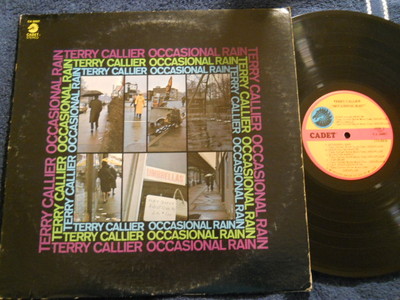
TERRY CALLIER - Occasional Rain 1972 orig w/ Ordinary Joe, northern soul NM-
$
140


Favourite Auctions
To save auctions to your favourites, please login
If you don't have an account, please register
Description
PLEASE TAKE A LOOK AT MY OTHER eBAY AUCTIONS - ALWAYS EXPECT THE UNEXPECTED
CHECK OUT MY OTHER SOUL ALBUM LISTINGS
TERRY CALLIER - "Occasional Rain" in stereo on Cadet CA 50007. A masterpiece, contains the northern soul classic Ordinary Joe; but this is not a northern soul album. Varied, some of it is mellow soul - combining elements of soul, jazz and folk with some fascinating arrangements by producer Charles Stepney. Background vocals are done by Minnie Ripperton, Shirley Wahls and Kitty Haywood.
Record Grade: Near Mint Minus, play-graded and plays up to visual grade. A couple of tiny 'dimples' in the pressing that do not affect play at all.
Cover Grade: VG+, minor to average wear, overall a nice cover
Labels: Yellow and red with blue logo
ABOUT THE ALBUM:
Occasional Rain, originally released in 1972, is the first of three albums, Chicago singer/songwriter Terry Callier cut for Cadet in the 1970s with producer Charles Stepney. Eight years earlier Callier, then a soulful blues and folk singer, cut an album of covers (as was par for the course in 1964 at the end of the folk revival, Bob Dylan was just getting his momentum) for Prestige, but it was shelved until 1968 and went nowhere. Callier spent the intervening time touring coffeehouses and small clubs around the country until he signed with Cadet. While the voice is most certainly the same, the nearly alchemical transformation of his sound via his own songwriting -- and the way those songs were treated by Stepney -- is still mind-boggling. Occasional Rain is recorded as a suite; not quite a concept album, there are segues, all titled "Go Head On," fading in and out that introduce various stages in the recording. Stepney put together a band led by Callier's excellent acoustic guitar playing, his own harpsichord and organ, pianist Leonard Pirani, bassist Sydney Simms, and drummer Bob Crowder -- it's the leanest production job in their collaboration. The beautiful touch, though, is Stepney adding a backing chorus with sopranos Minnie Riperton and Kitty Haywood, and contralto Shirley Wahls! The nearly baroque soul sound is heard almost immediately on the classic "Ordinary Joe." The organ and harpsichord momentarily offer the false impression of horns in a pulsing 4/4 before Callier lays out the poetic truth of his protagonist: "For my openin' line/I might try to indicate my state of mind/Or turn you on-or tell you that I'm laughin'/Just to keep from cryin'...Now I've seen a sparrow get high/And waste his time in the sky/He thinks it's easy to fly/he's just a little bit freer than me..." The jumbled images are met with the swell of a taut, killer band; they give him more room out there on the ledge to let his freely associated snapshots articulate into a whole that expresses a transition from heartbreak to resistance to determination, to a holistic spirituality and ultimately to hope as he transfers it from his own view to the woman he is addressing. Whew. These cats could have recorded for Buddah backing the Lemon Pipers, but Stepney keeps it from any saccharine sweetness, and makes it all flow into the direct expression of deep emotion.
"Golden Circle" follows, with that choir in the backdrop flowing in and out of a very scaled back mix where acoustic piano and Callier's acoustic guitar lead the flow of this deep expression of love as vulnerability. The grain in Callier's voice is very masculine, but its tenderness is total, his words poetic; sophisticated yet very direct. The added cello on "Trance on Sedgwick Street," by Earl Madison, makes for the startling juxtaposition of hard, street-tough truth and a critical examination of spirituality. Callier's guitar and that multi-tracked cello are devastatingly effective. The folk and blues roots in Callier's writing and singing just pour from this tune, but Stepney understands that these are soul tunes, so he creates bridges from one tradition to the next, making it a seamless whole.
The other classic tune from this session is the title cut. This beautiful and startling psychedelic soul tune is unlike anything else in Callier's catalog. Stepney adds multi-channel sound effects, tiny little organ tones that float through each channel beginning at the end of certain lines seemingly randomly. As an acoustic guitar plays atop a church organ which swells in the middle eight to fill out a shelf underneath Callier's voice, it feels like an entire universe floating between one channel and the next (especially on headphones!). It can even be startling, as those sounds, even though they are expected, are kind of a shock -- you'll need to listen through it a couple of times to get the full meaning of the Callier's gorgeous songwriting. In reference to the "Go Ahead On": they are the only direct reference to the blues roots in the songwriter's past and are very effective at both establishing that musical continuum and highlighting this wonderful new direction. This record is tight in a way the other Callier titles are sprawling. Here he holds the songs in check, and Stepney supports that while expanding the sonic palette that frames them. Certainly "Blues for Marcus," touches on those blues roots, to be sure, but the cellos and the decorative acoustic guitar turn it into a soul tune. That's what happens in the hands of two masters who know how to work together. Callier probably had no idea he was so inspired until he and Stepney began to tease the genius out of the songs on tape and illustrate them in such an organic yet wildly expansive way. The final cut "Lean on Me" (not to be confused with the Bill Withers tune of the same name) sends the set out on the highest of high notes: Callier's voice is so firm and determined, but his gentleness is not to be underestimated. The empathic dedication in his singing -- and its encouragement by that chorus of women makes the track -- and the album -- transcendent.
All records are carefully graded. In an attempt to give customers an accurate impression of condition rather than adhere to somewhat arbitrary criteria, I give an "overall presentation" grade, supplemented when necessary with additional remarks. Please refer to my grading system below for a more detailed explanation.
MY GRADING SYSTEMS: I’ve been told that I grade conservatively. My NM (near mint) is my highest grade for opened records (which would also include unplayed records). It’s a 9 or 10 on a 1-10 scale. M- would be equivalent to an 8; VG++ to a 7; VG+ to a 6; VG to a 5; VG- to a 4; G to a 3; F to a 2 and P to a 1. The same scale applies when I grade covers (jackets). Significant defects are specifically noted and taken into consideration in the grade.
GRADING DESCRIPTIONS
RECORDS:
- GRADING is based on the following criteria
- Sealed = store stock new
- Near Mint = like new or near new with only one or two small insignificant defects, a 9 or better on a 1-10 scale
- Near Mint Minus (or NM-) = very nice. Would be Near Mint, except for a couple of light hairlines or scuffs, which do not affect play
- VG++ = still a very nice record with all or nearly all of its original gloss but may have a few more light, surface marks, hairlines, needle tracks or the like which should not materially effect play
- VG+ = a nice, but used record that may have a series of light scuffs or scratches. It probably plays with a few pops, but has no serious problems.
- VG = a well-used record that still should sound OK when played, but may have moderate surface noise, pops, etc.
- VG- = a well-worn record that plays through without skipping, but will do until a better copy comes along.
- Good = not actually good at all but probably will play through but with much in the way of surface noise, pops, crackles, etc. Still, will have no cracks, chips or the like
- Fair = you’re getting this record just to own but not to play
- Poor = the sky’s the limit, generally I will discard a record this bad (and sell the cover, jacket or sleeve alone) unless the label holds some particular interest
VISUAL GRADING: All records are visually graded only unless I state that they are play-graded. Some major labels were pressed on better quality vinyl and will sound better than a record which visually appears the same on "budget" labels which were pressed on lower quality vinyl. Recording techniques also varied. The sound on live albums may be far inferior to studio recordings. There may also be defects in the pressing which are invisible. The point is that an album on a high quality label that was visually graded VG+ may sound better than an album on a budget label that was visually graded Mint- or even Near Mint. Please refer to my return policy, below. But please don’t be shocked if a record visually graded Near Mint doesn’t sound state of the art. If I base my grade on a PLAY GRADE, I will state this specifically in my grading section.
COVERS: There are really too many possible defects regarding covers to be as specific in my definitions as I had been with my record grades. But please keep in mind these general grading guidelines:
- I will give greater weight to the condition of the front cover than back cover when assigning an overall grade
- No cover with a cut out hole or saw mark will be graded Near Mint even if it is still in factory shrink and there is no other wear
- I will not reduce the grade of a cover for stickers which are glued to the jacket by the record company (eg. Contains the hit song Expressway to Your Heart); but will reduce the grade for stickers glued on the cover by stores, previous owners, etc.
- If I write that a cover has a bb hole, I’m talking about a small cut out hole
- A saw mark is a narrow cut in the perimeter of the cover, could be anywhere and vary in length from 1/2” to 2” at the most.
- The overall grade takes into consideration any stated defects. For example, if I grade a cover VG+ and then state it has 6” top and bottom seam splits - I’ve already reduced the grade because of the seam splits. If the seams weren’t split, the cover would be graded higher such as VG++ or Mint-.
Shipping Costs: CURRENT SHIPPING RATES AND POLICIES.
The winning bidder pays for shipping.
DOMESTIC SHIPPING WITHIN THE UNITED STATES: Due to increase in postage rates, I have sometimes been losing money on shipping as I send all records in sturdy professional Bags Unlimited mailers with one or more fillers. Therefore, I am now using the eBay postage calculator to determine postage. This will also result in a more equitable charge for priority mail shipments. Instead of a flat fee, those who live in the southeast and mid-east will reap the benefit of reduced priority mail rates.
DOMESTIC AND INTERNATIONAL SHIPMENTS: COMBINED SHIPPING - Save money when I mail 2 or more records in the same package. Please wait until I send you an invoice or request an invoice when combining two or more records or cd's in one shipment -prior to making payment.
INTERNATIONAL SHIPMENTS: Overseas customers are invited to bid. As with U.S. shipments, I will use eBay's postage calculator for all overseas shipments. Postage to Canada is substantially less than to other countries - if you live in Canada and don't see a separate rate for Canada , please e-mail me and I'll modify the invoice to reflect the lower shipping charges. Surface mail is no longer available for overseas. Express Mail International and Priority Mail International are available - rates are substantially higher than first class international and will be quoted for each purchase if buyer requests this service. Express Mail International or Registered mail is now required for purchases over $100. Generally, Express International costs $35 for 1 album and additional albums are about $5-6 more. Registered costs about $26 for 1 album, about $5 more for each additional album. Registered mail may not be available to certain countries. I am sorry but the increased risks and costs must be passed on to the international buyer. On the bright side of things, Express Mail International will get you the package faster and it is safer. Registered mail is the safest form of shipment (but not as fast as express mail international). So there are benefits to the buyer as well as the seller. Please wait until I send you an invoice or request an invoice when combining two or more records or cd's in one shipment -prior to making payment.
Please check out my other eBay auctions and stores listings.
I’ve been listing all types of records - mostly LP’s - including 50’s and 60’s rock ‘n’ roll, country, folk jazz, blues, personalities, new wave and punk, surf, psych, spoken word, comedy, etc., etc....... I try to list unusual, unique or obscure records, not the ones that you see all the time. While a majority of my listings are albums, you’ll often find a nice selection of 45’s, EP’s or picture sleeves...and an occasional 78 or two.
My return policy: . You may return an item if it's not in the condition described. You may not return items if you decide you don't like the music. I will return the base price of the item unless I make an error in shipment such as sending you the wrong record or cd. In that case, you will be reimbursed for the cost of the item and shipping both ways. In addition, the item must be returned in its original condition , i.e. the way it was shipped when it left my hands. While a very high percentage of my records arrive safe and sound (I use professional mailers and a filler or two, more for 78’s), they occasionally are damaged in transit. If that happens, I won’t accept the return of the record or other item.
Sealed Records: After a sealed record is paid for, I will gladly open it before mailing to make sure that the record is new & unplayed. If the record is not, I will give a full refund. Even though it is easy to spot most resealed records from the 50's and 60's [I will mention that in the desription if it looks like a possibility], not all records from the 70's & 80's are quite as obvious. Please ask for any details about the seal of a particular record & I will be happy to answer.
price rating