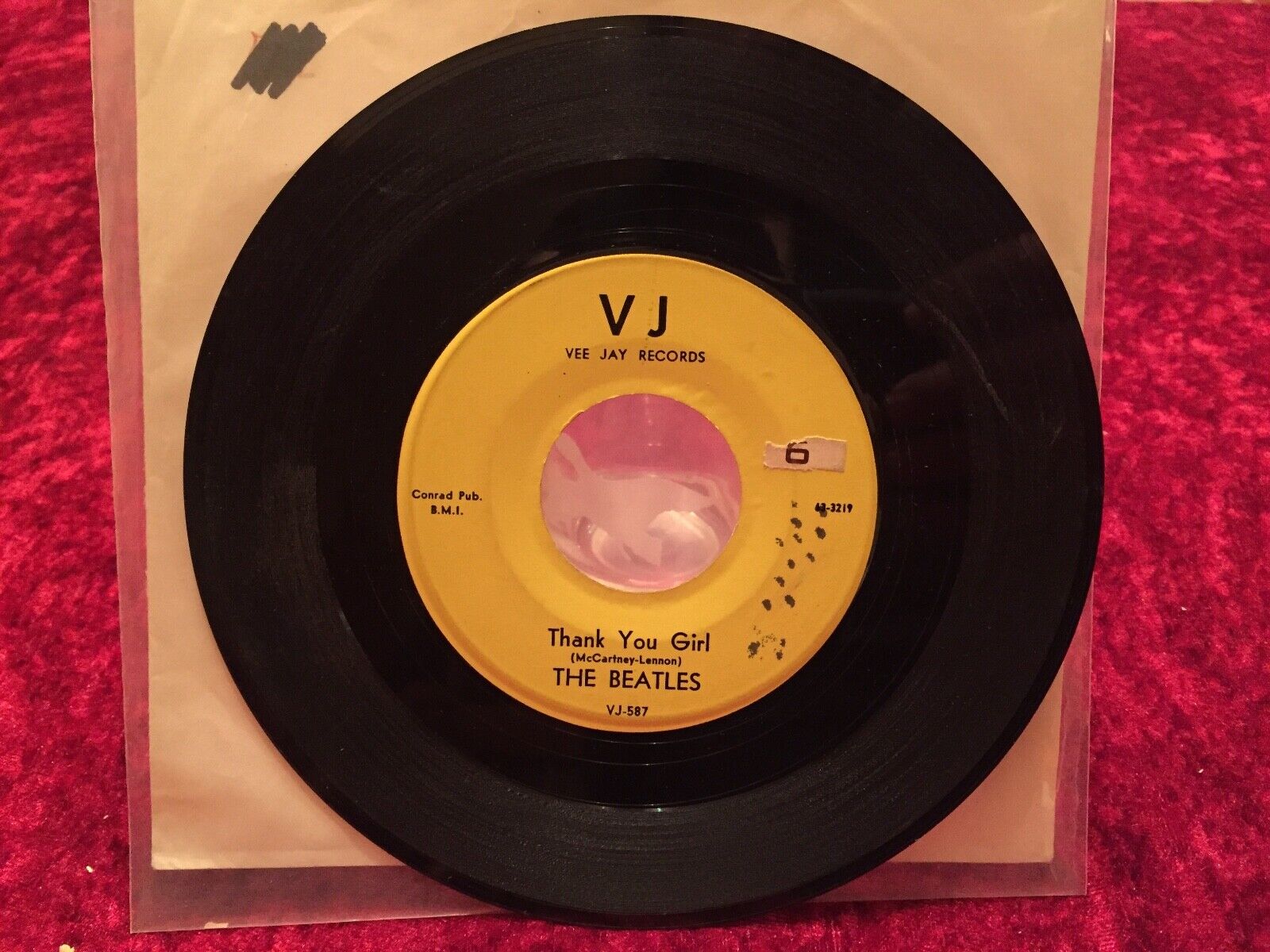
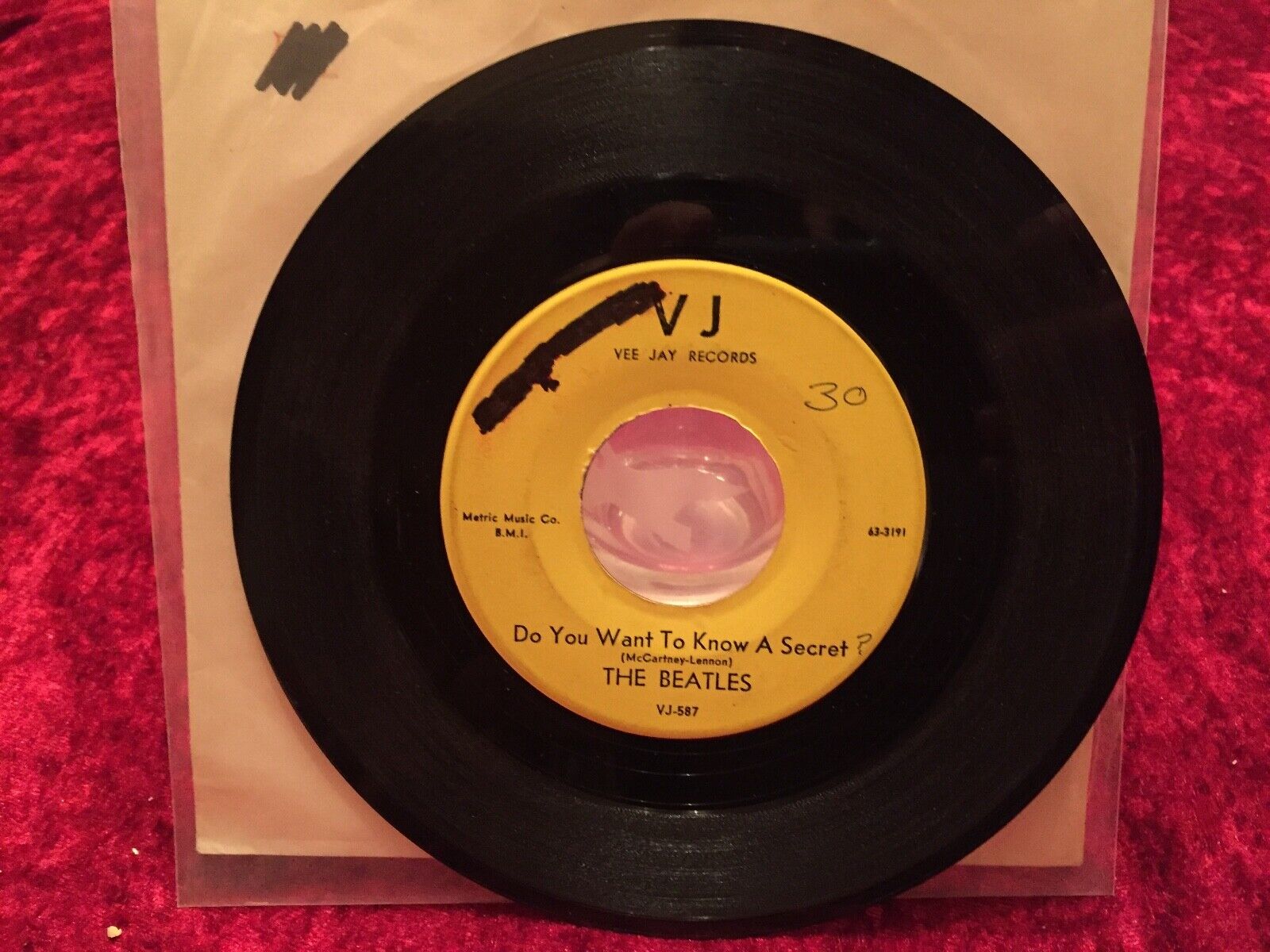
THE BEATLES Do You Want To Know A Secret / Thank You Girl VG+ 1964 VJ-587 1ST
$
23


Favourite Auctions
To save auctions to your favourites, please login
If you don't have an account, please register
Description
Vinyl: VG+ Play graded. Sounds great! Labels have writing on both sides, none of which makes any of the print unreadable. This is the RARE 1964 Original Vee-Jay 1ST PRESSING in MONO! VJ-587. This is the audiophile acclaimed Audio Matrix Pressings, from the Bronx, NY! A thorn in Capitol's side, there were a number of Beatles' songs that were issued by rogue record companies until Capitol strangled them in court to cease and desist...Legitimate releases nonetheless. BEATLEMANIA!!
SEE DISCOGRAPHY DEETS BELOW!!!
In the Dead Wax: matrices on both sides, etched, as well as both sides having the stamped "Audio Matrix". Complete Dead wax details cheerfully given upon request.
SLEEVE: VG (see photos) Plain paper sleeve.
Goldmine Standards. I play grade every record that I sell on eBay as I have found you can't rate a record accurately by just visually inspecting it. I wipe the dust off of every cover with clean, unscented baby wipes. I professionally clean the vinyl. (I also operate a Vinyl Record Cleaning business for your dusty/dirty records--if interested, send me a message).
See my other listings for other Beatles & Related items. I also have a treasure trove of Beatles LPs, 45s and memorabilia yet to be listed. Let me know what you're looking for. You can also click on "Save This Seller" and you'll be among the first to be notified when I post new listings.
U.S. Shipping: $3.99 Media Mail. Tracking included. 50 cents additional shipping per additional item, when the shipment is combined. If you wish to take advantage of my COMBINED SHIPPING deal, simply select your items by clicking on "ADD TO CART" on the main listing page. Do this for all of your selections and then go to your cart to checkout. Your combined shipping discount will be computed automatically. Free domestic shipping if you spend $100 or more!
All records are packaged securely with the vinyl sandwiched between two cardboard stiffeners and shipped in a custom cardboard record mailer box.
INTERNATIONAL BUYERS! EBAY'S PLATFORM DOESN'T ACCOMMODATE FOR COMBINED SHIPPING FOR INTERNATIONAL BUYERS---BUT DON'T LET THAT STOP YOU!!!---I CAN COMBINE SHIP FOR YOU AND MINIMIZE SHIPPING COSTS!!! TELL ME WHICH ITEMS YOU WANT TO BUY, AND I WILL WEIGH THEM AND THE SHIPPING BOX TOGETHER AND THEN I WILL CREATE A "LOT OF 2..." OR "LOT OF 3...", OR "LOT OF 4...", ETC WITH THE ITEMS YOU WANT, AND CREATE A LISTING WITH THE EXACT WEIGHT OF YOUR LOT. THIS WILL SAVE YOU A LOT OF MONEY!!! IF YOU'RE INTERESTED IN THIS, SEND ME A MESSAGE TELLING ME WHICH ITEMS YOU WOULD LIKE TO PURCHASE AND WE'LL GO FROM THERE. OR, FEEL FREE TO ASK QUESTIONS.
I ship internationally through EBay's Global Shipping Program. Check to be sure that they ship to your country. Feel free to ask any questions and happy shopping!
Once you're satisfied with your purchase, please leave positive feedback and I will do the same for you. If you're unsatisfied, please let me know so we can resolve it. I do not give partial refunds. Take a look at my previous feedback and buy with confidence. I've qualified for the "Top Rated Plus" seal from eBay, awarded to the most reputable sellers who consistently deliver outstanding customer service. Check my other items this week, check back often & CLICK ON "SAVE THIS SELLER" at the top of my listings page to be notified of New Listings as I will be adding more Rare items in the coming weeks! Thanks!
Why buy a first or early pressing and not a re-issue or a ‘re-mastered’ vinyl album?
First and early pressings are pressed from the first generation lacquers and stampers. They usually sound vastly superior to later issues/re-issues (which, in recent times, are often pressed from whatever 'best' tapes or digital sources are currently available) - many so-called 'audiophile' new 180g pressings are cut from hi-res digital sources…essentially an expensive CD pressed on vinyl. Why experience the worse elements of both formats? These are just High Maintenance CDs, with mid-ranges so cloaked with a veil as to sound smeared. They are nearly always compressed with murky transients and a general lifelessness in the overall sound. There are exceptions where re-masters/re-presses outshine the original issues, but they are exceptions and not the norm.
First or early pressings nearly always have more immediacy, presence and dynamics. The sound staging is wider. Subtle instrument nuances are better placed with more spacious textures. Balances are firmer in the bottom end with a far-tighter bass. Upper-mid ranges shine without harshness, and the overall depth is more immersive. Inner details are clearer.
On first and early pressings, the music tends to sound more ‘alive’ and vibrant. The physics of sound energy is hard to clarify and write about from a listening perspective, but the best we can describe it is to say that you can 'hear' what the mixing and mastering engineers wanted you to hear when they first recorded the music.
Composition[edit]
"Do You Want to Know a Secret", written in autumn 1962, was primarily composed by John Lennon but credited to Lennon–McCartney.[1] The 1963 version by Billy J. Kramer with the Dakotas (a UK No. 2) credited the composition to "McCartney–Lennon". The song was inspired by "I'm Wishing",[2] a tune from Walt Disney’s 1937 animated film Snow White and the Seven Dwarfs which Lennon's mother, Julia Lennon, would sing to him as a child. The first two lines of the song in Disney's movie ("Want to know a secret? Promise not to tell?") come right after the opening lyrics ("You'll never know how much I really love you... You'll never know how much I really care...").[3][4] McCartney has said it was a "50–50 collaboration written to order", i.e., for Harrison to sing,[5] but Lennon, who always claimed the song as his own, explained in a 1980 interview that he had realized as soon as he had finished writing the song that it best suited Harrison.[6]
Recording[edit]
In 1980, Lennon said that he gave "Do You Want to Know a Secret" to Harrison to sing because "it only had three notes and he wasn't the best singer in the world", but added "he has improved a lot since then."[4] The song was recorded as part of their marathon ten-hour recording session on 11 February 1963 along with nine other songs for Please Please Me.[7] Harrison sang two songs on Please Please Me—this song by Lennon–McCartney and "Chains" by Goffin/King. "Don't Bother Me" would be Harrison's debut composition and appeared on the Beatles' next UK album With the Beatles.[8]
Harrison and Lennon both played acoustic guitars on the recording in different channels – on the stereo mix, Harrison's guitar was panned to the right channel while Lennon's was panned to the left.[9]
Single release[edit]
"Do You Want to Know a Secret" was released a year later as a single by Vee-Jay in the United States on 23 March 1964, reaching the number two spot behind another Beatles song, "Can't Buy Me Love" in Billboard, reaching number three on the Cash Box chart, but reaching number one for two weeks in the chart published by the Teletheatre Research Institute. In the U.S., it was the most successful Beatles song on which Harrison sang lead vocal until "Something" peaked at No. 1 as part of a double-sided number one hit with "Come Together" in 1969.
Personnel[edit]
- George Harrison – lead vocals, acoustic guitar (right channel)
- John Lennon – acoustic guitar (left channel), backing vocals
- Paul McCartney – bass guitar, backing vocals
- Ringo Starr – drums, tapped drumsticks
Background[edit]
Originally titled "Thank You, Little Girl",[2] the song was written by John Lennon and Paul McCartney as a tribute to the band's many female fans. McCartney said, "We knew that if we wrote a song called, 'Thank You Girl', that a lot of the girls who wrote us fan letters would take it as a genuine 'thank you'. So a lot of our songs were directly addressed to the fans."[3] Written “eyeball to eyeball", a phrase Lennon and McCartney would later use to describe their early formulaic writing sessions, "Thank You Girl" demonstrates how they were able to produce a song from scratch by working in total partnership. Lyrically, Ian MacDonald suggests that Lennon probably wrote the first line of each verse, allowing McCartney to use his flair for word play and inner-rhyming in completing it.[4]
Lennon said the song was originally intended as a single: "'Thank You Girl' was one of our efforts at writing a single that didn't work. So it became a B-side or an album track."[5] In April 1972, he told Hit Parader, "[The song was written by] Paul and me. This was just a silly song we knocked off." McCartney seemed to agree describing it as "a bit of a hack song, but all good practice."
Both "From Me to You" and "Thank You Girl" were credited to "McCartney–Lennon", as were eight of the songs on the Please Please Me album. It would be permanently changed to the more familiar "Lennon–McCartney" songwriting credit for their next single release, "She Loves You".
Recording[edit]
The song was recorded in thirteen takes, the same number of takes needed to perfect "From Me To You" on 5 March 1963. This recording session is also notable because it marks the first studio appearances of two Lennon–McCartney songs that would not be released until much later in the band's career: "One After 909" (later re-recorded, appearing on Let It Be) and "What Goes On" (later re-recorded, appearing on Rubber Soul, credited as Lennon–McCartney/Starkey to reflect Ringo's contribution to the lyrics). Although both songs were rehearsed, only "One After 909" was recorded, and even then the results were deemed unsatisfactory for release.
John Lennon overdubbed the harmonica without the other Beatles eight days later. According to multiple sources, John came to the session directly from bed due to a severe cold. Engineer Geoff Emerick said it took John numerous takes to produce a satisfactory result because he was so unsteady.
The stereo mix of the song (included on the Capitol LP The Beatles' Second Album) is noticeably different from the original single mono mix (re-released on CD in 1988 on the compilation Past Masters, Volume One) in the middle 8. In the stereo version, a couple of extra harmonica lines can be heard, as well as at the very end of the song. In addition, this stereo mix contained reverb added by Capitol. The unadulterated stereo mix was released for the first time on the 2009 remastered CD Past Masters.[6]
Cover versions[edit]
The song was covered by the Smithereens on their 2008 album B-Sides The Beatles.[7][importance?]
Personnel[edit]
- John Lennon – double-tracked vocal, rhythm guitar, harmonica
- Paul McCartney – harmony vocal, bass guitar
- George Harrison – lead guitar
- Ringo Starr – drums
price rating