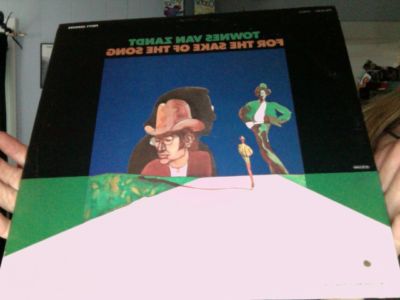
TOWNES VAN ZANDT For the Sake of the Song LP 1st press
$
50


Favourite Auctions
To save auctions to your favourites, please login
If you don't have an account, please register
Description
TOWNES VAN ZANDT For the Sake of the Song LP
1968 Poppy (PS-40,00) Vinyl/NM Sleeve/VG (rw, ph)Townes Van Zandt wrote songs with an uncommon grace and poetic clarity, and he sang them with a voice that was at once straightforward, eloquent, and mindful of the arid beauty of his images. A decade after Van Zandt released his first album, there would be dozens of singer/songwriters following his example, but he was a rather unusual commodity when For the Sake of the Song was released in 1968, and the album's production and arrangements occasionally suggest that Jack Clement and Jim Malloy didn't always know what to make of what he brought them. The 11 songs on Van Zandt's debut are all fine stuff (even the throwaway novelty "Talkin' Karate Blues" at least brings a chuckle), and the emotional force with which Van Zandt delivers "(Quicksilver Daydreams Of) Maria," "Tecumseh Valley," and the title tune belies the fact this was his first album. But on several tracks Clement and Malloy attempt to match the elusive mystery of Van Zandt's music with overblown accompaniment and deeply echoey recording, especially the cheesy chorus on "The Velvet Voices," the clichéd Western accompaniment of "I'll Be Here in the Morning," the tinkling keyboards on "Sad Cinderella," and the rattling percussion of "Waitin' Around to Die." In spite of the occasionally misguided production, For the Sake of the Song remains a classic debut. These songs make clear that Van Zandt's genius was already fully formed, and as both a composer and a performer he was a man of rare gifts; even when the backing threatens to drown him out, his gifts come shining through, and For the Sake of the Song was an auspicious debut offering from a talent of the first order.Townes Van Zandt's music doesn't jump up and down, wear fancy clothes, or beat around the bush. Whether he was singing a quiet, introspective country-folk song or a driving, hungry blues, Van Zandt's lyrics and melodies were filled with the kind of haunting truth and beauty that you knew instinctively. His music came straight from his soul by way of a kind heart, an honest mind, and a keen ear for the gentle blend of words and melody. He could bring you down to a place so sad that you felt like you were scraping bottom, but just as quickly he could lift your spirits and make you smile at the sparkle of a summer morning or a loved one's eyes -- or raise a chuckle with a quick and funny talking blues. The magic of his songs is that they never leave you alone.
Despite his warm, dusty-sweet voice, as a singer Van Zandt never had anything resembling a hit in his nearly 30-year recording career -- he had a hard enough time simply keeping his records in print. Nonetheless, he was widely respected and admired as one of the greatest country and folk artists of his generation. The long list of singers who've covered his songs includes Merle Haggard and Willie Nelson (who had a number one country hit with "Pancho and Lefty" in 1983), Emmylou Harris, Jimmie Dale Gilmore, Nanci Griffith, Hoyt Axton, Bobby Bare, the Tindersticks, and the Cowboy Junkies.
Van Zandt was a Texan by birth and a traveler by nature. His father was in the oil business, and the family moved around a lot -- Montana, Colorado, Minnesota, Illinois, among other places -- which accounted for his sometimes vague answers to questions of where he "came from." Van Zandt spent a couple years in a military academy and a bit more time in college in Colorado before dropping out to become a folksinger. (Van Zandt often returned to Colorado in subsequent years, spending entire summers, he said, alone in the mountains on horseback.)
Van Zandt moved to Houston and got his first paying gigs on the folk music circuit there in the mid-'60s. He played clubs like Sand Mountain and the Old Quarter (where in 1973 he recorded one of his finest albums, Live at the Old Quarter, released four years later), and he met singers such as Guy Clark (who became a lifelong friend and frequent road partner), Jerry Jeff Walker, and blues legend Lightnin' Hopkins, who had a large influence on Van Zandt's guitar playing in particular.
Another Texas songwriter, Mickey Newbury, saw Van Zandt in Houston one night and soon had him set up with a recording gig in Nashville (with Jack Clement producing). The sessions became Van Zandt's debut album, For the Sake of the Song, released in 1968 by Poppy Records. The next five years were the most prolific of Van Zandt's career, as Poppy released the albums Our Mother the Mountain, Townes Van Zandt, Delta Momma Blues, High, Low and in Between, and The Late Great Townes Van Zandt. These included such gems as "For the Sake of the Song," "To Live's to Fly," "Tecumseh Valley," "Pancho and Lefty," and many more that have made him a legend in American and European songwriting circles.
Van Zandt moved to Nashville in 1976 at the urging of his new manager, John Lomax III. He signed a new deal with Tomato Records and in 1977 released Live at the Old Quarter, a double album -- and the first of several live recordings -- that contained many of his finest songs. In 1978 Tomato released Flyin' Shoes; the long list of players on that album included Chips Moman and Spooner Oldham.
Van Zandt didn't record again for nearly a decade, but he continued to tour. He moved back to Texas briefly, returning again to Nashville in the mid-'80s. During the early '80s, both "If I Needed You" and "Pancho and Lefty" became country radio hits. In 1987, Van Zandt was back in business with his eighth studio album, At My Window, which came out on his new label, Sugar Hill. By this time, Van Zandt's voice had dropped to a lower register, but the weathered, somewhat road-weary edge to it was as pure and expressive as ever. Two years later, Sugar Hill released Live & Obscure (recorded in a Nashville club in 1985), and two more live albums (Rain on a Conga Drum and Rear View Mirror) appeared on European labels in the early '90s. In 1990, Van Zandt toured with the Cowboy Junkies, and he wrote a song for them, "Cowboy Junkies Lament," which appeared on the group's Black Eyed Man album (along with a song the Junkies wrote for him, "Townes Blues").
Sugar Hill released Roadsongs in 1994, on which Van Zandt covered songs by Lightnin' Hopkins, Bruce Springsteen, the Rolling Stones, and others, all recorded off the soundboard during recent concerts. At the end of that same year, Sugar Hill released No Deeper Blue, Van Zandt's first studio album since 1987. Van Zandt recorded it in Ireland with a group of Irish musicians. Van Zandt sang every song but only played guitar on one.
A year and a half after the release of No Deeper Blue, Van Zandt died unexpectedly on January 1, 1997; he was 52 years old. Posthumous releases included collections like Last Rights: The Life & Times of Townes Van Zandt and Anthology: 1968-1979, as well as albums like 1998's Abnormal and the following year's Far Cry From Dead, which featured previously unreleased songs.
The early 2000s saw a resurgence of interest in Van Zandt's music and enigmatic life; three book projects and two films entered production, and features on the musician appeared in such tastemaking rags as Mojo. But perhaps the greatest gem was the discovery of a collection of Van Zandt demos dating from 1966, a full two years before his proper debut. The ten previously unreleased recordings were issued by the Houston imprint Compadre in April 2003 as In the Beginning.... Included in the release were liner notes written by John Lomax III…
Payment:
Due within 10 days of auction end unless other arrangements have been made prior to bidding.
Shipping & packaging:
I package your records with the highest level of professionalism, using the best packing materials available. All shipping rates, including combined shipping is listed below. I will ship via priority or registered mail on request.
United States:
7" records and CD’s: $3.50 - .50 each additional.
10” records, LPs, 2xLPs, 3xLPs: $4.00 (media mail) - $1.00 each additional
Priority mail is $8.00-$1.00 each additional
Canada:
7" records/CD’s: $5.00 - $1 each additional.
LPs & 10": $9.00 - $2 each additional.
Double LPs, 180 & 220 gram records: $10 - $2.00 each additional.
Triple LPs, 2x 180 & 2x 220 gram records: $11.00 - $2.50 each additional.
International:
7" records/CD’s: $7.00- $1.50 each additional.
LPs & 10": $14 - $2.50 each additional
Double LPs, 180 & 220 gram records: $17.50 - $3.00 each additional
Triple LPs, 2x 180 & 2x 220 gram records: $18.50 - $3.50 each additional.
PACKAGING: I pack and mail items with care, I ship all LP’s in a new rigid custom LP mailer and filler pads with the disc, in the inner sleeve, placed behind cover to prevent seam splitting. I DO NOT use flimsy "freebie" post office priority mailers!
GRADING
(M) Mint : Absolutely perfect in every way - certainly never played, possibly even still sealed. (More on still sealed below). Should be used sparingly as a grade, if at all.
(NM or M-) Near Mint : A nearly perfect record. Many dealers won't give a grade higher than this implying (perhaps correctly) that no record is ever truly perfect. The record shows no obvious sign of wear. A 45-rpm sleeve has no more than the most minor defects, such as almost invisible ring wear or other signs of slight handling. An LP jacket has no creases, folds, seam splits or any other noticeable similar defect. No cutout holes, either. And of course, the same is true of any other inserts, such as posters, lyric sleeves, and the like. Basically, Near Mint looks as if you just got it home from a new record store and removed the shrink-wrap.
(VG+) Very Good Plus: Shows some signs that it was played and otherwise handled by a previous owner who took good care of it. Record surfaces may show some slight signs of wear and may have slight scuffs or very light scratches that don't affect one's listening experience. Slight warps that do not affect the sound are OK. The label may have some ring wear or discoloration, but is should be barely noticeable. The center hole is not misshapen by repeated play. Picture sleeves and LP inner sleeves will have some slight wear, lightly turn-up corners, or a slight seam-split. An LP jacket my have slight signs of wear also and may be marred by a cut-out hole, indentation or corner indicating it was taken out of print and sold at a discount. In general, if not for a couple of minor things wrong with it, this would be Near Mint. All but the most mint-crazy collectors will find a Very Good Plus record highly acceptable.
(VG) Very Good : Many of the defects found in a VG+ record are more pronounced in a VG disc. Surface noise is evident upon playing, especially in soft passages and during the song's intro and fade, but will not overpower the music otherwise. Groove wear will start to be noticeable, as will light scratches (deep enough to feel with a fingernail) that will affect the sound. Writing may mar labels, or have tape or stickers (or their residue) attached. The same will be true of picture sleeves or LP covers. However, it will not have all of these problems at the same time, only two or three of them.
(G) Good, (G+) Good Plus: Good does not mean bad! A record in Good or Good Plus condition can be put onto a turntable and will play through without skipping. But it will have significant surface noise and scratches and visible groove wear. A jacket or sleeve has seem splits, especially at the bottom or on the spine. Tape, writing, ring wear or other defects will start to overwhelm the object. If it's a common item, you'll probably find another copy in better shape eventually. Pass it up. But if it's something you have been seeking for years, and the price is right, get it.
(P) Poor , (F) Fair: The record is cracked, badly warped, and won't play through without skipping or repeating. The picture sleeve is water damaged, split on all three seams and heavily marred by wear and/or writing. The LP jacket barely keeps the LP inside it. Inner sleeves are fully seam split, and written upon. Except for impossibly rare records otherwise unattainable, records in this condition should be bought or sold for no more than a few cents each.
ABBREVIATIONS: WOC- writing on cover, WOL-writing on label, DH-drillhole/punchhole, PRST-promo stamp or sticker, RSST-radio station stamp, TSM-taped seam, SPSM-split seam, TOC-tear on cover, SMW-seamwear/scuffed seams (not split), STKRES-sticker residue/glue, RW-ringwear, CC-cut corner
price rating