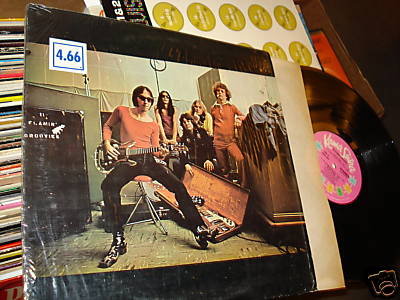
Teenage Head - The Flamin' Groovies LP IN SHRINK
$
61


Favourite Auctions
To save auctions to your favourites, please login
If you don't have an account, please register
Description
LP NM
Jacket NM- (Still In Shrink)
Biography by John Dougan
One of America's greatest, most influential, and legendary cult bands, the Flamin' Groovies came out of the San Francisco area in 1965 playing greasy, bluesy, rock & roll dashed with a liberal sprinkling of British Invasion panache, in an era soon to be dominated by hippie culture and hyperextended raga-rock freakouts. Caught in a double bind of playing the wrong kind of music at the wrong time (as well as not looking the part), the Groovies were almost completely forgotten as the Fillmore/Avalon Ballroom scenes, dominated by the Dead, the Jefferson Airplane, et al., rendered them anachronistic. The plain truth, however, was that despite not being in tune with the zeitgeist, the Groovies made great music, and managed to sustain a career that lasted for over two decades.
What made the Groovies such a formidable band was the double dynamite supplied by guitarist Cyril Jordan and singer/wildman Roy A. Loney. Together they formed an uneasy partnership that guided the band through its most fertile period, from 1968-1971. In 1968, for next to nothing, the band recorded a seven-song EP entitled Sneakers. This little bit of DIY ingenuity resulted in a contract with Epic and the huge sum of 80,000 dollars (1968 dollars, mind you) to be spent on their debut recording, Supersnazz. It was a great album that didn't sell, but did get them dropped from Epic. Quickly signing with Kama Sutra, the Groovies closed the '60s and started the '70s with two terrific records (Flamingo and Teenage Head), but public apathy and the increasingly tempestuous relationship between Jordan and Loney led to the latter's departure for a solo career in 1971. Jordan, now free to run the band as a "benevolent" dictator and indulge his passion for a more folk-rock (read: Byrds) focus, hired guitarist/vocalist Chris Wilson, curiously added the apostrophe to their first name, and in 1972 moved the band to England.
Oddly enough, the Groovies had a larger, more enthusiastic following in Europe (especially in England and Germany) than they did in the States, and it seemed perfectly reasonable to assume that if great rewards were to be reaped, it would happen in Europe first. Hooking up with Dave Edmunds, who was keen to produce them, Jordan and company recorded a handful of songs as early as 1972. However, this seemingly natural collaboration yielded little until 1976, when the Groovies released their finest post-Loney effort, Shake Some Action. Loaded with ringing guitars, great covers, and Edmunds' spongy, bass-heavy production, Shake Some Action became a well-received album in punk-era Britain, as was the fine follow-up, Flamin' Groovies Now. This new notoriety brought renewed interest in the Groovies in America, but the string of good albums ended abruptly with the mostly covers and mostly forgettable Jumpin' in the Night, in 1979. Clearly, the band had run out of gas. That fact, however, did little to convince Cyril Jordan that the Flamin' Groovies in any form were no longer viable.
So, after five or six years of no new music — there were instead countless repackagings, anthologies, and lousy bootlegs — the band ended up in Australia, now reduced to Jordan and a bunch of unknowns (with the exception of longtime bassist George Alexander), shamelessly covering '60s material and living off the band's legend. It should be noted that after his departure in 1971, Roy Loney, after a couple of music industry jobs, made some wonderful records with his band the Phantom Movers (with ex-Groovies drummer Danny Mihm). Loney occasionally worked behind the counter at Jack's Record Cellar in San Francisco, and recorded with the Young Fresh Fellows.
RECORD GRADING Based On Goldmine Grading Standards:
Near Mint (NM): A nearly perfect record. There may be one or two small inaudible defects. The record should show no obvious signs of wear. A 45 RPM or EP sleeve should have no more than the most minor defects, such as almost invisible ring wear or other sights of slight handling. An LP jacket should have no creases, folds, seam splits or any other noticeable similar defect. No cut-out holes, either.
Near Mint Minus (NM-): A record that should play mint but has a few slight visible marks. The album will have as much luster as an NM, there just may be some superficial scuffs from the sleeve or very light hairlines that shouldn't be audible. An NM- album cover subjectively fits somewhere in between VG+ and NM.
Very Good Plus (VG+): A Very Good Plus record will show some signs that it was played and otherwise handled by a previous owner who took good care of it. Record surfaces may show some slight signs of wear and may have slight scuffs or very light scratches that don t significantly affect play. Slight warps that do not affect the sound are OK. The label may have some ring wear or discoloration, but it should be barely noticeable. The center hole will not have been misshapen by repeated play. Picture sleeves and LP inner sleeves will have some slight wear, lightly turned-up corners, or a slight seam-split. An LP jacket may have slight signs of wear also and may be marred by a cut-out hole, indentation or corner indicating it was taken out of print and sold at a discount.
Very Good (VG): Many of the defects found in a VG+ record will be more pronounced in a VG disc. Surface noise will be evident upon playing, especially in soft passages and during a song s intro and fade, but will not overpower the music otherwise. Groove wear will start to be noticeable, as will light scratches (deep enough to feel with a fingernail) that will affect the sound. Labels may be marred by writing, or have tape or stickers (or their residue) attached. The same will be true of picture sleeves or LP covers. However, it will not have all of these problems at the same time, just two or three of them.
Good (G), Good Plus (G+): Good does not mean Bad! A record in Good or Good Plus condition can be put onto a turntable and will play though without skipping. But it will have significant surface noise and scratches and visible groove wear. A jacket or sleeve will have seam splits, especially at the bottom or on the spine. Tape, writing, ring wear or other defects will start to overwhelm the subject.
Poor (P), Fair (F): Below good. imperfections will be described.
Please check out my other items for sale. (I offer shipping discounts) I'll Be adding More Daily except for Friday and Saturday.
ALL SHIPPING PRICES ARE FINAL
additional items are 1.50 per item up to 6 within USA (if you are bidding on multiple items lots I have in one listing. you pay each shipping total added together)
NOTE: Gatefold Lps Count as 2 Lps when shipping out of the country
CANADA Multiple LP Shipping Rates In USD
1 LP 7.75
2. Lps 9.25
3 Lps 12.50
4 Lps 15.50
5 Lps 16.50
6 Lps 18.00
Multiple Shipping Rates Rest Of The World Outside USA in USD
Note: Gatefold Lps Count as 2 Lps
1 LP 14.00
2 LP 17.00
3. Lps 22.50
4 Lps 25.25
5 Lps 28.00
6 Lps 33.00
The MAN has to get his cut so Texas residents must add 8.25 % Sales Tax
If you are unsure about shipping costs please do not hesitate to e-mail me.
QUESTIONS:? Please ask. That is what I am here for. (I may not get to them if you wait close to an item's ending.)
MORE PICTURES? Just ask and I'll send them to you
MEDIA MAIL: is not recommended for rare items. Priority mail is faster and safer.
I leave feedback after item arrives and it is left for me. (It's easier to keep up with that way) Please limit your feedback comments to things within the realm of my responsibility.
Thank you for reading all of this :-)
price rating