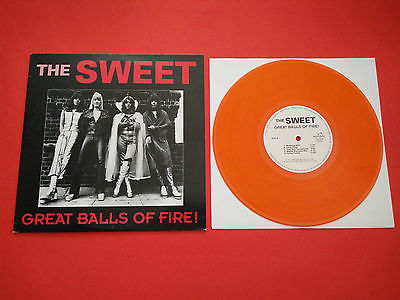
The Sweet Great Balls of Fire Live Sweden 1971 RSD LMT #215 10" Orange Vinyl LP
$
33


Favourite Auctions
To save auctions to your favourites, please login
If you don't have an account, please register
Description
This Sweet 10" is #215 out of #500, Limited Edition. It's in excellent condition. This never comes up on eBay. Get it while you can!
The Sweet ?– Great Balls Of Fire!
Label: Pseudonym ?– V10C 2008 Format: Vinyl, 10", Limited Edition, Orange VinylCountry: Netherlands Released: 1993 Genre: Rock Style: Glam, Classic Rock
Tracklist
A1 Mocking Bird 1:16 A2 Chop Chop 2:07 A3 Tom Tom Turnaround 3:56 A4 Mister Business Man 3:19 A5 Funny Funny 2:55 B1 Rock 'n Roll Medley 3:37 B2 Co Co 2:55 B3 A Message From Sweet 0:35 B4 Baby What Do You Want Me To Do 3:00 B5 Great Balls Of Fire 1:43Credits
- Bass – Steve Priest
- Drums – Mick Tucker
- Guitar – Andy Scott
- Lead Vocals – Brian Connolly
Notes
Edition in orange vinyl limited to 500.Live In Sweden 1971
? 1971 Swedish Broadcast Corp.
© 1993 Pseudonym Records Holland
*********************************************************************************************************
The Sweet (also referred to as Sweet, and originally called Sweetshop) are a British glam rock band that rose to worldwide fame in the 1970s with their most prolific line-up: lead vocalist Brian Connolly, bass player, Steve Priest, guitarist Andy Scott, and drummer Mick Tucker.
The band were formed in 1968 and achieved their first hit "Funny Funny" in 1971 after teaming up with songwriters Nicky Chinn and Mike Chapman and record producer Phil Wainman. During 1971 and 1972, their musical style followed a marked progression from the Archies-like bubblegum style of "Funny Funny" to a Who-influenced hard rock style supplemented by a striking use of high-pitched backing vocals.
The band achieved notable success in the UK charts, with thirteen Top 20 hits during the 1970s alone, with "Block Buster!" (1973) topping the chart, followed by three consecutive number two hits in "Hell Raiser" (1973), "The Ballroom Blitz" (1973) and "Teenage Rampage" (1974). The band turned to more hard rock style with their mid-career singles like 1974's "Turn It Down". Their first self-written and produced single, "Fox on the Run" (1975), also reached number two on the UK charts. These results were topped in West Germany and other countries on the European mainland, where the band was very popular. They also achieved success and popularity in the United States with the top ten hits Little Willy, The Ballroom Blitz, and Fox on the Run.
The Sweet had their last Top 10 hit in 1978 with "Love Is Like Oxygen". Connolly left the group in 1979 to start a solo career and the remaining members continued as a threesome until disbanding in 1981.
From the mid-1980s, Scott, Connolly and Priest each played with their own versions of Sweet at different times. Connolly died in 1997 and Tucker in 2002. The two surviving members are still active in their respective versions of the band; Scott's is based in England and Priest's in Los Angeles.
Contents
[hide]- 1History
- 1.1Origins
- 1.2Early years
- 1.3New line-up and new record deal
- 1.4First album
- 1.5Initial success and rise to fame
- 1.6Forming a new image
- 1.7Desolation Boulevard
- 1.8Writing and producing their own material
- 1.9Decline in popularity
- 1.10Level Headed and a change in style
- 1.11Departure of Brian Connolly
- 1.12Three piece Sweet
- 2Re-formed versions (1984–present)
- 2.1Mick Tucker's Sweet / Andy Scott's Sweet (1985–present)[* 1]
- 2.2New Sweet, Brian Connolly's Sweet (1984–97)
- 2.3Steve Priest's Sweet (2008–present)
- 3Brief reunions and the deaths of Brian Connolly and Mick Tucker
- 4Recent years
- 5Personnel
- 5.1Sweet
- 5.1.1Members
- 5.1.2Lineups
- 5.2Brian Connolly Band, New Sweet, Brian Connolly's Sweet
- 5.2.1Members
- 5.2.2Lineups
- 5.3Andy Scott's Sweet
- 5.3.1Members
- 5.3.2Lineups[* 2]
- 5.4Steve Priest's Sweet
- 5.4.1Members
- 5.4.2Lineups[* 11]
- 5.1Sweet
- 6Timelines
- 6.1Sweet, Andy Scott's Sweet timeline
- 6.2Brian Connolly Band, The New Sweet, Brian Connolly's Sweet timeline
- 7Discography
- 8Notes
- 9References
- 10External links
History[edit]
This section needs additional citations for verification. Please help improve this article by adding citations to reliable sources. Unsourced material may be challenged and removed. (January 2016) (Learn how and when to remove this template message) This section may contain an excessive amount of intricate detail that may only interest a specific audience. Please help by spinning off or relocating any relevant information, and removing excessive detail that may be against Wikipedia's inclusion policy. (January 2016)Origins[edit]
Sweet's origins can be traced back to British soul band Wainwright's Gentlemen. Mark Lay's history of that band states they formed around 1962 and were initially known as Unit 4. Founder members included Chris Wright (vocals), Jan Frewer (bass), with Jim Searle and Alfred Fripp on guitars. Phil Kenton joined on drums as the band changed its name to Wainwright's Gentlemen (due to there being another band known as Unit 4). Managed by Frewer's father, the band performed in the Hayes, Harrow and Wembley area. By 1964 the group was also playing in London, including at the Saint Germain Club in Poland Street.
In January 1964 the band came 5th in a national beat group contest judged by Jimmy Savile, with finals held at the Lyceum, Strand on 4 May 1964. Highlights of the show were presented on BBC1 by Alan Freeman. Chris Wright left the line-up in late 1964 and was replaced by Ian Gillan. A female vocalist named Ann Cully joined the band soon after. Mick Tucker, from Ruislip, joined on drums, replacing Phil Kenton. The band recorded a number of tracks including a cover of the Coasters-the Hollies' hit "Ain't That Just Like Me", which was probably recorded at Jackson Sound Studios in Rickmansworth. The track includes Gillan on vocals, Tucker on drums and, according to band bassist Jan Frewer, is thought to have been recorded in 1965. Gillan quit in May 1965 to join Episode Six, and, later, Deep Purple. Cully remained on as vocalist before departing some time later. Gillan's and Cully's eventual replacement, in late 1966, was Scots-born vocalist Brian Connolly, who hailed more recently from Harefield. Tony Hall had joined on saxophone and vocals and when Fripp left he was replaced by Gordon Fairminer. Fairminer's position was eventually assumed by Frank Torpey - a schoolfriend of Tucker's who had just left West London group the Tribe (aka The Dream). Torpey only lasted a few months, and in late 1967 Robin Box took his place. Searle, regarded by many as the most talented musically, disappeared from the scene. Tucker and Connolly remained with Wainwright's Gentlemen until the end of 1967. Tucker was replaced in Wainwright's Gentlemen by Roger Hills. When the Gentlemen eventually broke up, Hills and Box joined White Plains and scored a big hit with "My Baby Loves Lovin'".
Early years[edit]
In January 1968 Connolly and Tucker formed a new band, calling themselves the Sweetshop. They recruited the bass guitarist and lead vocalist Steve Priest of a local band called the Army, who had previously played with another local band the Countdowns. Frank Torpey was again recruited to play guitar. The quartet made its public debut at the Pavilion in Hemel Hempstead in March 1968 and soon developed a following on the pub circuit, which led to a contract with Fontana Records. At the time, another UK band released a single under the same name Sweetshop, so the band changed the name to the Sweet. The band was managed by Paul Nicholas, who later went on to star in "Hair". Nicholas worked with record producer Phil Wainman at Mellin Music Publishing and recommended the band to him. Their debut single "Slow Motion" (July 1968), produced by Wainman, and released on Fontana failed to chart and owing to its rarity now sells for several hundred pounds when auctioned. Sweet were released from the recording contract and Frank Torpey left. In his autobiography Are You Ready Steve, Priest said that Gordon Fairminer was approached to play for them when Torpey decided to leave in July 1969 but turned the job down as he wanted to concentrate on other interests.
New line-up and new record deal[edit]
Guitarist Mick Stewart joined in 1969. Stewart had some rock pedigree, having previously worked with The (Ealing) Redcaps and Simon Scott & The All-Nite Workers in the mid-1960s. In late 1965, that band became The Phil Wainman Set when the future Sweet producer joined on drums and the group cut some singles with Errol Dixon. In early 1966, Stewart left and later worked with Johnny Kidd & The Pirates.
The Sweet signed a new record contract with EMI's Parlophone label. Three bubblegum pop singles were released: "Lollipop Man" (September 1969), "All You'll Ever Get from Me" (January 1970), and a cover version of the Archies' "Get on the Line" (June 1970), all of which failed to chart. Stewart then quit, and was not replaced for some time. Connolly and Tucker had a chance meeting with their former producer Phil Wainman who knew of two aspiring songwriters, Nicky Chinn and Mike Chapman, who were looking for a group to sing over some demos they had written together. Connolly, Priest and Tucker provided the vocals on a track called "Funny Funny" which featured Pip Williams on guitar, John Roberts on bass and Wainman on drums. The latter began offering the track to various recording companies. The band held auditions for a replacement guitarist and settled on Welsh-born Andy Scott. He had most recently been playing with Mike McCartney (brother of Paul) in the Scaffold. As a member of the Elastic Band, he had played guitar on two singles for Decca, "Think of You Baby" and "Do Unto Others". He also appeared on the band's lone album release, Expansions on Life, and on some recordings by the Scaffold. The band rehearsed for a number of weeks before Scott made his live debut with Sweet in September, 1970 at Redcar.
The Sweet initially attempted to combine various musical influences, including the Monkees and 1960s bubblegum pop groups such as the Archies, with more heavy rock-oriented groups such as the Who. The Sweet adopted the rich vocal harmony style of the Hollies, with distorted guitars and a heavy rhythm section. This fusion of pop and hard rock would remain a central trademark of Sweet's music and prefigured the hair metal of a decade later.
The Sweet's initial album appearance was on the budget label Music for Pleasure as part of a compilation called Gimme Dat Ding, released in December 1970. The Sweet had one side of the record; the Pipkins (whose sole hit, "Gimme Dat Ding", gave the LP its name) had the other. The Sweet side consisted of the A- and B-sides of the band's three Parlophone singles. Andy Scott appears in the album cover shot, even though he did not play on any of the recordings.
First album[edit]
The Sweet made their UK television debut in December 1970 on a pop show called Lift Off, performing the song "Funny Funny". A management deal was signed with a newly formed, unknown songwriting team consisting of Nicky Chinn and Mike Chapman. Phil Wainman resumed his collaboration with Sweet, as executive producer. This management deal also included a worldwide (the U.S. excepted) record contract with RCA Records (in the United States and Canada Bell Records issued the group's music until late 1973; followed by Capitol Records).
In March 1971, RCA issued "Funny Funny", written by Chinn and Chapman, which became the group's first international hit, climbing to the Top 20 on many of the world's charts. EMI reissued their 1970 single "All You'll Ever Get from Me" (May 1971) and it again failed to chart. Their next RCA release "Co-Co" (June 1971) went to number two in the U.K., their follow up single, "Alexander Graham Bell" (October 1971), only went to #33.[1] These tracks still featured session musicians on the instruments with the quartet known as the Sweet providing the vocals.
The Sweet's first full LP album, Funny How Sweet Co-Co Can Be, was released in November 1971. A collection of the band's recent singles supplemented by some new Chinn/Chapman tunes (including "Chop Chop" and "Tom Tom Turnaround") and pop covers (such as the Lovin' Spoonful's "Daydream" and the Supremes' "Reflections"), the album, recorded at Nova Studios in London was produced by Phil Wainman and engineered by Richard Dodd and Eric Holland. It was not a serious contender on the charts. Their albums' failure to match the success of their singles was a problem that would plague the band throughout their career.
Initial success and rise to fame[edit]
February 1972 saw the release of "Poppa Joe", which reached number 1 in Finland, peaked at number 11 in the UK Singles Chart.[1] The next two singles of that year, "Little Willy" and "Wig-Wam Bam", both reached No. 4 in the UK,[1] and "Little Willy" peaked at No. 3 on the U.S. Billboard Hot 100 after a re-issue in 1973, thus becoming the group's biggest American hit. Although "Wig-Wam Bam" remained largely true to the style of the Sweet's previous recordings, the vocals and guitars had a harder, more rock-oriented sound, largely because it was the first Chinn-Chapman single on which only members of Sweet played. In January 1973 "Block Buster!" became the Sweet's first single to reach number 1 on the UK chart, remaining there for five consecutive weeks.[1] After their next single "Hell Raiser" was released in May and reached number 2 in the U.K., the Sweet's U.S. label released the group's first American album The Sweet in July 1973.[1]
To promote their singles, the Sweet made numerous appearances on U.K. and European TV shows such as Top of the Pops and Supersonic. In one performance of "Block Buster!" on Top of the Pops, Priest aroused complaints after he appeared wearing a German uniform and displaying a swastika armband.[2] The band also capitalised on the glam rock explosion, rivalling Gary Glitter, T. Rex, Queen, Slade, and Wizzard for outrageous stage clothing.
Despite the Sweet's success, the relationship with their management was becoming increasingly tense. While they had developed a large fan-base among teenagers, the Sweet were not happy with their 'bubblegum' image. The Sweet had always composed their own heavy-rock songs on the B-sides of their singles to contrast with the bubblegum A-sides which were composed by Chinn and Chapman. During this time, Sweet's live performances consisted of B-sides, album tracks, and various medleys of rock and roll classics; they avoided older 'novelty' hits like "Funny Funny" and "Poppa Joe". A 1973 performance at the Palace Theatre and Grand Hall in Kilmarnockended in the Sweet being bottled off stage; the disorder was attributed by some (including Steve Priest) to the Sweet's lipstick and eye-shadow look, and by others to the audience being unfamiliar with the concert set (the 1999 CD release Live at the Rainbow 1973 documents a live show from this period). The incident would be immortalised in the hit "The Ballroom Blitz" (September 1973). In the meantime, the Sweet's chart success continued, showing particular strength in England, Denmark, Germany, Sweden, and Australia. At the end of 1973, the band's name evolved from "The Sweet" to "Sweet". The change would be reflected in all of their releases from 1974 onward.
Forming a new image[edit]
By 1974, Sweet had grown tired of the management team of Chinn and Chapman, who wrote the group's major hits and cultivated the band's glam rock image. The group and producer Phil Wainman assisted by engineer Peter Coleman recorded the album Sweet Fanny Adams, which was released in April 1974. Sweet's technical proficiency was demonstrated for the first time on self-penned hard rock tracks such as "Sweet F.A." and "Set Me Free". Sweet also adopted a more conventional hard rock sound and appearance. Sweet Fanny Adams also featured compressed high-pitched backing vocal harmonies, which was a trend that continued on all of Sweet's albums.
During sessions for the album Brian Connolly was injured in a fight in Staines High Street. His throat was badly injured and his ability to sing severely limited. Priest and Scott filled in on lead vocals on some tracks ("No You Don't", "Into The Night" and "Restless") and Connolly, under treatment from a Harley Street specialist, managed to complete the album. The band did not publicise the incident and told the press that subsequent cancelled shows were due to Connolly having a throat infection.[3]
No previous singles appeared on the album, and none were released except in Japan, New Zealand and Australia, where "Peppermint Twist/Rebel Rouser", apparently released by their record company without their knowledge, gained a #1 chart position in the latter. Sweet Fanny Adams would be Sweet's only non-compilation release to break the UK Albums Chart Top 40.[1]
Sweet were invited by Pete Townshend to support the Who, who were playing at Charlton Athletic's football ground, The Valley in June 1974. However, Connolly's badly bruised throat kept them from fulfilling the role. Sweet had frequently cited the Who as being one of their main influences and played a medley of their tracks in their live set for many years.
Desolation Boulevard[edit]
Their third album, Desolation Boulevard, was released later in 1974, six months after Sweet Fanny Adams. By that stage, producer Phil Wainman had moved on and the album was produced by Mike Chapman. It was recorded in a mere six days and featured a rawer "live" sound. One track, The Man With The Golden Arm, written by Elmer Bernstein and Sylvia Fine for the Frank Sinatra movie of the same name, featured drummer Mick Tucker performing an 8 and half minute solo. This had been a staple of the band's live performance for years. The first single from the LP, the heavy-melodic "The Six Teens" (July 1974), was a Top 10 hit in the U.K.[1] and still part of the amazing unbroken string of #1's in Denmark. However, the subsequent single release, "Turn It Down" (November 1974), reached only number 41 on the U.K. chart and #2 in Denmark.[1] "Turn It Down" received minimal airplayon UK radio and was banned by some radio stations because of certain lyrical content - "God-awful sound" and "For God sakes, turn it down" - which were deemed "unsuitable for family listening." The band resumed playing live shows nearly a full six months after Connolly's throat injury, with band and critics noting a rougher edge to his voice and a reduced range. The album also featured a group composition "Fox On The Run" which was to be re-recorded months later.
The U.S. version of Desolation Boulevard was different from the U.K. version and included several songs from Sweet Fanny Adams in addition to the "Ballroom Blitz" and "Fox on the Run" singles. Side One of the album contained all Chapman-Chinn penned songs, while Side Two featured songs written and produced by Sweet.
Writing and producing their own material[edit]
In 1975 Sweet went back into the studio to re-arrange and record a more pop-oriented version of the track "Fox on the Run". Sweet's first self-written and produced single, "Fox on the Run" was released worldwide in March 1975 and became their biggest selling hit, reaching number one in Germany, Denmark, and South Africa, number two in the United Kingdom, Ireland, Norway and the Netherlands, and number three in Austria and Switzerland. In Australia it not only made it to the top of the charts, it also became the biggest selling single of that year.[4] In North America the song was released in the fall and reached number two in Canada and number five in the U.S. The release of this track marked the end of the formal Chinn-Chapman working relationship and the band stressed it was now fully self-sufficient as writers and producers.
The following single release, "Action" (July 1975), peaked at number 15 in the UK. Now confident in their own songwriting and production abilities, Sweet spent the latter half of 1975 in Musicland Studios in Munich, Germany, where they recorded the Give Us A Wink album with German sound engineer Reinhold Mack, who later recorded with Electric Light Orchestra and co-produced Queen. The new album release was deferred until 1976 so as not to stifle the chart success Desolation Boulevard was enjoying in North America, peaking at number 25 in the US and number 5 in Canada.
With Give Us a Wink being held over, RCA issued a double album in Europe, Strung Up, in November. It contained one live disc, recorded in London in December 1973, and one disc compiling previously released single tracks (plus an unused track by Chinn and Chapman – "I Wanna Be Committed"). At the end of the year, Andy Scott released his first solo single, "Lady Starlight" b/w "Where D'Ya Go". Tucker played drums on both tracks.
Decline in popularity[edit]
January 1976 saw the release of the single "The Lies In Your Eyes", which made the Top 10 in Germany, Denmark, Finland, Sweden, the Netherlands, and Australia, but only reached No. 35 on the U.K. charts. Sweet's first album to be fully produced and written by themselves, Give Us A Wink, was released in March 1976. A third single from the album, "4th Of July", was issued in Australia.
By this time, Sweet strove to build on their growing popularity in America with a schedule of more than fifty headline concert dates. Even though Give Us A Wink's release was imminent, the band's set essentially promoted the US version of Desolation Boulevard plus the new single "Action". During an appearance at Santa Monica Civic Auditorium in California on 24 March, Sweet played "All Right Now" with Ritchie Blackmore as a tribute to mark the death of Free guitarist Paul Kossoff, who was to have supported Sweet with his band Back Street Crawler. Following the end of the US tour, the band went on to Scandinavia and Germany. The band also spent a week at the Who's Rampart Studio in Battersea demoing material for a new album before abandoning that project and playing eight dates in Japan.
Between October 1976 and January 1977, Sweet wrote and recorded new material at Kingsway Recorders and Audio International London studios for their next album. An advance single from the album, "Lost Angels", was only a hit in Germany,[5] Austria and Sweden. A new album, Off the Record, was released in April. The next single from the album, "Fever of Love", represented the band heading in a somewhat more Europop hard rock direction, once again charting in Germany,[5] Austria and Sweden, while reaching number 10 in South Africa. On this album, Sweet again worked with Give Us A Wink engineer Louis Austin, who would later engineer Def Leppard's On Through The Night 1980 début album. The band did not play any live dates in support of the album and, in fact, did not play a single concert for the whole of 1977.
Level Headed and a change in style[edit]
Sweet left RCA in 1977 and signed a new deal with Polydor though it would not come into force until later in the year. Sweet's manager David Walker, from Handle Artists, negotiated the move which was reputed to be worth around £750,000. In North American markets, Capitol issued Sweet's albums since 1974 and would continue to do so through 1980.
The first Polydor album, Level Headed (1978), found Sweet experimenting by combining rock and classical sounds "a-la clavesin", an approach similar to Electric Light Orchestra, and featured the single "Love Is Like Oxygen". Largely recorded during 1977 at Château d'Hérouville near Paris, France and Clearwell Castle in the Forest Of Dean UK, the album represented a new musical direction with its Led Zeppelin influenced rock style, interspersed with ballads accompanied by a 30-piece orchestra. The ballad, "Lettres D'Amour", featured a duet between Connolly and emerging singer Stevie Lange (who would emerge as lead singer with the group Night in 1979).
With the addition of session and touring musicians keyboardist Gary Moberley and guitarist Nico Ramsden, Sweet undertook a short European and Scandinavian tour followed by a single British concert at London's Hammersmith Odeon on 24 February 1978. However, "Love Is Like Oxygen" (January 1978) was their last U.K., U.S. and German Top 10 hit.[1][5] Scott was nominated for an Ivor Novello Award for co-composing the song. One more single from the album, "California Nights" (May 1978), featuring Steve Priest as the lead vocalist, peaked at number 23 on the German charts.
Departure of Brian Connolly[edit]
Between March and May 1978 Sweet extensively toured the US, as a support act for Bob Seger and the Silver Bullet Band. The tour included a disastrous date in Birmingham, Alabama, at which visiting Capitol Records executives in the audience saw Brian Connolly give a drunken and incoherent performance that terminated early in the set with his collapse on stage, leaving the rest of the group to play on without him. The band returned briefly to Britain before resuming the second leg of their US tour in late May supporting other acts, including Foghat and Alice Cooper, finishing the US tour in early July 1978. Brian's alcoholism was steadily becoming a greater issue.
In late October, Sweet arrived at The Town House studio in Shepherds Bush, London to write and record new material for their next album, Cut Above the Rest. As a last-ditch effort, the group organised for Connolly's long-time friend and fellow founding member, Mick Tucker, to go into the studio without Andy Scott as producer. A number of tracks were recorded featuring Connolly on vocals. However, these efforts were deemed unsatisfactory, and some of the contributions were then erased from the ensuing album.
On 23 February 1979, Brian Connolly's departure from Sweet was announced by manager David Walker. Publicly, Connolly was said to be pursuing a solo career with an interest in recording country rock.
Three piece Sweet[edit]
Sweet continued as a trio with Steve Priest and Andy Scott handling lead vocals, with Mick Tucker continuing on drums. Guest keyboard player Gary Moberley continued to augment the group on stage. Guitarist Ray McRiner joined their touring line-up in 1979, with a small tour with Journey in the eastern United States and Cheap Trick in Texas to support Cut Above The Rest. McRiner would also contribute the songs "Too Much Talking" and the single "Give The Lady Some Respect" to the next Sweet album, Waters Edge which was recorded in Canada. In the US, Waters Edge was titled Sweet VI. It featured the singles "Sixties Man" and "Give The Lady Some Respect". Tragedy befell Mick Tucker when his wife Pauline drowned in the bath at their home on 26 December 1979.
One more studio album, Identity Crisis, was recorded during 1980–81 but was only released in West Germany and Mexico. Sweet undertook a short tour of the UK and performed their last live show at Glasgow University on 20 March 1981. Steve Priest then returned to the United States, where he had been living since late 1979. Shortly after his return to the US, Steve Priest remarried, ending any hopes of a return to the UK. When Polydor releasedIdentity Crisis in 1982, the original Sweet had been disbanded for almost a year.
price rating