Tony SHERIDAN (1940-2013) Eigenh. Notenzeilen. Beatles Autograph SELTEN
€
58
$
65


Favourite Auctions
To save auctions to your favourites, please login
If you don't have an account, please register
Description
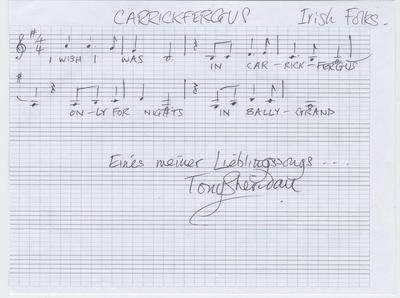
Tony SHERIDAN (1940-2013) Irischer Musiker. Beatles-Pionier in Hamburg der 1960er Jahre. Notenblatt mit zwei eigenhändigen Notenzeilen "CARRICKFERGUS (Irish Folk)" (15x18cm), eigenhändige Bezeichnung "Eines meiner Lieblingssongs" und eigenhändiger Unterschrift ! Beigelegt Foto (12,5x12,5cm,The Beatles"My Bonnie"-Cover) mit original Unterschrift !
...................... sehr schön und extrem selten !
TONY SHERIDAN (1940-2013) Beat pionoeer with the Beatles in Hamburg in the 1960. Photo (12,5x12,5cm,cover of the Beatles "My Bonnie" record) mit original Unterschrift ! Paper (15x18cm) with two lines of hand-written music notes "CARRICKFERGUS (Irish Folk)" and original signature !
________________________________________________________________________________________________________________________________________________________
Tony Sheridan, eigentlich Anthony Esmond Sheridan McGinnity, (* 21. Mai 1940 in Norwich, England; † 16. Februar 2013 in Hamburg, Deutschland[1]) war ein britischer Musiker. In den frühen 1960er Jahren war er einer der Begründer der Beatmusik. Nach Hamburg verschlug es Tony Sheridan als Mitglied der Gruppe The Jets im Jahr 1960, wo sie im „Kaiserkeller“ auf der „Großen Freiheit“ auftraten. Mitglieder der Jets zog es wieder zurück nach England, während Tony Sheridan in Hamburg blieb und als Solo-Sänger im „Top Ten“ auf der Reeperbahn auftrat. Begleitet wurde er von verschiedenen Bands, zum Beispiel Gerry & the Pacemakers, doch die bekannteste Begleit-Gruppe waren ein paar junge Musiker aus Liverpool, die sich The Beatles nannten und damals noch zu fünft mit Stuart Sutcliffe am Bass und Pete Best am Schlagzeug auftraten. Die Beatles begleiteten Tony Sheridan nicht nur auf der Bühne, man wohnte auch monatelang zusammen und verbrachte einen Großteil der knappen Freizeit gemeinsam. Noch heute spricht Paul McCartney von Sheridan als dem „Teacher“ (deutsch: ‚Lehrer‘), und George Harrison sowie John Lennon erlernten einige Techniken und Tricks auf der Gitarre von ihm. Unter der Leitung des Musikproduzenten Bert Kaempfert nahm Tony Sheridan 1961 für Polydor neun Titel mit den Beatles auf, die aufgrund eines Einwandes der Plattenfirma bei dieser Aufnahme als Beat Brothers in Erscheinung traten. Darunter war der Titel My Bonnie, der Ende 1961 immerhin bis auf Platz 32 in der deutschen Hitparade kam und so den Erfolg der Beatles mitbegründete, da sich aufgrund der Nachfrage nach dieser Single der spätere Manager der Beatles, Brian Epstein, für die Gruppe zu interessieren begann. Später wurde Tony Sheridan für diese LP eine Goldene Schallplatte für bis dahin über 1.000.000 verkaufte Exemplare verliehen.Ein Wiedersehen mit den Beatles fand im April 1962 statt, als der legendäre „Star-Club“ eröffnet wurde. Im Programm waren unter anderem die Beatles und Tony Sheridan. Beim letzten Auftritt der Beatles im Star-Club im Dezember 1962 entstand auch die einzige gemeinsame Komposition von McCartney und Tony Sheridan: Tell Me If You Can. Während der Jahre in Hamburg nahm Tony Sheridan für Polydor mehrere Alben auf, sein größter Hit dieser Zeit wurde Skinny Minnie, aufgenommen 1964 mit der Band Big Six aus Schottland. Im selben Jahr unternahm er eine Tour durch Australien, aufgrund des großen Erfolges seines dortigen Hits Why.
Tony Sheridan (born Anthony Esmond Sheridan McGinnity, 21 May 1940 – 16 February 2013), was an English rock and roll singer-songwriter and guitarist. He was best known as an early collaborator of The Beatles, (though the record was labelled as being with "The Beat Brothers"), one of two non-Beatles (the other being Billy Preston) to receive label performance credit on a record with the group, and the only non-Beatle to appear as lead singer on a Beatles recording which charted as a single.
While performing in Hamburg between 1960 and 1963, Sheridan employed various backup bands, most of which were really "pickup bands", or simply an amalgam of various musicians, rather than a group proper. However, in 1961, the young Beatles (with their line-up at the time of John Lennon, Paul McCartney, George Harrison and Pete Best) who had met and admired Sheridan during their first visit to Hamburg in 1960, and who openly worked with him on their second visit, became even closer. The relationship was largely symbiotic, with the Beatles sometimes backing Sheridan, but with Sheridan often joining the Beatles during their own sets backing them on guitar.[4] When German Polydor producer/A and R man Bert Kaempfert saw the pairing on stage, he suggested that Sheridan and the Beatles make some recordings together. Kaempfert viewed Sheridan as the one with "star" potential, and though they signed the Beatles to play on Sheridan's records their contract with them stipulated that the four Beatles (Lennon, McCartney, Harrison and Best) only had to play on a minimum of two songs. Of the seven songs recorded during Sheridan's two day-long sessions for Polydor in June 1961, it should be pointed out that at times the band behind Sheridan would be down to only two Beatles, and that conversely only on their two solo songs do all four Beatles play (minus Sheridan), while Sheridan plays on all of his tracks. These sessions produced Sheridan's "My Bonnie" and "The Saints", and the Beatles' "Ain't She Sweet" and "Cry for a Shadow" (formerly titled "Beatle Bop"), plus three other songs. Polydor's beliefs in Sheridan's coming stardom were so strong that they buried the two solo Beatle tracks until much later. Both John Lennon and Tony Sheridan swore that there were several other Beatle tracks that were recorded during the two-day session, but they have not resurfaced. In 1962, after a series of singles (the first of which, "My Bonnie"/"The Saints" made it to number 5 in the UK singles chart), the record was released in America on Decca with a black label and also in a pink label for demo play. The record has the distinction of being one of the most expensive collectible 45 rpm with the black label in mint condition selling for $15,000 in 2007 and the pink label selling for $3000. Ringo Starr also very briefly played in Sheridan's backing band during very early 1962, before returning to Rory Storm and the Hurricanes. Starr was reportedly unhappy with Sheridan performing songs he had not rehearsed with his band. Ringo thus narrowly missed playing on Sheridan's album debut. Also in 1962, Polydor released the album My Bonnie across Germany. The word Beatles was judged to sound too similar to the Hamburgisch dialect word Pidels (pronounced peedles), the plural of a slang term for penis, hence the album was credited to Tony Sheridan and The Beat Brothers.After the Beatles had gained fame, the album was re-released in the United Kingdom, with the credit altered to "Tony Sheridan and The Beatles". The Beatles' Hamburg studio recordings, as well as some live recordings from the same period, have been reissued several times over the decades.
In the mid-Sixties Sheridan's musical style underwent a transformation, away from his rock and roll roots and towards a more blues- and jazz-oriented sound. Though these recordings were praised by some, many fans of his earlier work felt disappointed. This change was presaged by liner notes from his 1964 album Just a Little Bit of Tony Sheridan in which his musical preferences are listed as "jazz and classical" rather than rock. The liner notes also mention his wanting to visit the southern U.S. "to hear at first hand the original negro music and experience the atmosphere that has been instrumental in creating negro jazz and the spiritual, for which he has a great liking." Sheridan continued performing in Hamburg at the same club for a number of years, but eventually Polydor dropped him as a recording artist. By 1967, Sheridan had become disillusioned with his Beatle-brought fame. As he was more concerned by the Vietnam War, Sheridan agreed to perform for the Allied troops. While in Vietnam however, the band that he had assembled was fired upon and one of the members was killed. Reuters reported that Sheridan himself had died. For his work entertaining the Allies, Sheridan was made an honorary Captain of the United States army. In the early 1970s, Sheridan managed a West German radio programme of blues music, which was well received. In 1978, the Star Club was reopened, and Sheridan performed there along with Elvis Presley's TCB Band. In 1991 Joe Sunseri, Sheridan biographer and then-manager, completed Nobody's Child: The Tony Sheridan Story. However, due to a falling-out, the biography remained unpublished. On 13 August 2002, Sheridan released Vagabond, a collection largely of his own material, but also including a new cover version of "Skinny Minnie", a song he had years earlier recorded for his first album. Tony played guitar and sang for the Argentinean rock musician Charly Garcia. The album was called Influencia and it was released in 2002. Tony Sheridan lived in Seestermühe, a village north of Hamburg. In addition to music, he was interested in heraldry and designed coats of arms. Tony Sheridan died on February 16, 2013 in Hamburg,after undergoing heart surgery.His oldest child, Tony Sheridan, Jr, is a rockabilly guitarist/singer in his own right. He lives in the United States (where he has dual USA-UK citizenship) , and returns to the UK regularly to perform at rockabilly festivals.
price rating










![Jamiroquai - High Times High Times Singles 1992-2006 (Deluxe) [New Vinyl LP] Del](https://www.popsike.net/php/thumbnail.php?url=https://www.popsike.pics/pix/20221207/134356843905.jpg)