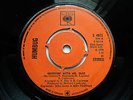
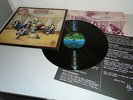
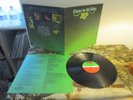
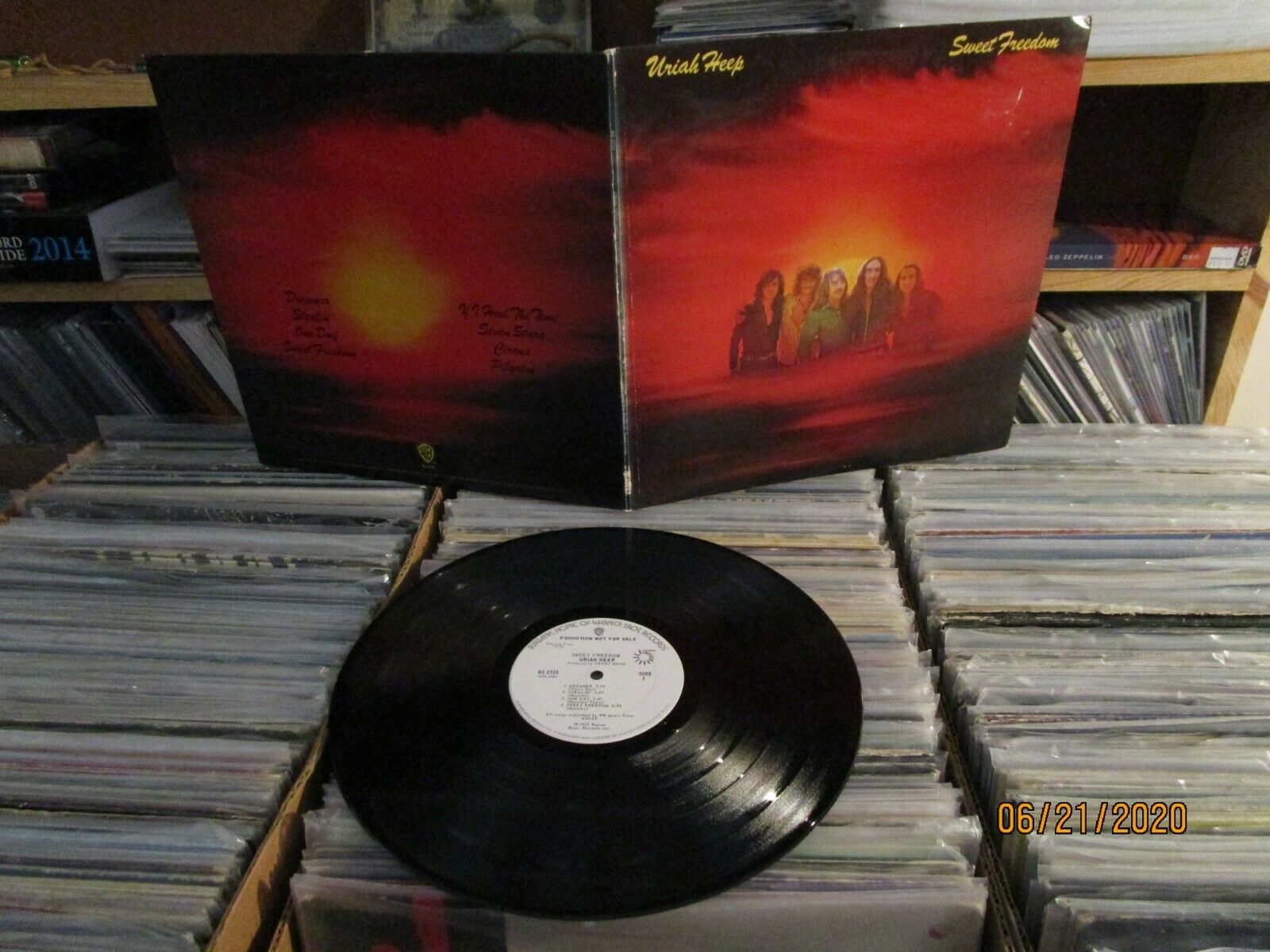
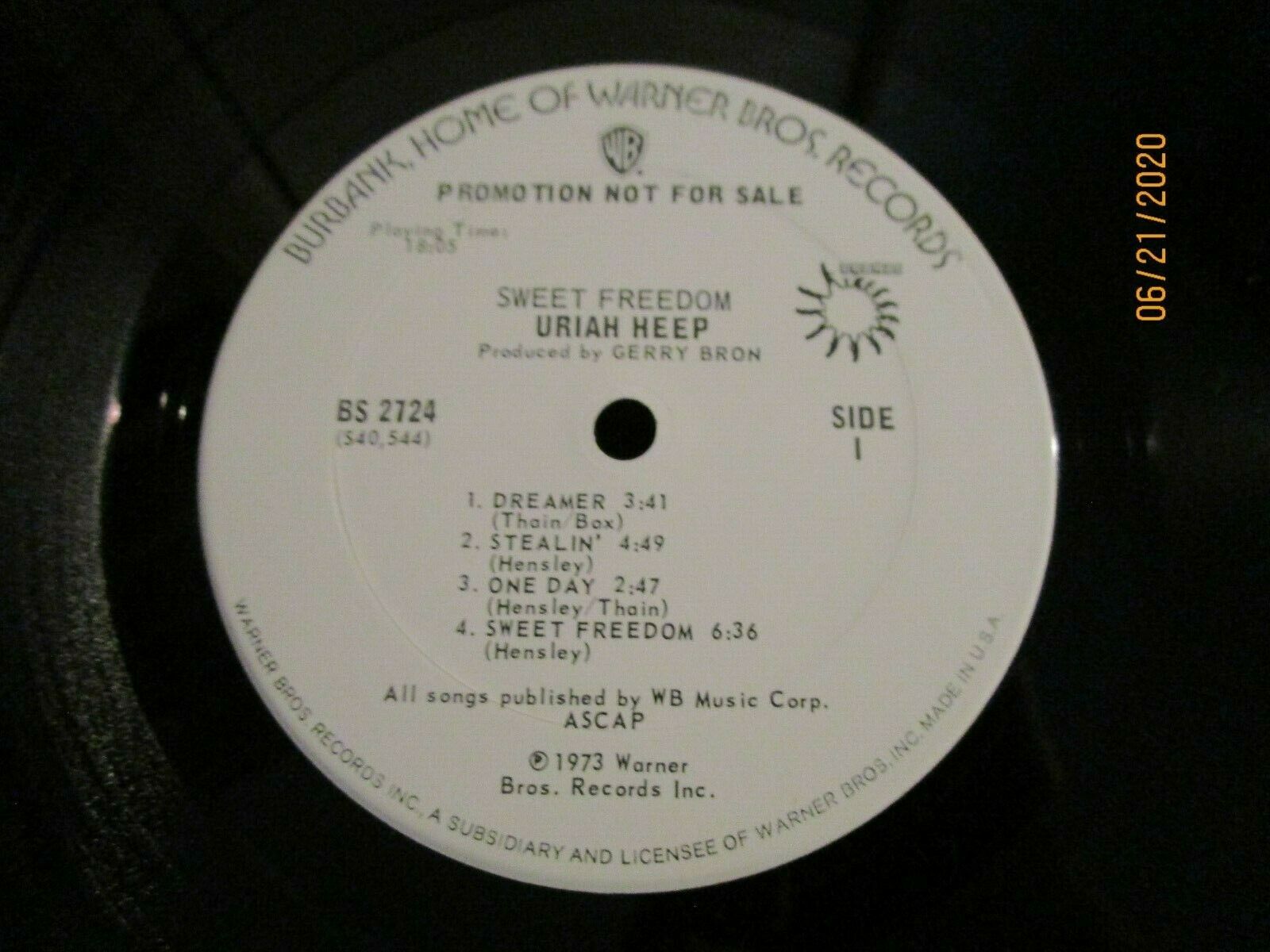
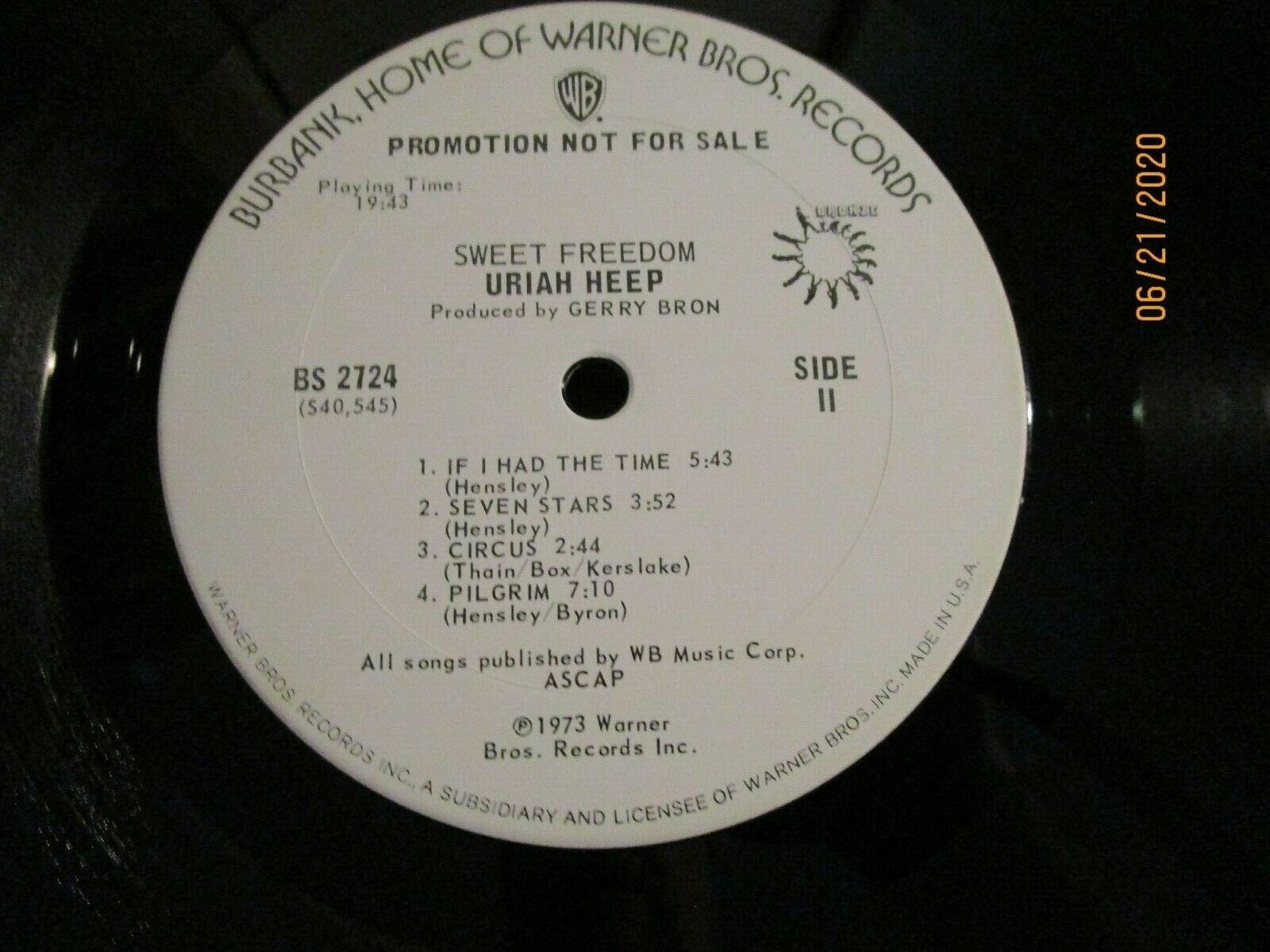
Uriah Heep - Sweet Freedom -LP promo analog vg+/ex/nm play tested cleaned
$
25

Favourite Auctions
To save auctions to your favourites, please login
If you don't have an account, please register
Description
Competitive pricing is my goal to get rid of the hundred's of Lp's. I try my best to grade lp's, and on occasion I will play test if time allows... I am trying to clean records that raises my ire of suspicion, but am finding my self these days cleaning everything. My only method of cleaning is a cloth and some Audio Advisor product. That requires to listening to the LP after about 12 hours of product drying; listening with my turntable & needle (which cost more money these days) and collecting the dust from the grooves. If a stubborn noise erupts I will then look under a light and microscope. It is quite time consuming. So I may miss a thing or two sometimes on my listings, but I will always be here to help resolve the issue. All I ask is my buyers realize these points and be rest assured I offer a refund policy but I would prefer you email me so we can work something out first, I may have a back up copy... Ebay deducts points for to many defective records, which I agree it is seller's responsibility...
I have been collecting records since my 20's... Its has been a passion and a part-time hobby, I hope you love and enjoy music as much as I do, and selling is another way to get to know other people with a like minded interest as I. I offer a refund policy, so please give me the opportunity to make good if there is a problem with a transaction. I reserve the right to cancel a transaction after the sale If I find a missed defect on your behalf.
shipping: 1-2 Lp's: $3.50 3 Lp's: $3.80 4-5 Lp's: $4.50 6 Lp's $5.50 7-9 Lp's $6.50 more. let me know I will do the math.
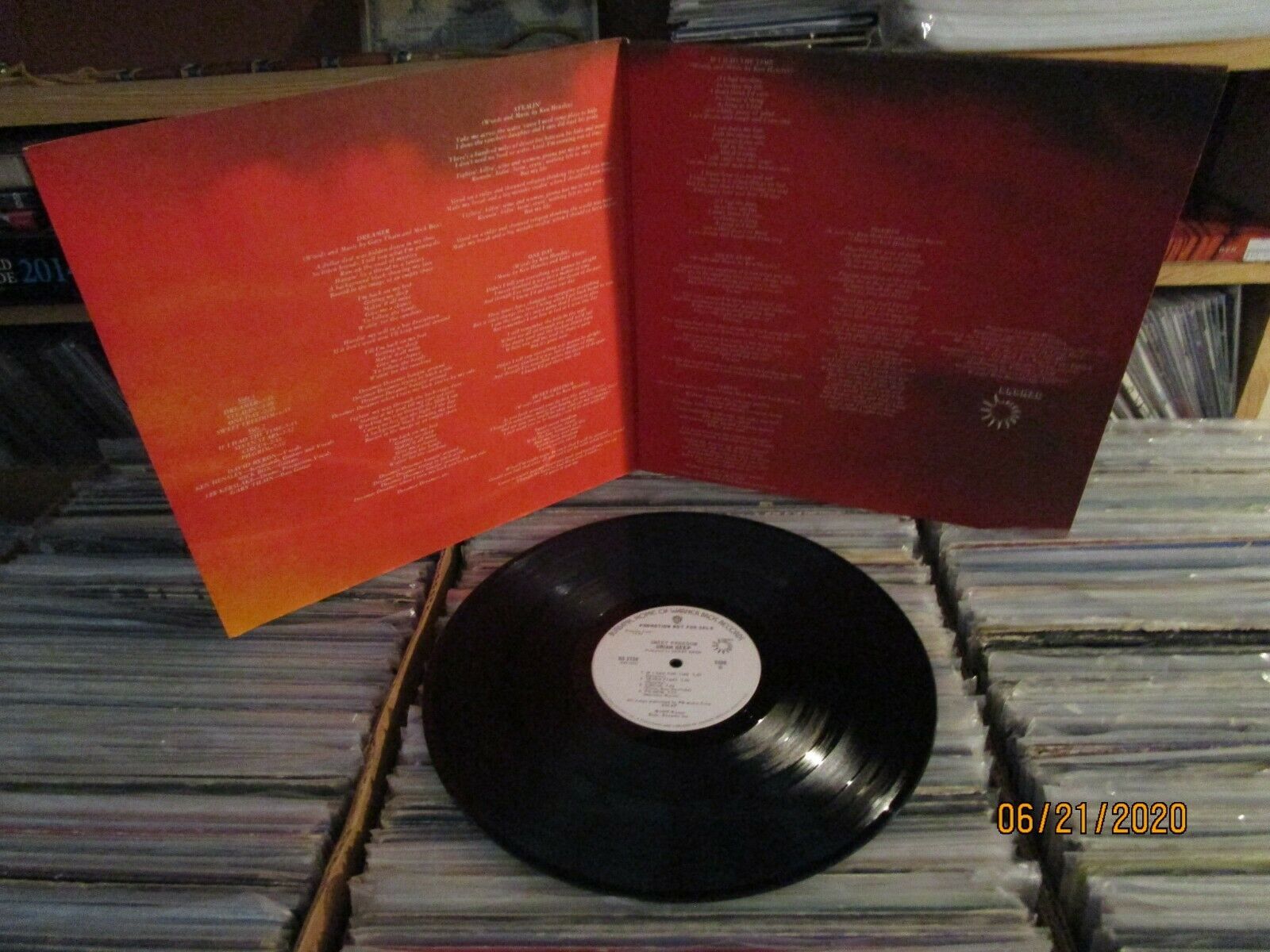
Jacket vg+. Inside ex. Does not have the pink promo label... Record ex. Close to nm but may have a click, pop or two diffinitely debris. Debris always finds a way to adhere to Lp. Always best to brush and wipe with a lint free cloth and store in inner sleeve and tucked away in plastic. Cleaned and play tested. Let me know if you would like for me to listen to it again before you bid I can do for a final listening.
Uriah Heep are an English rock band formed in London in 1969. Its current lineup since 2013 has been lead and rhythm guitarist Mick Box, keyboardist Phil Lanzon, lead vocalist Bernie Shaw, drummer Russell Gilbrook, and bassist Davey Rimmer. Of this lineup, Box is the only remaining original member. Throughout many lineup changes, the band has included many notable musicians, such as vocalists David Byron, John Lawton, John Sloman, Peter Goalby and Steff Fontaine, bassists Gary Thain, Trevor Bolder, John Wetton, Bob Daisley and John Jowitt, drummers Nigel Olsson, Lee Kerslake and Chris Slade, and keyboardists Ken Hensley and John Sinclair.
Over the course of their 50-year career, Uriah Heep have released twenty-five studio albums, two albums composed of re-recorded material, eighteen live albums and thirty-nine compilation albums. Twelve of the band's studio albums have made it to the UK Albums Chart (Return to Fantasy reached No. 7 in 1975) while of the fifteen Billboard 200 Uriah Heep albums Demons and Wizards was the most successful (#23, 1972). In the late 1970s the band had massive success in Germany, where the "Lady in Black" single was a big hit.
The band maintains a significant following and performs at arena-sized venues in the Balkans, Germany, Japan, the Netherlands, Russia and Scandinavia. They have sold over 45 million albums worldwide with over 4 million sales in the U.S, where its best-known songs include "Easy Livin'", "The Wizard", "Sweet Lorraine", and "Stealin'".
The band's origins go back to 1967 when 19-year-old guitarist Mick Box formed a band in Brentwood called Hogwash, which began playing in local clubs and pubs. When the band's singer left, drummer Roger Penlington suggested his cousin David Garrick (who knew the band) as a replacement. Box and Garrick instantly formed a songwriting partnership and, having higher musical aspirations than their colleagues, decided to give up their day jobs and go professional. They set up a new band called Spice; it was then that David Garrick changed his surname to Byron. Drummer Alex Napier (born 1947 in Glasgow, Strathclyde, Scotland) joined, having answered a music paper ad; bassist Paul Newton of the Gods completed the line-up.
From the very beginning, Spice avoided playing covers and, according to Box, always strove "...to do something original." Managed initially by Newton's father, the band climbed their way up to The Marquee level, then got signed by Gerry Bron (the Hit Record Productions Ltd.'s boss) who saw the band at the Blues Loft club in High Wycombe. "I thought they were a band I could develop and I took them on that basis," remembered Bron later. He became the band's manager and signed them to Vertigo Records, the newly formed Philips label. The four-piece found themselves booked into the Lansdowne Studios in London, still under the name of Spice. Then the name was changed to that of the well-known character from David Copperfield, Uriah Heep (for, according to biographer Kirk Blows, "Dickens' name being everywhere around Christmas '69 due to it being the hundredth anniversary of his death"). According to Dave Ling's 2001 autobiography of the band, Wizards and Demons, The Uriah Heep Story, though the "Uriah Heep" moniker was chosen in December 1969, the band continued to play gigs as "Spice" until Ken Hensley joined in February 1970. Uriah Heep then decided to widen the sound. "We'd actually recorded half the first album when we decided that keyboards would be good for our sound. I was a big Vanilla Fudge fan, with their Hammond organ and searing guitar on top, and we had David's high vibrato vocals anyway so that's how we decided to shape it," Box recalled. Gerry Bron brought in session player Colin Wood, followed by Ken Hensley, a former colleague of Newton in the Gods, who was then playing guitar in Toe Fat. "I saw a lot of potential in the group to do something very different," remembered Hensley.
Their 1970 debut album, …Very 'Eavy …Very 'Umble (released as Uriah Heep in the United States), introduced Hensley's heavy organ and guitar-driven sound, with David Byron's theatrical, dynamic vocals soaring above thunderous sonic backgrounds, although acoustic and jazz elements also featured in the mix. The album's title references the signature phrase of the Dickens character Uriah Heep ("very 'umble"). Hensley had little to contribute to the debut: Box and Byron wrote most of the material, including "Gypsy", in many ways (according to Blows) "...a marriage of contrasts" that, in time, became their trademark. In a 1989 interview, Mick Box recalled, "The funny thing was we wrote it at the Hanwell Community Centre, and Deep Purple were rehearsing in the room next door to us. You can imagine the kind of racket we were both making between us." During the winter of 1970, three quarters into the recording of the album, drummer Alex Napier was replaced by Nigel Olsson, recommended to Byron by Elton John. The debut was not popular with rock critics (especially in the USA where Rolling Stone reviewer Melissa Mills infamously promised to commit suicide "if this band makes it") but in retrospect the attitude towards it changed. "Those unfamiliar with Uriah Heep may want to try out Demons and Wizards or a compilation first, but anyone with a serious interest in Uriah Heep or the roots of heavy metal will find plenty to like on ...Very 'eavy ...Very 'umble," advised critic Donald A. Guarisco. In the course of the album's making the writing relationship between Box, Byron and Hensley was beginning to develop. "It was very quick, because we were all into the same things. It was like it was meant to be, there was that kind of chemistry," Mick Box recalled.
When Nigel Olsson returned to Elton John's group in the spring of 1970, Keith Baker took his place. The band's second album, Salisbury (February 1971), was more squarely in the progressive rock genre, with its 16-minute title track featuring a 24-piece orchestra. One of the album's tracks, "Lady in Black", described as, "...a stylishly arranged tune that builds from a folk-styled acoustic tune into a throbbing rocker full of ghostly harmonies and crunching guitar riffs," became a hit in Germany upon its re-release in 1977 (earning the band the Radio Luxemburg Lion award). Produced by Gerry Bron, the second album went a long way to (according to AllMusic) perfect Uriah Heep's "blend of heavy metal power and prog rock complexity" and was also significant for Ken Hensley's instant rise to the position of main songwriter.
In December 1970 Keith Baker left the band and was replaced by Iain Clark (from another Vertigo band Cressida). With him the band toured Germany in late December 1970/January 1971 and made their first US tour in the spring of 1971, supporting Three Dog Night and Steppenwolf.
By this time, Gerry Bron's deal with Philips/Vertigo was over, so he set up his own label, Bronze Records. The third album was recorded in the summer months of 1971, during the band's three visits to Lansdowne. "It was the point in time when the band really found a solid musical direction," said Bron later. The third album, Look at Yourself, released in October 1971, marked the solidification of disparate ideas that had been a prominent feature of Salisbury and presented the unified sound and direction. Among the stand-outs were the title track, "Tears In My Eyes" and "July Morning", an epic many Heep fans regard as equal to Led Zeppelin's "Stairway to Heaven" and Deep Purple's "Child in Time". "I think that 'July Morning' is one of the best examples of the way the band was developing at that point in time. It introduced a lot of dynamics, a lot of light and shade into our sound," Ken Hensley said. The album peaked at No. 39 in the UK.
Wonderworld (June 1974), recorded in Munich's Musicland Studios in January, disappointed fans and band members alike. "Recording abroad disrupted the band's normal method of operation and that had a big negative effect on the group. Our communication was falling apart, we were arguing over stuff like royalties and we were getting involved in matters beyond music," Hensley said. Box remembered weeks spent in the studio as "dramatic" for all the wrong reasons. "David was drunk for most of the time, Kenny was having an emotional time of it and I was constantly trying to help them so it was difficult for me too. There was also a little bit of friction because (artistic) Kenny didn't like all the attention that (flamboyant) David was getting." Gary Thain was in even more serious trouble. According to Blows, "A strenuous touring schedule, compounded by the bassist's heavy drug dependency (inherent even before joining Heep) was taking its toll, though matters came to a head while on tour during September," when the bassist received a serious electric shock on stage in Dallas during a gig at Southern Methodist University’s Moody Coliseum on 15 September 1974. The rest of the US tour was then canceled and their UK dates rescheduled to October. Soon after going out of hospital, Thain, in Sounds, openly accused manager Gerry Bron of having turned Uriah Heep into a mere "financial thing" and was fired two months after the group's final gig of 1974 at New Theatre in Oxford, England on 14 December. A year later, on 8 December 1975, Gary Thain was found dead in his Norwood Green home, having overdosed on heroin.
Dreamer 3:41 Stealin' 4:49 One Day 2:47 Sweet Freedom 6:37 If I Had The Time 5:43 Seven Stars 3:52 Circus 2:44 Pilgrim 7:10
price rating