V-Disc ALBUM Six V-Discs 1943 World War 2 Goodman Ellington Waller
$
85


Favourite Auctions
To save auctions to your favourites, please login
If you don't have an account, please register
Description
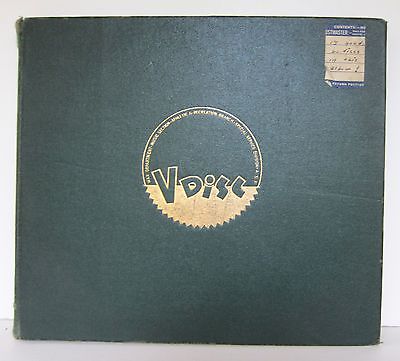
V-DISC ALBUM WITH SIX RECORDS
This rare ALBUM containing six 12-inch V-Discs is part of the series of recordings made in 1943 during World War 2 by the US Government and various private record companies and sent to military personnel overseas. (See Wickepedia article excerpt below for details.)
- There is a list pasted on the inside cover listing what was supposed to be in the album, but those have long since been replaced by the discs listed below recorded by some of the most prominent musicians of the day.
- Underneath that list and obscured by it is a letter describing what the program was about. I have reproduced the letter in the photographs and transcribed it below.
- The discs themselves have seen a great deal of use and have certainly fulfilled their stated purpose entertaining those fighting for our country. I have not played them, so can't guarantee their quality.
- The sturdy cover of the album has some wear and a rip in the spine. I have reinforced some of the sleeves with archival mending paper so the records won't fall out.
CONTENTS OF RECORDS:
94a: Vaughn Monroe - For The First Time
94b: Vaughn Monroe - Jealous
165a: "Fats" Waller And Ada Brown - That Ain't Right
165b: Meade "Lux" Lewis - Doll House Boogie
183a: Capt Glenn Miller And The Army Air Forces Training Command Orchestra - (1) Embraceable You - (2) G. I. Jive
183b: Duke Ellington And His Orchestra - (1) Sophisticated Lady - (2) Azure
186a: Coast Guard Training Station Band Curtis Bay, Md. - (1) My Heart Isn't In It - (2) Annie Laurie
186b: Coast Guard Training Station Band Curtis Bay, Md. - (1) Mary Lou - (2) Shine
203a: Philharmonicas - Harmonica Boogie Woogie
203b: Philharmonicas - Czardas
205a: The Ink Spots (1) We'll Meet Again
205b: Benny Goodman - (1) Down By The Old Mill Stream - (2) Jumpin' At The Woodside
~~~~~~~~~~~~~~~~~~~
Letter on Inside Cover:
WAR DEPARTMENT
Headquarters, Army Service Forces
Washington D.C.
The Special Service Division presents to the Armed Forces this preview of the V-DISC, a new feature of the Music Section, Athletic and Recreation Branch. It is planned to make monthly releases of phonograph records, not only of the latest and best n popular songs and marches, but also of the finest classical, concert, military, sacred, fold and patriotic music, so that the individual interests of the men in the Armed Forces may be fulfilled.
This album of six records contains a number of the leading sons from the Army Hit Kit and several special arrangements appropriately captioned, "Music for Marching Men."
V-DISCs can be played over post public address systems, for drill, in the service clubs, mess halls, movie theaters, over camp carrier radio and many other places.
Comments and suggestions on this new project are earnestly requested.
F.H. Osborn
Brigadier General
Special Service Division
~~~~~~~~~~~~~~~~~~~~~~~~~
An interesting article about the origins of the V-Disc project from Wickepedia:
V-Disc ("V" for Victory) was a morale-boosting initiative involving the production of several series of recordings during the World War II era by special arrangement between the United States government and various private U.S. record companies. The records were produced for the use of United States military personnel overseas. Many popular singers, big bands and orchestras of the era recorded special V-Disc records. These 12-inch, vinyl 78 rpm gramophone recordings were created for the Army between October 1943 and May 1949. Navy discs were released between July 1944 and September 1945. Twelve-inch discs were used because, when 136 grooves per inch were cut, they could hold up to six and a half minutes of music. Not all releases were pressed of vinyl; many were of the much less durable shellac compound used for standard 78 RPM records of the day.
The V-Disc project actually began in June 1941, six months before the United States' involvement in World War II, when Captain Howard Bronson was assigned to the Army's Recreation and Welfare Section as a musical advisor. Bronson suggested the troops might appreciate a series of records featuring military band music, inspirational records that could motivate soldiers and improve morale. By 1942, the Armed Forces Radio Service (AFRS) sent 16-inch, 33 rpm vinyl transcription discs to the troops from eight sources: special recording sessions, concerts, recitals, radio broadcasts, film sound tracks and commercial records.
Meanwhile, the American Federation of Musicians, under the leadership of James Caesar Petrillo, were involved in a major recording strike against the four major record companies. This continued until the intervention of recording pioneer George Robert Vincent, who was at that point a lieutenant. On October 27, 1943, Vincent convinced Petrillo to allow his union musicians to record sides for the military, as long as the records were not offered for purchase in the United States. From that moment on, artists who wanted to record now had an outlet for their productivity — as well as a guaranteed, receptive, enthusiastic worldwide audience of soldiers, sailors and airmen.
price rating






![Various Artists - Eric Clapton: Life In 12 Bars (Various Artists) [New Vinyl LP]](https://www.popsike.net/php/thumbnail.php?url=https://www.popsike.pics/pix/20180717/362387690009.jpg)