VINTAGE 12" VINYL - BEGGARS BANQUET - ROLLING STONES - DESIGN#10/V.1 SKL4955
£
38
$
50


Favourite Auctions
To save auctions to your favourites, please login
If you don't have an account, please register
Description
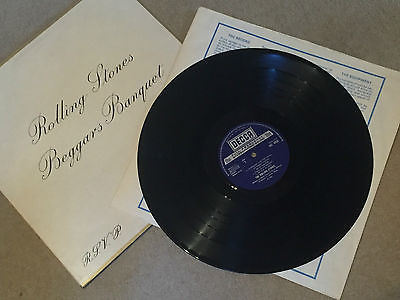
VINTAGE 12" VINYL - BEGGARS BANQUET - ROLLING STONES - DESIGN#10/V.1 SKL4955
ARTIST ROLLING STONES
TITLE BEGGARS BANQUET
LABEL DECCA
CATALOGUE # SKL 4955
FORMAT 12” VINYL
COUNTRY UK
RELEASED 1968
VINYL CONDITION EX+
SLEEVE CONDITION EX+
MATRIX / RUNOFF XZAL-8476-2K
Outside of the UK, ask for a postal cost
As the original cover shown below was banned initially by the record company there were several versions of the alternative that was released in 1968 over a very short period of time, really only noticeable by the label (some red) and the matrix - this is classed as Number 10 version 1.
Beggars Banquet is the seventh British and ninth American studio album by English rock band The Rolling Stones. It was released in December 1968 by Decca Records in the United Kingdom and London Records in the United States. The album was a return to roots rock for the band following the psychedelic pop of their 1967 album Their Satanic Majesties Request.
Glyn Johns, the album's recording engineer and longtime collaborator of the band, said that Beggars Banquet signalled "the Rolling Stones' coming of age ... I think that the material was far better than anything they'd ever done before. The whole mood of the record was far stronger to me musically."[3] Producer Jimmy Miller described guitarist Keith Richards as "a real workhorse" while recording the album, mostly due to the infrequent presence of Brian Jones. When he did show up at the sessions, Jones behaved erratically due to his drug use and emotional problems.[3] Miller said that Jones would "show up occasionally when he was in the mood to play, and he could never really be relied on:
When he would show up at a session—let's say he had just bought a sitar that day, he'd feel like playing it, so he'd look in his calendar to see if the Stones were in. Now he may have missed the previous four sessions. We'd be doing let's say, a blues thing. He'd walk in with a sitar, which was totally irrelevant to what we were doing, and want to play it. I used to try to accommodate him. I would isolate him, put him in a booth and not record him onto any track that we really needed. And the others, particularly Mick and Keith, would often say to me, 'Just tell him to piss off and get the hell out of here'.[3]
Jones played sitar[4] and tanpura on "Street Fighting Man",[5] slide guitar on "No Expectations",[6][7][8] harmonica on "Parachute Woman", "Dear Doctor" and "Prodigal Son",[9] and Mellotron on "Jig-Saw Puzzle" and "Stray Cat Blues".[10] Jones is sometimes mistakenly credited for playing the slide guitar on "Jig-Saw Puzzle"; both guitars are played by Keith Richards[11][12] The basic track of "Street Fighting Man" was recorded on an early Philips cassette deck at London's Olympic Sound Studios, where he played a Gibson Hummingbird acoustic guitar, and Charlie Watts played on an antique, portable practice drum kit.[13] Richards and Mick Jagger were mistakenly credited as writers on "Prodigal Son", a cover of Robert Wilkins's Biblical blues song of the same name.[3] According to Keith Richards the name Beggars Banquet "comes from a cat called Christopher Gibbs".[14]
Cover art dispute, and Rock and Roll Circus
On 7 June 1968, a photoshoot for the album, with photographer Michael Joseph, was held at Sarum Chase, a mansion in Hampstead, London.[15] Previously unseen images from the shoot were exhibited at the Blink Gallery in London in November and December 2008.[16] The album's original cover art, depicting a bathroom wall covered with graffiti, was rejected by the band's record company, and their unsuccessful dispute delayed the album's release for months.[3]
On 10–11 December 1968 the band filmed a television extravaganza entitled The Rolling Stones Rock and Roll Circus featuring John Lennon, Eric Clapton, The Who, Jethro Tull, and Marianne Faithfull among the musical guests. One of the original aims of the project was to promote Beggars Banquet, but the film was shelved by the Rolling Stones until 1996, when it was finally released officially.[citation needed]
Critical reception
Professional ratings Review scores Source Rating AllMusic [17] Blender [18] Boston Herald [19] eMusic [20] Encyclopedia of Popular Music [21] Entertainment Weekly A[22] The Great Rock Discography 10/10[23] NME 8/10[24] Rolling Stone [3] The Rolling Stone Album Guide [25]Critics considered the LP a return to form.[17] It was also a commercial success, reaching No. 3 in the UK and No. 5 in the US (on the way to eventual platinum status).[citation needed] According to music journalist Anthony DeCurtis, the "political correctness" of "Street Fighting Man", particularly the ambivalent lyrics "What can a poor boy do/'Cept sing in a rock and roll band", sparked intense debate in the underground media.[3] Music critic Robert Christgau ranked it as the third best album of the year, and "Salt of the Earth" the best pop song of the year, in his ballot for Jazz & Pop magazine's annual critics poll.[26]
In a retrospective review for eMusic, music critic Ben Fong-Torres called Beggars Banquet "an album flush with masterful and growling instant classics", and said that it "responds more to the chaos of '68 and to themselves than to any fellow artists ... the mood is one of dissolution and resignation, in the guise of a voice of an ambivalent authority."[20] Colin Larkin, writing in the Encyclopedia of Popular Music (2006), viewed it as "a return to strength" which included "the socio-political 'Street Fighting Man' and the brilliantly macabre 'Sympathy for the Devil', in which Jagger's seductive vocal was backed by hypnotic Afro-rhythms and dervish yelps."[21] Larry Katz from the Boston Herald called Beggars Banquet "both a return to basics and leap forward."[19] In Rolling Stone magazine, DeCurtis said the album was "filled with distinctive and original touches", and remarked on its legacy:
For the album, the Stones had gone to great lengths to toughen their sound and banish the haze of psychedelia, and in doing so, they launched a five-year period in which they would produce their very greatest records.[3]
According to Martin C. Strong, Beggars Banquet was the first album in "a staggering burst of creativity" in a five-year period that ultimately comprised four of the best rock albums of all time.[23] In 2003, the album was ranked No. 58 on Rolling Stone magazine's list of the 500 greatest albums of all time.[27] In the same year, the TV network VH1 named Beggars Banquet the 67th greatest album of all time. The album is also featured in the book 1001 Albums You Must Hear Before You Die.[28]
Reissue
In August 2002, ABKCO Records reissued Beggars Banquet as a newly remastered LP and SACD/CD hybrid disk.[29] This release corrected an important flaw in the original album by restoring each song to its proper, slightly faster speed. Due to an error in the mastering, Beggars Banquet was heard for over thirty years at a slower speed than it was recorded. This had the effect of altering not only the tempo of each song, but the song's key as well. These differences were subtle but important, and the remastered version is about 30 seconds shorter than the original release.
Also in 2002 the Russian label CD-Maximum unofficially released the limited edition Beggars Banquet + 7 Bonus,[30] which was also bootleged on a German counterfeit-DECCA label as Beggars Banquet (the Mono Beggars).[31]
It was released once again in 2010 by Universal Music Enterprises in a Japanese only SHM-SACD version;[32] and on 24 November 2010 ABKCO Records released a SHM-CD version.[33]
On 28 May 2013 ABKCO Records reissued the LP on vinyl.[34]
Track listing
All songs written by Mick Jagger and Keith Richards, except "Prodigal Son" by Robert Wilkins.
Side one No. Title Length 1. "Sympathy for the Devil" 6:18 2. "No Expectations" 3:56 3. "Dear Doctor" 3:28 4. "Parachute Woman" 2:20 5. "Jigsaw Puzzle" 6:06 Side two No. Title Length 6. "Street Fighting Man" 3:16 7. "Prodigal Son" 2:51 8. "Stray Cat Blues" 4:38 9. "Factory Girl" 2:09 10. "Salt of the Earth" 4:48Please note : This is part of a private sale, I am not a dealer. I have collected vinyl for over 45 years and have amassed appx 750 single and 350 albums, between the 60’s and 90’s until cassettes came out.
I have recently purchased a new stereo that copies vinyl direct to my PC so gradually I will be copying that vinyl that I wish to keep and this whole collection will be put on sale. I will therefore have played some to check their quality, but in the meantime some will be listed un-played, though I will have checked all for any damage or scratches. When an item then sells I will check the record is of the standard I have described and if not, then would immediately refund your money instead of posting and disappointing. If anyone though wishes me to check a particular item before bidding then I will do so. Please also note that the likes of David Cassidy, David Essex and similar are not mine but my wifes.
Click on "See Other Items" to view all the records I am selling
Vinyl
Mint The record itself is in brand new condition with no surface marks or deterioration in sound quality.
Excellent+ The record shows some signs of having been played, but there is no lessening in sound quality. Very minor light surface marks.
Excellent The record shows some signs of having been played, but there is very little lessening in sound quality. Light surface marks.
Very Good The record has been played many times, but displays no major deterioration in sound quality despite noticeable surface marks.
Covers
We will not send grossly damaged /torn or dirty sleeves.
Excellent Minimal creasing, no tears, no sticker damage, no writing. Many are as new.
Very Good May have small tears (nothing over 5mm), minimal sticker damage, creasing or small writing.
price rating