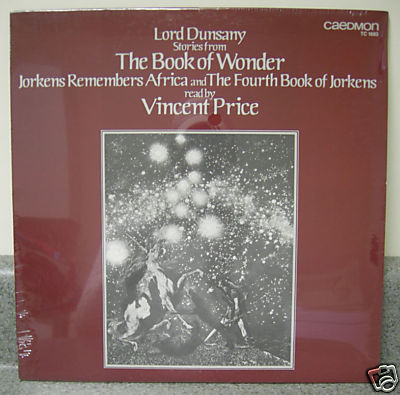
Vincent Price Estate LP: Lord Dunsany Stories, 1982
$
65


$ 65
Sold For
Aug 24, 2009
Sold Date
Aug 17, 2009
Start Date
$ 2
Start price
14
Number Of Bids
USA
Country Of Seller
eBay
Auctioned at
Favourite Auctions
To save auctions to your favourites, please login
If you don't have an account, please register
Description
Vincent Price was justly famous for his mellifluous voice--and he frequently made recordings in all genres.
This 1976 recording, featuring "Warlock: Vincent Price" contains stories and poems for Halloween.
This is Price's personal copy and it is still shrink wrapped.
This recording, narrated by Vincent Price, draws on some of the works of the famed Irish fantasy author whose work would later inspire the likes of HP Lovecraft and Ursula Le Guin.
About Lord Dunsany:
Born to one of the oldest titles in the Irish peerage, Dunsany lived much of his life at perhaps Ireland's longest-inhabited home, Dunsany Castle near Tara, worked with W.B. Yeats and Lady Gregory, received an honorary doctorate from Trinity College, was chess and pistol-shooting champion of Ireland, and travelled and hunted extensively. He died in Dublin after an attack of appendicitis.
Edward Plunkett (Dunsany) was the first son of John William Plunkett, 17th Baron of Dunsany (1853–1899) and his wife, Ernle Elizabeth Louisa Maria Grosvenor Ernle-Erle-Drax, née Ernle Elizabeth Louisa Jessica Burton (1855–1916).
From a historically wealthy and famous family, Dunsany was related to many other well-known Irish figures. He was a kinsman of the Catholic Saint Oliver Plunkett, the martyred Archbishop of Armagh. His mother was a cousin of Sir Richard Burton, and he inherited from her considerable height, being 6' 4". The Countess of Fingall, wife of Dunsany's cousin, the Earl of Fingall, wrote a best-selling account of the life of the aristocracy in Ireland in the late 19th century and early 20th century, called Seventy Years Young.
Plunkett's only sibling, a younger brother, from whom he was later estranged, was the noted British naval officer, Admiral The Honorable Sir Reginald Aylmer Ranfurly Plunkett-Ernle-Erle-Drax.
Edward Plunkett grew up at the family properties, most notably (Dunstall Priory) in Shoreham, Kent and Dunsany Castle in County Meath but also family homes such as in London. His schooling was at Cheam, Eton and finally Sandhurst, which he entered in 1896.
The title passed to him at his father's death at a fairly young age, in 1899, and Dunsany returned to Dunsany Castle after war duty, in 1901.
In 1903, he met Lady Beatrice Child Villiers (1880–1970), youngest daughter of the 7th Earl of Jersey (head of the Jersey banking family), living at Osterley Park, and they were married in 1904. Their only child, Randal, was born in 1906. Beatrice was supportive, and assisted Dunsany in his writing, typing his manuscripts, selecting work for his 1950s retrospective short story collection, and overseeing his literary heritage after his death.
The Dunsanys were socially active in both Dublin and London, and travelled between their homes in Meath, London and Kent, other than during World Wars I and II, and the Irish War of Independence. Dunsany himself circulated with the literary figures of the time, to many of whom he was first introduced by his uncle, the co-operative pioneer Horace Plunkett, who also helped to manage his estate and investments for a time. He was friendly with, for example, George William Russell, Oliver St. John Gogarty and, for a time, W. B. Yeats.
Dunsany was a keen hunter (for many years hosting the hounds of a local hunt, as well as hunting in parts of Africa) and sportsman, and was at one time the pistol-shooting champion of Ireland.
He enjoyed cricket, provided the local cricket ground situated near Dunsany Crossroads, and later played for and presided at Shoreham Cricket Club.
Dunsany was a keen chess player, set chess puzzles for journals including The Times (of London), played Capablanca to a draw, and also invented Dunsany's chess, an asymmetric chess variant that is notable for not involving any fairy pieces, unlike many variants that require the player to learn unconventional piece movements. He was president of both the Irish Chess Union and the Kent County Chess Association for some years, and of Sevenoaks Chess Club for 54 years.
Dunsany campaigned for animal rights, being known especially for his opposition to the "docking" of dogs' tails, and was president of the West Kent branch of the RSPCA in his later years.
He was a supporter of scouting over many years, serving as President of the Sevenoaks district Boy Scouts Association. He also supported the amateur drama group, the Shoreham Players.
Dunsany provided support for the British Legion in both Ireland and Kent, including grounds in Trim and poetry for the Irish branch's annual memorial service on a number of occasions.
Dunsany served as a Second Lieutenant in the Coldstream Guards during the Second Boer War and as a Captain in the Royal Inniskilling Fusiliers in World War I, when he was wounded. Having been refused forward positioning in 1916, being listed as valuable as a trainer, in the latter stages of the war he spent time in the trenches, and in the very last period wrote material for the War Office. Dunsany signed-up for the local defence forces of both Ireland and the United Kingdom during World War II, and was especially active in Shoreham in Kent, the most-bombed village in the Battle of Britain.
Dunsany's fame arose chiefly from his prolific writings, and he was involved with the Irish Literary Revival. Supporting the Revival, Dunsany was a major donor to the Abbey Theatre, and he moved in Irish literary circles. He was well acquainted with W. B. Yeats (who rarely acted as editor, but gathered and published a Dunsany selection), Lady Gregory, Percy French, "AE" Russell, Oliver St John Gogarty, Padraic Colum (with whom he jointly wrote a play) and others. He befriended and supported Francis Ledwidge to whom he gave the use of his library.
Lord Dunsany, New York, 1919
Dunsany made his first literary tour to the USA in 1919, and made further such visits right up to the 1950s, notably to California. Dunsany's own work, and contribution to the Irish literary heritage, was recognized through an honorary degree from Trinity College, Dublin.
In the 1930s, Dunsany transferred his Meath estate to his son and heir under a trust, and settled in Shoreham, Kent, at his Kent property, not far from the home of Rudyard Kipling, a friend, and visiting Ireland only occasionally thereafter.
In 1940, Dunsany was appointed Byron Professor of English in Athens University, Greece but had to be evacuated due to wartime disruptions, returning home by a circuitous route, his travels forming a basis for a long poem published in book form. Olivia Manning's character "Lord Pinkrose" in her novel sequence the Fortunes of War was a mocking portrait of Dunsany during this period.
In 1957, Lord Dunsany took ill while eating with the Earl and Countess of Fingall, in what proved to be an attack of appendicitis, and died in hospital in Dublin. He had directed that he be buried in the churchyard of the ancient church of St. Peter and St. Paul, Shoreham, Kent, in memory of shared war times. His funeral was attended by a wide range of family (including Pakenham, Jersey and Fingal) and Shoreham figures, and representatives of his old regiment and various bodies in which he had taken an interest. A memorial service was held at Kilmessan, Meath, with a reading of "Crossing the Bar" which was noted as coinciding with a passing flock of geese.
Lady Beatrice survived Lord Dunsany, living on primarily at Shoreham, overseeing his literary legacy until her death in 1970, while their son, Randal, succeeded him to the Barony, and was in turn succeeded by his grandson, to whom literary rights passed directly.
About the beloved, Vincent Price:
Vincent Price is best remembered for his roles in horror movies, specifically the Roger Corman adaptations from Edger Allan Poe. Although these gave him a wide variety of characters to play and were striking enough, they type cast him for the remainder of his career. Price did not start out with the intentions of becoming an actor but rather an art historian. He obtained degrees in Art History and English at Yale and then taught school for a year. He felt that he needed to further his education though as the students seemed to know more than he did! Price returned to college to take his Masters in Fine Arts at the Courtauld Institute in London, he also studied briefly in Vienna.
It was while in London In 1934 that the theatre bug hit him, theatre tickets were relatively cheap and Price took advantage of this. He first appeared as an actor at the Gate Theatre, at the time a private experimental theater, as the judge and a policeman in the play "Chicago'. He also appeared here as Albert in 'Victoria Regina', the role that was to bring him to Broadway and the public's attention. The show's producer Gilbert Miller, decided to take the play to New York and open with Helen Hayes (the number one actress in America at the time), in the leading role. Miller also decided to take Vincent Price to New York to play opposite her. The play opened on the 26th December 1935 and ran for three years.
The program notes in the original 1936 playbill give an interesting insight into Vincent Price's entrance to the theatrical profession....
"Vincent Price's appearance as leading man to Helen Hayes marks his professional as well as his American debut on the stage. This extraordinary circumstance is due to the fact that although Mr. Price has had stage aspirations since he was ten years old, he was forced to earn his living as a schoolmaster until mere chance decreed otherwise.
He was studying the history of German art at the Courtauld Institute in London when a friend took him to London's Gate Theater, where casting of Maurine Watkins' "Chicago" was in process. American accents being at a premium, Mr. Price was thrust into the production and found himself doubling as a burly policeman and a venerable judge. His remarkable resemblance to Prince Albert led to his being offered the important role of the Price Consort in the ensuing production of "Victoria Regina".
He received glowing notices and was subsequently signed by Gilbert Miller for the American production."
How accurate that "he was forced to earn his living as a schoolmaster until mere chance decreed otherwise." is probably an exaggeration, his father did own the National Candy Company in St Louis.
Price's love of art never left him and he used his education to good advantage. He was responsible, in 1951, of founding the Vincent Price Gallery, with his then wife Mary Grant Price on the campus of East Los Angeles Collage. Price had been invited to lecture on the ''Aesthetic Responsibilities of the Citizen,'' he arrived to find he was, ''speaking in a Quonset hut on a mud flat.''
He was so struck by the students' spirits and the need for the community to have the opportunity to experience original art works first hand, Price donated some ninety pieces which established the first ''teaching art collection'' owned by a community college in the United States. Over the decades, Price and other patrons continued to contribute art with the goal of illustrating diverse periods, styles, mediums, and techniques: from Egyptian sculpture circa 600 BC to 1990s serigraphs. He continued to maintain a hands-on interest in the gallery with selecting exhibits and developing a fund raising program to which he leant his name and support. In 1991, he was quoted,
''We just wanted it to serve the community. We didn't want to make publicity out of it since everything actors do is suspect! We just shut up and let it grow.''
Price's love of American Indian Art led to another little known side of him, his work for Native Americans, he worked for 15 years with the Department of the Interior and was quoted as saying in an interview:
"I have an enormous respect for the American Indian. I think we shut them off, at a period when they might have become the most creative people on the face of the earth. But we killed them off."
Prior to his movie career Price joined Orson Wells' Mercury Theatre for a brief spell, here he claimed, everyone in the company had a disagreement with Wells at some point or another. Price's first movie was "Service DeLuxe" in 1938 and he went on to play such diverse historical characters as Raleigh, Clarence, Richelieu, Charles II and the Mormon Joseph Smith. He was also cast in several films as a charming but effete young man, notably in 'Laura' (1944) and 'The Fly' (1958). The occasional horror role came his way too at this time, he reveled in the old Lionel Atwell part of the demented sculptor in "The House of Wax" (1953). Price's niche in the horror movie genre was carved in 1960 with the classic movie "The Fall of the House of Usher".
Price did return to the stage in later years. He toured his one-man show of Oscar Wilde throughout America for many years to great acclaim. It was a demonstration of the excellence performing skills of Vincent Price and an escape from the type casting.
In his later years, Price became involved with the rock & roll industry, he was involved in music videos with performers including Alice Cooper, Ringo Starr, and Michael Jackson. Price had his own ideas why he was chosen for this honor.
"I have great admiration for rock `n roll, but not when it's done badly. My God! You know, I have a theory about how I get selected for these things. I think they've based a lot of their stuff on my movies. They go out and do the rock `n roll, and they're all high, and making the noise and flying around, and then they go back to their hotel room, turn on the TV, and there I am! Alice and I met a couple of times, and I liked him, then he asked me to do 'Welcome to My Nightmare'. Then one time I got a call and they said would you come and do a recording with Michael Jackson, called 'Thriller'. I said, "Sure, I'll do anything." So I went and did it, and I didn't think anything would happen with it, than it came out and sold 40 million copies! I didn't do it for the money, because I didn't have a percentage of it. It was just fun to do.
You know to be identified with the most popular record ever made is not just chopped liver! It has really done me a lot of good, because it has given me a new audience. "
As if Price didn't have enough to occupy himself during his career as an actor, he began another career as a TV chef, which ran for several series. He had a reputation as an outstanding cook and collector of recipes. He also found time to write a book , “Joe".
Towards the end of his life, he was struck with a great personal loss. His beloved third wife, Coral Browne, succumbed to breast cancer two days after Vincent Price's 80th birthday on May 29th, 1991. In the Autumn of that year a memorial service was held at London's Farmers Church, many of Coral Browne's friends from the Theater and Film attended. Price's own frail health made it impossible for him to be at the memorial in person. A letter written by Price was read out by director John Schlesinger --
"Dear John:
When I was courting Coral, the first gift she gave me was a photo of herself simply signed, "Remember Coral" -- not really a challenge as the problem was, how could you forget her? I've come to believe remembering someone is not the highest compliment -- it is missing them. I find I miss every hour of Coral's life -- I miss her morning cloudiness, noon mellowness, evening brightness. I miss her in every corner of our house, every crevice of my life. In missing her, I feel I'm missing much of life itself. Over her long illness, as I held her hand or stroked her brow, or just lay still beside her, it was not the affectionate contact we'd known as we wandered down the glamorous paths we'd been privileged to share in our few years together; we were marching towards the end of our time and we both knew it. But, in our looks, our smiles, the private, few, soft-spoken word, there was hope of other places, other ways, perhaps, to meet again.
One fact of Coral I'll always miss, her many, many devoted friends -- many here, today, in this beautiful church, celebrating her life more than mourning her death, and missing the liveliness of her wit, her personal beauty, her outgoing self. I love them all for loving her. Many of you have shared more of her life than I have, but that very private and intense passion for her is mine alone.
She survived that last long year on the love of her friends, their caring and concern -- and very especially yours, dear John. I miss you all, and though we may not meet as often, nor in the great good company of my wife, you are in my memory locked.
All my love,
Vincent
price rating














![The Complete Stax/Volt Singles... [Box] - Bar-Kays (...](https://www.popsike.net/php/thumbnail.php?url=https://www.popsike.pics/pix/20040304/4000207437.jpg)
