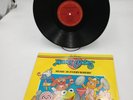
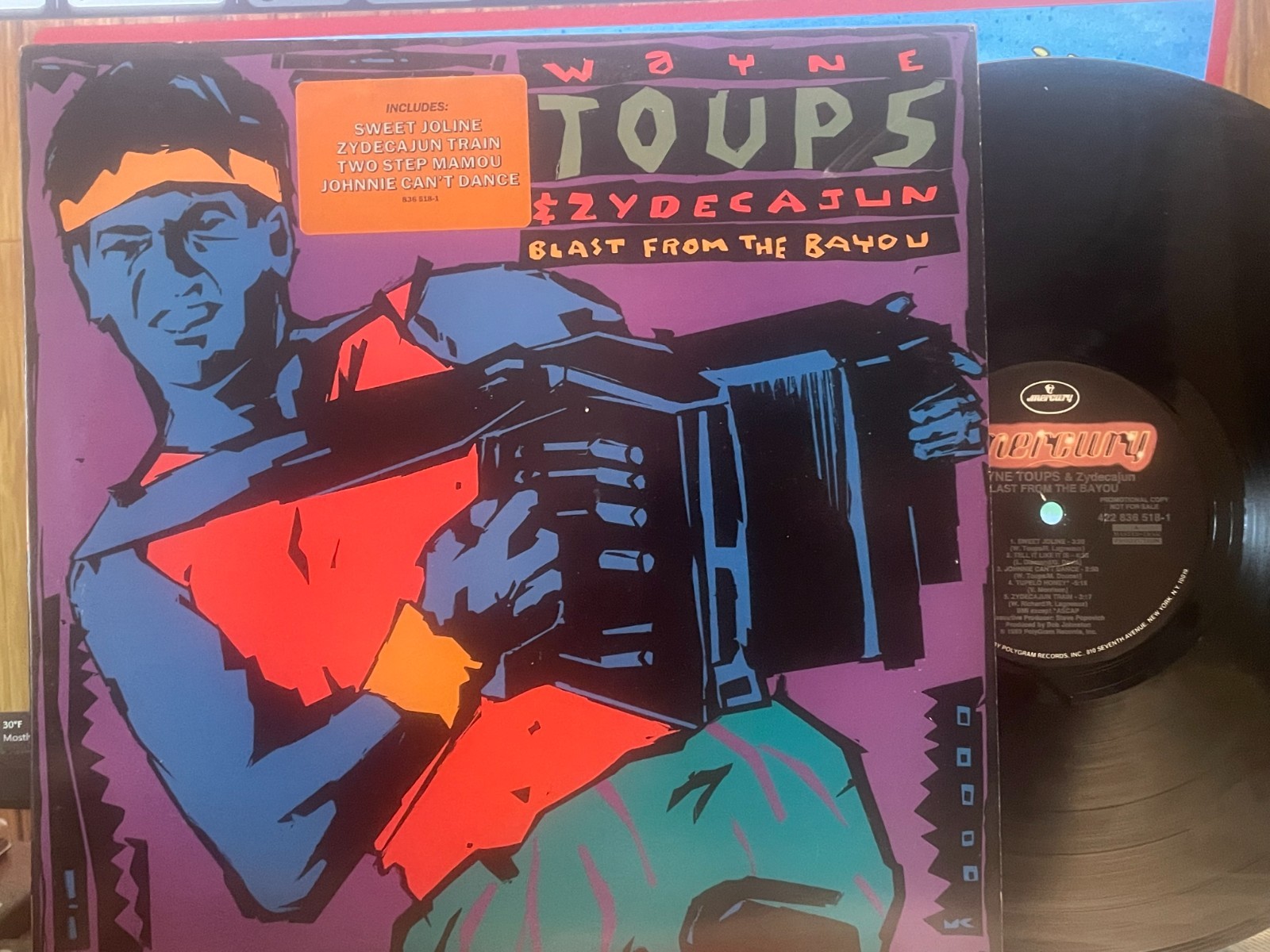
WAYNE TOUPS & Zydecajun "Blast From The Bayou" LP NM/NM Gold Stamped Promo 1989
$
23


Favourite Auctions
To save auctions to your favourites, please login
If you don't have an account, please register
Description
Wayne Toups Biography by Mark Deming
Blast from the Bayou
One of the most exciting musicians to come out of Acadiana, Wayne Toups has been nicknamed "the Cajun Springsteen." His strong stage presence is underscored by his flashy style on the accordion, performing a brand of music he calls "zydecajun." As the name suggests, his music fuses the traditional Cajun country sound with the bluesier sound of zydeco, while adding a rock & roll twist. Picking up the accordion in his early teens, Toups cut his first single in 1975, and became a Louisiana star thanks to his hot-wired brand of Cajun music. Toups was one of the first Cajun acts to be signed to a major label, and his 1989 album, Blast from the Bayou, took his music to a nationwide audience. Playing up to 200 dates a year, Toups maintained a loyal audience even after he began recording for smaller labels, rocking hard with albums like Back to the Bayou (1995) and Whoever Said It Was Easy (2004). Personal problems put Toups' career on hold in the mid-2000s, but he returned stronger than ever, earning a Grammy Award for 2012's The Band Courtbouillon (a collaboration with fellow Cajun stars Steve Riley and Wilson Savoy) and reveling in his country influences on 2016's Wayne Toups.
Zydecajun
Toups, born in 1958, was immersed in Cajun heritage as a child in Crowley, Louisiana. He started playing accordion at 13 and soon headed for the stage, performing the music of accordion masters like Iry LeJeune and Belton Richard. After a stint performing with the Crowley Aces and Camey Doucet, Toups was inspired to try reaching a new generation of music listeners. With his energetic fusion of roots rock and traditional Louisiana sounds as well as dashes of soul and classic rock, Toups created a sound that appealed to younger listeners as well as fans of classic Cajun and zydeco. His rock & roll style and primarily English lyrics had an instant appeal for a new mainstream audience, as well as Cajun music aficionados open to something new. As his "zydecajun" sound swept through the South, Mercury Records caught wind of his success, signing him to a record contract and releasing the album Zydecajun in 1985.
Johnnie Can't Dance
Mercury put more promotional muscle behind 1988's Blast from the Bayou, and the album became a success, earning him a new audience outside the South. Toups stormed on, cutting two more albums for Mercury (1990's Johnnie Can't Dance and 1991's Fish Out of Water) while keeping up a frenetic touring pace, taking his unique sound all over the world. Festival and television appearances made him one of the most visible musicians of his culture. Toups appeared on soundtracks for television (Broken Badges) and films (Steel Magnolias). He backed many renowned country singers, including Mark Chesnutt, Alan Jackson, George Jones, and Clay Walker. Toups then returned to his roots, but in his own inimitable way. He signed with the Louisiana-based Swallow Records label for 1995's Back to the Bayou, which soon became the label's fastest seller. His 2000 release Little Wooden Box (his debut for Shanachie Records) contained songs in both French and English and traditional tunes reinvented as rockers.
Reflections of the Past
Toups' second Shanachie date, Whoever Said It Was Easy, was issued in 2004. Reflections of the Past, a collection of traditional Cajun favorites, appeared the following year. Toups had a tough year in 2005: he was arrested and convicted on federal charges of cocaine distribution. He spent ten months in prison, but the event proved to be a turning point, as he got sober and earned his high-school equivalency diploma. He didn't release another record until Live in 2009. Toups was married in 2012, and he released The Band Courtbouillon, a trio record with Steve Riley and Wilson Savoy. The album won a Grammy for Best Regional Roots Music Album at the following year's ceremony. Live at Jazzfest 2013, from his set that spring at the New Orleans Jazz & Heritage Festival (Toups appeared at the festival for 27 years in a row, more consecutive appearances than any other artist), was issued by MunckMix. In 2015, Toups also signed with Southern blues and R&B label Malaco Records, and began working on his first album for the company. The following January, he became a father. Wayne Toups was released in April 2016, continuing to offer his zydecajun sound steeped in modern and classic country and R&B. In 2017, MunckMix brought out another concert album from Toups, Live at Jazzfest 2017.
Blast from the Bayou Review by AllMusic
Wayne Toups aspires to a sound that combines the two traditions of Louisiana French music, as is indicated by the name of his band. And indeed, it is a fusion of the more tradional Cajun style and the more African-American, rhythm & blues-oriented zydeco sound. The band uses a Hammond B3 organ in addition to the accordion (like Buckwheat Zydeco and the Ils Sont Partis band.) The songs are mostly sung in English, with a smattering of French to keep the disc authentic. But Wayne Toups is definitely reaching out to a broader audience than most zydeco or Cajun artists. Toups attempts a couple of covers--a version of "Tell It Like It Is," and Van Morrison's "Tupelo Honey." He gives these a new spin, and they are quite successful versions. A fun "Johnny Ne Peut Pas Danser"--or, more familiarly, "Johnny Can't Dance," written by Wayne Toups and Michael Doucet, gives an example of this band's unique sound.
Wayne Toups & Zydecajun – Blast From The Bayou
Label:
Mercury – 836 518-1, Mercury – 422 836 518-1
Format:
Vinyl, LP, Album, Promo
Country:
US
Released:
1989
Genre:
Folk, World, & Country
Style:
Cajun, Zydeco
A1 Sweet Joline
Written-By – R. Lagneaux*, W. Toups*
3:20
A2 Tell It Like It Is
Written-By – G. Davis*, L. Diamond*
4:35
A3 Johnnie Can't Dance
Written-By – M. Doucet*, W. Toups*
2:50
A4 Tupelo Honey
Written-By – V. Morrison*
5:15
A5 Zydecajun Train
Written-By – R. Lagneaux*, W. Richard*
3:17
B1 Two Step Mamou
Written-By – J. Miller*, J. Arceneaux*, W. Toups*
3:22
B2 Let's Fall In Love (All Over Again)
Written-By – R. Lagneaux*
3:18
B3 Sugar Bee
Written-By – E. Shuler*
3:02
B4 A Secret Love
Written-By – J. Miller*, J. Arceneaux*, W. Toups*
2:37
B5 Going Back To Big Mamou
Written-By – G. Morris*
3:18
Recorded At – Master Trak Studio
Recorded At – Digital Recorders
Mixed At – Digital Recorders
Mixed At – Fantasy Studios
Mastered At – Georgetown Masters
Pressed By – Specialty Records Corporation
Phonographic Copyright ℗ – Polygram Records, Inc.
Copyright © – Polygram Records, Inc.
Manufactured By – Polygram Records, Inc.
Marketed By – Polygram Records, Inc.
Accordion, Lead Vocals – Wayne Toups
Arranged By [Arrangements By] – Wayne Toups
Art Direction, Design – Chris Thompson (18), Michael Bays
Bass Guitar – Mark Miller (2)
Crew [Road Crew] – Keith Guidroz, Kevin Touchet
Drums – Troy Gaspard
Electric Guitar, Backing Vocals – Wade Richard
Engineer [2nd Engineer] – Mark Miller (2)
Engineer [Assistant Engineer, Digital Recorders] – Eric Paul
Engineer [Recording & Mixing Engineers] – Andrew Johnston (3), Tom Flye
Executive-Producer – Steve Popovich
Horns – Jack D. Hale, Sr.* (tracks: A2), Jim Horn (tracks: A2), Michael Haynes* (tracks: A2)
Illustration – Michael Klotz (2)
Mastered By – Denny Purcell
Performer [Zydecajun] – Mark Miller (2), Rick Lagneaux, Troy Gaspard, Wade Richard
Piano [Kurzweil], Organ [Hammond B-3], Backing Vocals – Rick Lagneaux
Producer [Produced By] – Bob Johnston
Recorded at Master Track Enterprises, studios A & B in Crowley, Louisiana and Digital Recorders in Nashville, Tennessee.
Remixed at Digital Recorders in Nashville, Tennessee, except "Johnnie Can't Dance" remixed at Fantasy Studios in Berkeley, California.
Mastered at Georgetown Masters, Inc. in Nashville, Tennessee.
Jim Horn appears courtesy of Warner Bros. Records Inc.
Printed on the center labels: "Promotional Copy Not For Sale".
Both forms of the catalog number can be found from the release:
836 518-1 from the back cover and spine, and
422 836 518-1 from the center labels.
A Master-Trak Production
℗ © 1989 Polygram Records, Inc.
Printed in U.S.A.
Barcode: 042283651814
Matrix / Runout (Runout, side A): 422-836-518-1-A-SP denny/Georgetown 1-1 SRC
Matrix / Runout (Runout, side B): 422 836 518-1-B SP denny/Georgetown SRC
MINT ---- It should appear to be perfect. No scuffs or scratches, blotches or stains, labels or writing, tears or splits. Mint means perfect.
NEAR MINT ---- Otherwise mint but has one or two tiny inconsequential flaws that do not affect play. Covers should be close to perfect with minor signs of wear or age just becoming evident: slight ring-wear, minor denting to a corner, or writing on the cover should all be noted properly.
VERY GOOD PLUS ---- The record has been handled and played infrequently or very carefully. Not too far from perfect. On a disc, there may be light paper scuffs from sliding in and out of a sleeve or the vinyl or some of the original luster may be lost. A slight scratch that did not affect play would be acceptably VG+ for most collectors.
VERY GOOD ---- Record displays visible signs of handling and playing, such as loss of vinyl luster, light surface scratches, groove wear and spindle trails. Some audible surface noise, but should not overwhelm the musical experience. Usually a cover is VG when one or two of these problems are evident: ring wear, seam splits, bent corners, loss of gloss, stains, etc.
GOOD ---- Well played with little luster and significant surface noise. Despite defects, record should still play all the way through without skipping. Several cover flaws will be apparent, but should not obliterate the artwork.
POOR ---- Any record or cover that does not qualify for the above "Good" grading should be seen as Poor. Seeral cover flaws.
price rating