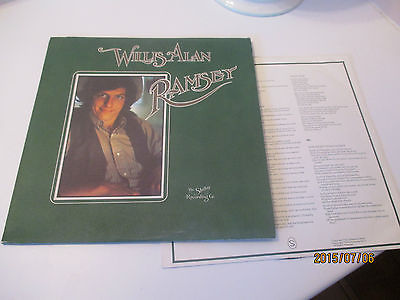
WILLIS ALAN RAMSEY ORIGINAL 1972 SHELTER LP FOLK PSYCH DOWNER ONLY P
$
25


Favourite Auctions
To save auctions to your favourites, please login
If you don't have an account, please register
Description
You are bidding on WILLIS ALAN RAMSEY .
This is on Shelter ( Capitol) SW-8914.
Cover is VG+ ( some light water damage on bottom left corner). It includes the original lyric inner sleeve.
Vinyl is a very glossy VG++ and better with a few very light superficial hairline scratches that do not affect the sound.
Buyer pays $12 shipping to the US , $20 overseas
PLEASE WAIT FOR MY INVOICE AND DO NOT USE THE EBAY CHECKOUT INVOICE AS IT IS INCORRECT.
BIO:
Willis Alan Ramsey (born March 5, 1951) is an American singer/songwriter, a cult legend among fans of Americana and Texas country. He was born in Birmingham, Alabama and raised in Dallas, Texas. Ramsey graduated from Highland Park High School in 1969, and was a prominent baritone in the High School's Lads and Lassies Choir. In his senior year, he played a leading role in the musical Carousel. He released the critically acclaimed album, Willis Alan Ramsey, in 1972 on the Shelter label. The album included "Muskrat Candlelight" which was covered twice as "Muskrat Love," first by America in 1973, then by Captain & Tennille,[1] who scored a #4 hit with the tune.
Windham Hill artist Michael Hedges cited Ramsey as a strong influence on his left-handed tapping techniques. In a radio interview, Hedges claimed he developed the technique listening to Ramsey's album, saying Ramsey had no idea "how I got it from him, so I guess I'm safe."
Owing to conflict with his label, Ramsey left Shelter at the end of his contract. As a result, Ramsey's fans have been waiting more than 40 years for the release of his "mythical second album". When asked where the new album is, he often responds, "What's wrong with the first one?"
In the 1980s, he moved to Great Britain[2] to reconnect with his ancestry and study traditional and modern music narrative. At the same time, he enjoyed a revival in the United States, due in part to numerous artists who cut versions of Ramsey's songs, including Widespread Panic ("Geraldine & The Honey Bee"), Jerry Jeff Walker ("Northeast Texas Women"), Waylon Jennings, Shawn Colvin ("Satin Sheets"), Jimmy Buffett ("The Ballad of Spider John," "Northeast Texas Women"), and Jimmie Dale Gilmore ("Goodbye to Old Missoula").[3] In 1989, he returned to the United States and began performing again. Backed by Champ Hood, multi-instrumentalist (of Uncle Walt's Band fame), Ramsey could often be found on the same bill with another Dallas singer-songwriter, Alison Rogers. The two married in 1991 and continue to perform together. In 1996, Ramsey and Rogers co-wrote Lyle Lovett's hit, "That's Right, You're Not From Texas".
In 2000, Ramsey appeared on Austin City Limits, showcasing his new material and performing his classics. He is currently mixing his new album, "Gentilly",[3] an independent release, financed by old friends and fans mostly from the Dallas and Austin area. Co-produced by Willis, Alison Rogers and Jamie Oldaker, guest musicians include Oldaker (drums, percussion); Sam Bush & Tim O'Brien (mandolin, vocals); Viktor Krauss, Roscoe Beck & Freebo (bass); Bruce Bouton (steel guitar); Mickey Raphael (harmonica); Walt Richmond (piano, organ); Joel Guzman (accordion); Marcia Ball, Tommy Malone, Abra Moore & Alison Rogers (vocals). Ramsey, Rogers, and Everett Moran are engineering.
A note from 1000 RECORDINGS TO HEAR BEFORE YOU DIE:
The One (and Only) Record from a Visionary
This, the lone album by enigmatic Texas singer-songwriter Willis Alan Ramsey, gave the world one of the most poignant songs ever written about Woody Guthrie (the pedal-steel drenched "Boy from Oklahoma") as well as "Muskrat Love," the whimsical hit for the soft-rock group the Captain and Tennille (here titled "Muskrat Candlelight"). That spread tells something about the Alabama-born tune-smith, whose works have been memorably covered by Jimmy Buffett ("The Ballad of Spider John") and Waylon Jennings ("Satin Sheets"). A storyteller with a quick wit and a penchant for catchy melodies, Ramsey helped develop the sound and the sensibility of "progressive" or "alternative" country associated with everyone from Lyle Lovett to Son Volt. And then he went underground.
Recorded quickly for a small label in 1972, Ramsey's debut has acquired mythic status over the years, in part because he's been so stingy with his work. He cowrote a few songs with Lovett in the 1990s, but has yet to release a follow-up. One website claims he moved to the British isles to study Celtic balladry.
The genius of Willis Alan Ramsey lies in his vocals. Ramsey's songs are salt-of-the-earth stuff, with zero pretension—no cornpone wizardry needed. Ramsey sings with a slightly bemused affect, a raconteur who counts on his slight drawl to keep his story at least plausible. This unassuming delivery makes you want to follow Ramsey's characters around and be there when the title character of "Watermelon Man," who's been awaiting the arrival of the sweet fruit for months, gets that first juicy bite.
price rating


