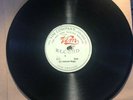
1908 Russian Dealer J H ZIMMERMANN St Petersburg Record Sleeve Advertising
$
25


$ 25
Sold For
May 29, 2024
Sold Date
1
Number Of Bids
USA
Country Of Seller
eBay
Sold at
Favourite Auctions
To save auctions to your favourites, please login
If you don't have an account, please register
Description
A series of great Russian, Ukrainian, Polish, Czech and Yugo-Slav Records from early G&Ts to World War II recordings on 78 rpm Victrola Records
Click this link for more Russian and Slavic Records in my other listings!
Click this link for more great Opera and Vocal Records in my other listings!
Julius Heinrich Zimmermann
Russian Gramophone Dealer Sleeve by one of the major phonograph dealers in Russia, the firm of J. H. Zimmermann.
this sleeve dates around 1908 - 10 with gorgeous Art Nouveau Lettering
and lithographed pictures of a table top (Kabinetnyya shkatulki) and upright gramophone (Salonnye Shkafy)
Translation of cyrillic
Hornless gramophones with hidden wooden resonators
New systems
Inexpensive varieties at 15, 25 and 35 rubles.
Cabinet boxes in 45, 60, 80 and 100 rubles.
Salon Cabinets at 125, 150, 175, 200, 250, 300 rubles. and more expensive
10 Rubles were about $5 in 1910
Julius Heinrich Zimmermann
Morskaya 34
Telefon 13-91
Sankt Petersburg
Moscow - Riga - Nizhny Novgorod Fair
approx 1908 Russian Dealer Record Sleeve 10" by firm of J. H. Zimmermann
Blue print on cream heavy paper stock. Edges reinforced with cloth.
Condition: EXCELLENT only minor signs of use, paper and edges in sound condition.
House of M. K. Calmeyer - Building of the Russian Foreign Trade Bank
1873 - architect. Yakovlev R.
House 34 at the beginning of the 20th century, like houses 30-32, belonged to the Russian Foreign Trade Bank.
In 1873, R. Yakovlev erected a five-story building for the then owner, merchant of the 1st guild Ernest Friedrich Juncker; Since the late 1880s, it was owned by Maria Karlovna Kalmeyer. The house housed the board of directors of the Vladikavkaz Railway. There was a music store and a music factory of the famous Zimmerman company here. In 1902, the company offered pianos and grand pianos, string and wind instruments, as well as harmonicas and even gramophones and phonographs.
In 1903, the house had several owners with the names Kalmeyer, Grunwald and others. Apparently, these are the heirs of Maria Karlovna.
In the pre-revolutionary years, the building belonged to the Russian Bank for Foreign Trade, which owned two more houses on the left along the street.
Julius (Julius) Heinrich Zimmermann ( German: Julius Heinrich Zimmermann ; September 22, 1851, Sternberg - April 23, 1923, Berlin ) was a manufacturer of musical instruments and music publisher of German origin, who worked for a long time in the Russian Empire .
Period in Russia
Born into an old family of German piano makers (according to other sources, into the family of a tannery owner [1] ). After studying banking in Berlin, he moved to St. Petersburg in 1876 , where he opened a store and music publishing house. Zimmerman soon became widely known as one of the best suppliers of musical instruments, and his company opened branches in Moscow (1882), London (1897), Riga (1903 or 1905 [1] ) and Leipzig (1886, since 1929 it became independent) , where the production of stringed, wooden, brass and plucked instruments of its own brand “JHZ” began. Masters invited from Markneukirchen worked in Zimmermann's workshops , in particular brass instrument master Joseph Schimmer. In 1883, he opened a musical instrument factory in St. Petersburg, where, in particular, violins , mandolins , zithers , flutes , clarinets and cornets were produced [2] . Zimmerman's store was located in Moscow on Kuznetsky Most in the house of Torletsky - Zakharyin , in St. Petersburg - on Bolshaya Morskaya , 34-40 [1] .
Zimmerman was a representative of the companies Blüthner (St. Petersburg and Moscow), Schröder (Moscow and Leipzig), Steinway and Sons (St. Petersburg and Moscow) and others [1] .
For his services to the Russian Empire, Julius Zimmermann was awarded the Order of St. Stanislaus (1901) and declared the exclusive supplier of musical instruments for the Russian army [2] .
Period in Germany
In 1886, Zimmermann returned to Germany and moved the center of his enterprise to Leipzig , which included the music publishing house. Since 1893, the company was regularly represented at international exhibitions, where it repeatedly won gold medals for musical instruments of its own production.
In 1900, the German company passed into his hands. Adler-Musikwerke in Leipzig. In 1904, Zimmermann acquired the piano factory of Gustav Fiedler, where he continued the production of keyboard instruments under this name, as well as under his own name “Jul. Heinr. Zimmermann." The factory also produced various mechanical music boxes and "Fortuna" machines, and the "orgophone" and "cantophone" models became patented inventions.
By the end of the 19th century, the music publishing house Zimmermann was already releasing sheet music in millions of copies in Europe and America (in the USA - together with the English company G. Schirmer in New York ). Zimmerman published sheet music by composers Balakirev , S. Lyapunov , P. Yuon , Sarasate , L. Spohr , K. Reinecke , E. Köhler , F. Büchner , I. Andersen , E. Prill , W. Popp , K. Venus , V. N. Tsybin , A. Tershak , S. Yadasson , A. Lvov , V. Vasilevsky, N. Artemyev, N. Potapov, etc.; schools of playing various instruments, fingerings for playing wind instruments, catalogs of musical literature.
After 1914
In 1914, after the outbreak of the First World War, the company in Russia was declared an “enemy property”. During the German pogroms in May 1915, one of the largest Zimmerman musical instrument stores in Moscow on Kuznetsky Most was attacked by an angry crowd: pianos were thrown from the fourth floor of the building [3] . In 1919 the company was nationalized. On the basis of the wind instrument factory, the Leningrad Wind Instruments Factory [4] (now the St. Petersburg Wind Musical Instruments Factory) was created.
In 1919, Zimmermann opened a new branch of the workshop in Markneukirchen . Until 1936, balalaikas were mainly produced there , by master Paul Fischer, who then founded his own workshop.
In 1922, Julius Zimmermann transferred all the affairs to his sons - Wilhelm (1891-1946) and August (1877-1952). Died at the age of 70 [2] . In 1928 the company was divided, part of the company for the production of musical instruments (including the workshop in Markneukirchen) went to August Zimmermann; existed until 1936. The music publishing went to Wilhelm Zimmermann, who later became the publisher of Nikolai Medtner . The music publishing house Zimmermann is still one of the largest in the world; the central office of the publishing house is located in Frankfurt am Main .
price rating