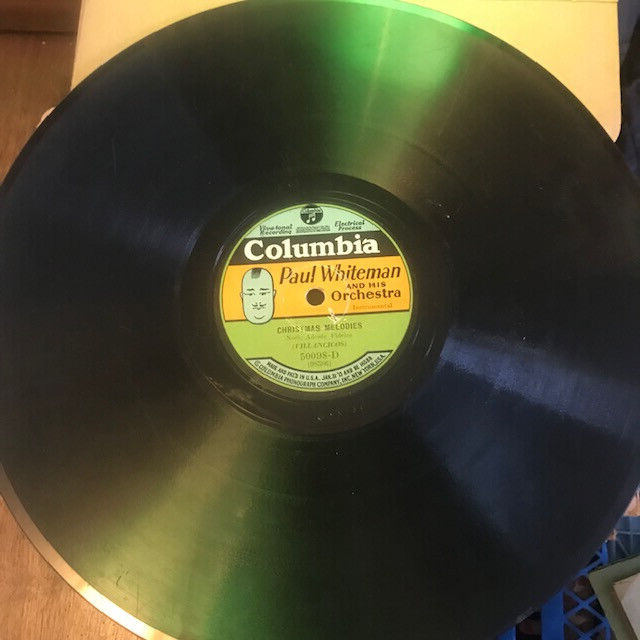
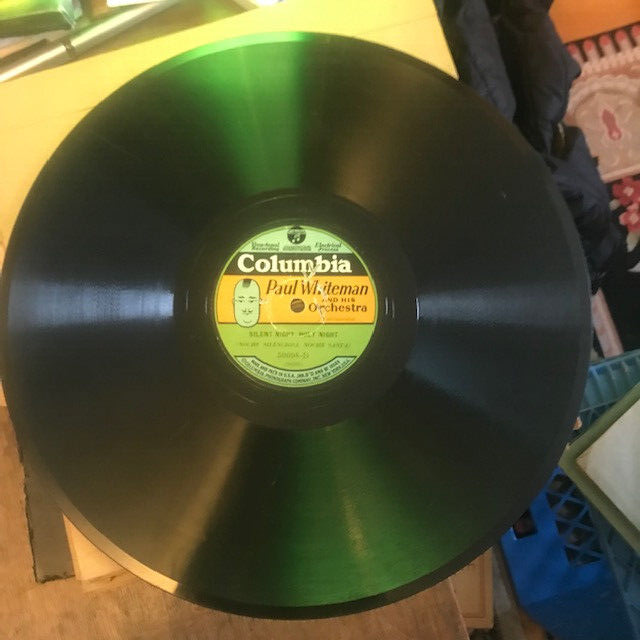
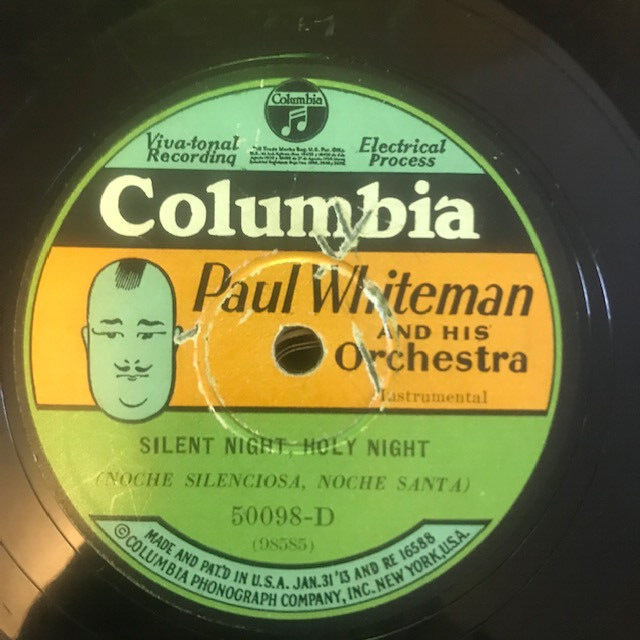
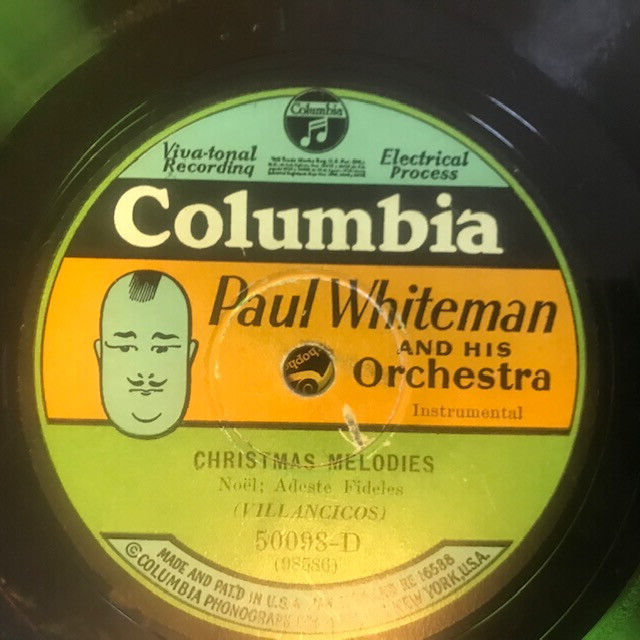
RARE Potato head paul whiteman 78 12 in CHRISTMAS
$
24

Favourite Auctions
To save auctions to your favourites, please login
If you don't have an account, please register
Description
PAUL WHITEMAN POTATO HEAD COLUMBIA 50098 Silent night / Christmas Melodies V+ at least
WIKIPEDIA:
Usage of terminology is not uniform across the English-speaking world (see below). In more modern usage, the playback device is often called a "turntable", "record player", or "record changer", although each of these terms denote categorically distinct items. When used in conjunction with a mixer as part of a DJ setup, turntables are often colloquially called "decks".[5] In later electric phonographs (more often known since the 1940s as record players or turntables), the motions of the stylus are converted into an analogous electrical signal by a transducer, then converted back into sound by a loudspeaker.[6]
Close up of the mechanism of an Edison Amberola, circa 1915The term phonograph ("sound writing") was derived from the Greek words φωνή (phonē, 'sound' or 'voice') and γραφή (graphē, 'writing'). The similar related terms gramophone (from the Greek γράμμα gramma 'letter' and φωνή phōnē 'voice') and graphophone have similar root meanings.[7]
In British English, "gramophone" may refer to any sound-reproducing machine using disc records, which were introduced and popularized in the UK by the Gramophone Company. Originally, "gramophone" was a proprietary trademark of that company and any use of the name by competing makers of disc records was vigorously prosecuted in the courts, but in 1910 an English court decision decreed that it had become a generic term;[8]
United States
Early phonograph at Deaf Smith County Historical Museum in Hereford, TexasIn American English, "phonograph", properly specific to machines made by Edison, was sometimes used in a generic sense as early as the 1890s to include cylinder-playing machines made by others. But it was then considered strictly incorrect to apply it to Emile Berliner's upstart Gramophone, a very different machine which played nonrecordable discs (although Edison's original Phonograph patent included the use of discs.[9])
Australia
Wood engraving published in The Illustrated Australian News, depicting a public demonstration of new technology at the Royal Society of Victoria (Melbourne, Australia) on 8 August 1878.In Australian English, "record player" was the term; "turntable" was a more technical term; "gramophone" was restricted to the old mechanical (i.e., wind-up) players; and "phonograph" was used as in British English. The "phonograph" was first demonstrated in Australia on 14 June 1878 to a meeting of the Royal Society of Victoria by the Society's Honorary Secretary, Alex Sutherland who published "The Sounds of the Consonants, as Indicated by the Phonograph" in the Society's journal in November that year.[10] On 8 August 1878 the phonograph was publicly demonstrated at the Society's annual conversazione, along with a range of other new inventions, including the microphone.[11]
Early history
Dictionary illustration of a phonautograph. This version uses a barrel made of plaster of Paris.Phonautograph
Main article: PhonautographThe phonautograph was invented on March 25, 1857 by Frenchman Édouard-Léon Scott de Martinville,[12] an editor and typographer of manuscripts at a scientific publishing house in Paris.[13] One day while editing Professor Longet's Traité de Physiologie, he happened upon that customer’s engraved illustration of the anatomy of the human ear, and conceived of "the imprudent idea of photographing the word." In 1853 or 1854 (Scott cited both years) he began working on "le problème de la parole s'écrivant elle-même" ("the problem of speech writing itself"), aiming to build a device that could replicate the function of the human ear.[13][14]
Scott coated a plate of glass with a thin layer of lampblack. He then took an acoustic trumpet, and at its tapered end affixed a thin membrane that served as the analog to the eardrum. At the center of that membrane, he attached a rigid boar's bristle approximately a centimeter long, placed so that it just grazed the lampblack. As the glass plate was slid horizontally in a well formed groove at a speed of one meter per second, a person would speak into the trumpet, causing the membrane to vibrate and the stylus to trace figures[13] that were scratched into the lampblack.[15] On March 25, 1857, Scott received the French patent[16] #17,897/31,470 for his device, which he called a phonautograph.[17] The earliest known surviving recorded sound of a human voice was conducted on April 9, 1860 when Scott recorded[15] someone singing the song "Au Clair de la Lune" ("By the Light of the Moon") on the device.[18] However, the device was not designed to play back sounds,[15][19] as Scott intended for people to read back the tracings,[20] which he called phonautograms.[14] This was not the first time someone had used a device to create direct tracings of the vibrations of sound-producing objects, as tuning forks had been used in this way by English physicist Thomas Young in 1807.[21] By late 1857, with support from the Société d'encouragement pour l'industrie nationale, Scott’s phonautograph was recording sounds with sufficient precision to be adopted by the scientific community, paving the way for the nascent science of acoustics.[14]
The device’s true significance in the history of recorded sound was not fully realized prior to March 2008, when it was discovered and resurrected in a Paris patent office by First Sounds, an informal collaborative of American audio historians, recording engineers, and sound archivists founded to make the earliest sound recordings available to the public. The phonautograms were then digitally converted by scientists at the Lawrence Berkeley National Laboratory in California, who were able to play back the recorded sounds, something Scott had never conceived of. Prior to this point, the earliest known record of a human voice was thought to be an 1877 phonograph recording by Thomas Edison.[15][22] The phonautograph would play a role in the development of the gramophone, whose inventor, Emile Berliner, worked with the phonautograph in the course of developing his own device.[23]
Paleophone
Charles Cros, a French poet and amateur scientist, is the first person known to have made the conceptual leap from recording sound as a traced line to the theoretical possibility of reproducing the sound from the tracing and then to devising a definite method for accomplishing the reproduction. On April 30, 1877, he deposited a sealed envelope containing a summary of his ideas with the French Academy of Sciences, a standard procedure used by scientists and inventors to establish priority of conception of unpublished ideas in the event of any later dispute.[24]
An account of his invention was published on October 10, 1877, by which date Cros had devised a more direct procedure: the recording stylus could scribe its tracing through a thin coating of acid-resistant material on a metal surface and the surface could then be etched in an acid bath, producing the desired groove without the complication of an intermediate photographic procedure.[25] The author of this article called the device a phonographe, but Cros himself favored the word paleophone, sometimes rendered in French as voix du passé ('voice of the past').[citation needed]
Cros was a poet of meager means, not in a position to pay a machinist to build a working model, and largely content to bequeath his ideas to the public domain free of charge and let others reduce them to practice, but after the earliest reports of Edison's presumably independent invention crossed the Atlantic he had his sealed letter of April 30 opened and read at the December 3, 1877 meeting of the French Academy of Sciences, claiming due scientific credit for priority of conception.[26]
Throughout the first decade (1890–1900) of commercial production of the earliest crude disc records, the direct acid-etch method first invented by Cros was used to create the metal master discs, but Cros was not around to claim any credit or to witness the humble beginnings of the eventually rich phonographic library he had foreseen. He had died in 1888 at the age of 45.[27]
The early phonographs
Patent drawing for Edison's phonograph, May 18, 1880Thomas Edison conceived the principle of recording and reproducing sound between May and July 1877 as a byproduct of his efforts to "play back" recorded telegraph messages and to automate speech sounds for transmission by telephone.[28] His first experiments were with waxed paper.[29] He announced his invention of the first phonograph, a device for recording and replaying sound, on November 21, 1877 (early reports appear in Scientific American and several newspapers in the beginning of November, and an even earlier announcement of Edison working on a 'talking-machine' can be found in the Chicago Daily Tribune on May 9), and he demonstrated the device for the first time on November 29 (it was patented on February 19, 1878, as US Patent 200,521). "In December, 1877, a young man came into the office of the Scientific American, and placed before the editors a small, simple machine about which very few preliminary remarks were offered. The visitor without any ceremony whatever turned the crank, and to the astonishment of all present the machine said: 'Good morning. How do you do? How do you like the phonograph?' The machine thus spoke for itself, and made known the fact that it was the phonograph..."[30]
The music critic Herman Klein attended an early demonstration (1881–2) of a similar machine. On the early phonograph's reproductive capabilities he writes "It sounded to my ear like someone singing about half a mile away, or talking at the other end of a big hall; but the effect was rather pleasant, save for a peculiar nasal quality wholly due to the mechanism, though there was little of the scratching which later was a prominent feature of the flat disc. Recording for that primitive machine was a comparatively simple matter. I had to keep my mouth about six inches away from the horn and remember not to make my voice too loud if I wanted anything approximating to a clear reproduction; that was all. When it was played over to me and I heard my own voice for the first time, one or two friends who were present said that it sounded rather like mine; others declared that they would never have recognised it. I daresay both opinions were correct."[31]
The Argus newspaper from Melbourne, Australia, reported on an 1878 demonstration at the Royal Society of Victoria, writing "There was a large attendance of ladies and gentlemen, who appeared greatly interested in the various scientific instruments exhibited. Among these the most interesting, perhaps, was the trial made by Mr. Sutherland with the phonograph, which was most amusing. Several trials were made, and were all more or less successful. "Rule Britannia" was distinctly repeated, but great laughter was caused by the repetition of the convivial song of "He's a jolly good fellow," which sounded as if it was being sung by an old man of 80 with a very cracked voice."[32]
Early machines
Phonograph cabinet built with Edison cement, 1912. The clockwork portion of the phonograph is concealed in the base beneath the statue; the amplifying horn is the shell behind the human figure.Edison's early phonographs recorded onto a thin sheet of metal, normally tinfoil, which was temporarily wrapped around a helically grooved cylinder mounted on a correspondingly threaded rod supported by plain and threaded bearings. While the cylinder was rotated and slowly progressed along its axis, the airborne sound vibrated a diaphragm connected to a stylus that indented the foil into the cylinder's groove, thereby recording the vibrations as "hill-and-dale" variations of the depth of the indentation.[33]
Introduction of the disc record
"I Am The Edison Phonograph" 2:24 This 1906 recording (with the character being voiced by Len Spencer) enticed store customers with the wonders of the invention.2 minutes, 23 seconds. Problems playing this file? See media help.
By 1890, record manufacturers had begun using a rudimentary duplication process to mass-produce their product. While the live performers recorded the master phonograph, up to ten tubes led to blank cylinders in other phonographs. Until this development, each record had to be custom-made. Before long, a more advanced pantograph-based process made it possible to simultaneously produce 90–150 copies of each record. However, as demand for certain records grew, popular artists still needed to re-record and re-re-record their songs. Reportedly, the medium's first major African-American star George Washington Johnson was obliged to perform his "The Laughing Song" (or the separate "The Whistling Coon")[34] literally thousands of times in a studio during his recording career. Sometimes he would sing "The Laughing Song" more than fifty times in a day, at twenty cents per rendition. (The average price of a single cylinder in the mid-1890s was about fifty cents.)[citation needed]
Oldest surviving recordings
Lambert's lead cylinder recording for an experimental talking clock is often identified as the oldest surviving playable sound recording,[35] although the evidence advanced for its early date is controversial.[36] Wax phonograph cylinder recordings of Handel's choral music made on June 29, 1888, at The Crystal Palace in London were thought to be the oldest-known surviving musical recordings,[37] until the recent playback by a group of American historians of a phonautograph recording of Au clair de la lune made on April 9, 1860.[38]
The 1860 phonautogram had not until then been played, as it was only a transcription of sound waves into graphic form on paper for visual study. Recently developed optical scanning and image processing techniques have given new life to early recordings by making it possible to play unusually delicate or physically unplayable media without physical contact.[39]
A recording made on a sheet of tinfoil at an 1878 demonstration of Edison's phonograph in St. Louis, Missouri has been played back by optical scanning and digital analysis. A few other early tinfoil recordings are known to survive, including a slightly earlier one which is believed to preserve the voice of U.S. President Rutherford B. Hayes, but as of May 2014 they have not yet been scanned.[clarification needed] These antique tinfoil recordings, which have typically been stored folded, are too fragile to be played back with a stylus without seriously damaging them. Edison's 1877 tinfoil recording of Mary Had a Little Lamb, not preserved, has been called the first instance of recorded verse.[40]
On the occasion of the 50th anniversary of the phonograph, Edison recounted reciting Mary Had a Little Lamb to test his first machine. The 1927 event was filmed by an early sound-on-film newsreel camera, and an audio clip from that film's soundtrack is sometimes mistakenly presented as the original 1877 recording.[41] Wax cylinder recordings made by 19th century media legends such as P. T. Barnum and Shakespearean actor Edwin Booth are amongst the earliest verified recordings by the famous that have survived to the present.[42][43]
Improvements at the Volta Laboratory
Main article: Volta Laboratory and Bureau § Sound recording and phonograph developmentAlexander Graham Bell and his two associates took Edison's tinfoil phonograph and modified it considerably to make it reproduce sound from wax instead of tinfoil. They began their work at Bell's Volta Laboratory in Washington, D. C., in 1879, and continued until they were granted basic patents in 1886 for recording in wax.[44]
Although Edison had invented the phonograph in 1877, the fame bestowed on him for this invention was not due to its efficiency. Recording with his tinfoil phonograph was too difficult to be practical, as the tinfoil tore easily, and even when the stylus was properly adjusted, its reproduction of sound was distorted, and good for only a few playbacks; nevertheless Edison had discovered the idea of sound recording. However immediately after his discovery he did not improve it, allegedly because of an agreement to spend the next five years developing the New York City electric light and power system.[44]
Volta's early challenge
Meanwhile, Bell, a scientist and experimenter at heart, was looking for new worlds to conquer after having patented the telephone. According to Sumner Tainter, it was through Gardiner Green Hubbard that Bell took up the phonograph challenge. Bell had married Hubbard's daughter Mabel in 1879 while Hubbard was president of the Edison Speaking Phonograph Co., and his organization, which had purchased the Edison patent, was financially troubled because people did not want to buy a machine which seldom worked well and proved difficult for the average person to operate.[44]
Volta Graphophone
See also: Graphophone A 'G' (Graham Bell) model Graphophone being played back by a typist after its cylinder had recorded dictation.The sound vibrations had been indented in the wax which had been applied to the Edison phonograph. The following was the text of one of their recordings: "There are more things in heaven and earth, Horatio, than are dreamed of in your philosophy. I am a Graphophone and my mother was a phonograph."[45] Most of the disc machines designed at the Volta Lab had their disc mounted on vertical turntables. The explanation is that in the early experiments, the turntable, with disc, was mounted on the shop lathe, along with the recording and reproducing heads. Later, when the complete models were built, most of them featured vertical turntables.[44]
One interesting exception was a horizontal seven inch turntable. The machine, although made in 1886, was a duplicate of one made earlier but taken to Europe by Chichester Bell. Tainter was granted U.S. Patent 385,886 on July 10, 1888. The playing arm is rigid, except for a pivoted vertical motion of 90 degrees to allow removal of the record or a return to starting position. While recording or playing, the record not only rotated, but moved laterally under the stylus, which thus described a spiral, recording 150 grooves to the inch.[44]
The basic distinction between the Edison's first phonograph patent and the Bell and Tainter patent of 1886 was the method of recording. Edison's method was to indent the sound waves on a piece of tin foil, while Bell and Tainter's invention called for cutting, or "engraving", the sound waves into a wax record with a sharp recording stylus.[44]
Graphophone commercialization
A later-model Columbia Graphophone of 1901 3:52 Edison-Phonograph playing: Iola by the Edison Military Band (video, 3 min 51 s)In 1885, when the Volta Associates were sure that they had a number of practical inventions, they filed patent applications and began to seek out investors. The Volta Graphophone Company of Alexandria, Virginia, was created on January 6, 1886, and incorporated on February 3, 1886. It was formed to control the patents and to handle the commercial development of their sound recording and reproduction inventions, one of which became the first Dictaphone.[44]
After the Volta Associates gave several demonstrations in the City of Washington, businessmen from Philadelphia created the American Graphophone Company on March 28, 1887, in order to produce and sell the machines for the budding phonograph marketplace.[46] The Volta Graphophone Company then merged with American Graphophone,[46] which itself later evolved into Columbia Records.[47][48]
A coin-operated version of the Graphophone, U.S. Patent 506,348, was developed by Tainter in 1893 to compete with nickel-in-the-slot entertainment phonograph U.S. Patent 428,750 demonstrated in 1889 by Louis T. Glass, manager of the Pacific Phonograph Company.[49]
The work of the Volta Associates laid the foundation for the successful use of dictating machines in business, because their wax recording process was practical and their machines were durable. But it would take several more years and the renewed efforts of Edison and the further improvements of Emile Berliner and many others, before the recording industry became a major factor in home entertainment.[44]
Disc vs. cylinder as a recording medium
Discs (that aren't re-recordable) are not inherently better than cylinders at providing audio fidelity. Rather, the advantages of the format are seen in the manufacturing process: discs can be stamped, and the matrixes to stamp disc can be shipped to other printing plants for a global distribution of recordings; cylinders could not be stamped until 1901–1902, when the gold moulding process was introduced by Edison.[50]
A Victor V phonograph, circa 1907Through experimentation, in 1892 Berliner began commercial production of his disc records, and "gramophones". His "gramophone record" was the first disc record to be offered to the public. They were five inches (12.7 cm) in diameter and recorded on one side only. Seven-inch (17.5 cm) records followed in 1895. Also in 1895 Berliner replaced the hard rubber used to make the discs with a shellac compound.[51] Berliner's early records had very poor sound quality, however. Work by Eldridge R. Johnson eventually improved the sound fidelity to a point where it was as good as the cylinder.[52]
Dominance of the disc record
A 1930s portable wind-up gramophone from EMI (His Master's Voice)In the 1930s, vinyl (originally known as vinylite) was introduced as a record material for radio transcription discs, and for radio commercials. At that time, virtually no discs for home use were made from this material. Vinyl was used for the popular 78-rpm V-discs issued to US soldiers during World War II. This significantly reduced breakage during transport. The first commercial vinylite record was the set of five 12" discs "Prince Igor" (Asch Records album S-800, dubbed from Soviet masters in 1945). Victor began selling some home-use vinyl 78s in late 1945; but most 78s were made of a shellac compound until the 78-rpm format was completely phased out. (Shellac records were heavier and more brittle.) 33s and 45s were, however, made exclusively of vinyl, with the exception of some 45s manufactured out of polystyrene.[53]
First all-transistor phonograph
Philco all-transistor model TPA-1 phonograph, developed and produced in 1955 Philco all-transistor model TPA-1 phonograph – Radio and Television News magazine, issue October 1955In 1955, Philco developed and produced the world's first all-transistor phonograph models TPA-1 and TPA-2, which were announced in the June 28, 1955 edition of the Wall Street Journal.[54] Philco started to sell these all-transistor phonographs in the fall of 1955, for the price of $59.95. The October 1955 issue of Radio & Television News magazine (page 41), had a full page detailed article on Philco's new consumer product. The all-transistor portable phonograph TPA-1 and TPA-2 models played only 45rpm records and used four 1.5 volt "D" batteries for their power supply. The "TPA" stands for "Transistor Phonograph Amplifier". Their circuitry used three Philco germanium PNP alloy-fused junction audio frequency transistors. After the 1956 season had ended, Philco decided to discontinue both models, for transistors were too expensive compared to vacuum tubes,[55][56] but by 1961 a $49.95 ($452.94 in 2020) portable, battery-powered radio-phonograph with seven transistors was available.[57]
First direct-drive turntable
The first direct-drive turntable was invented by Shuichi Obata, an engineer at Matsushita (now Panasonic).[58] In 1969, Matsushita released it as the SP-10.[59] the first direct-drive turntable on the market.[60]
A Technics SL-1200 turntableThe most influential turntable was the Technics SL-1200.[61] Since then, turntablism spread widely in hip hop culture, and the SL-1200 remained the most widely used turntable in DJ culture for the next several decades.[61]
Arm systems
Linear tracking
Early developments in linear turntables were from Rek-O-Kut (portable lathe/phonograph) and Ortho-Sonic in the 1950s, and Acoustical in the early 1960s. These were eclipsed by more successful implementations of the concept from the late 1960s through the early 1980s.[62]
Pickup systems
Typical magnetic cartridgeAdditionally, cartridges may contain styli or needles that can be separated according to their tip: Spherical styli, and elliptical styli. Spherical styli have their tip shaped like one half of a sphere, and elliptical styli have their tip shaped like one end of an ellipse. Spherical styli preserve more of the groove of the record than elliptical styli, while elliptical styli offer higher sound quality.[63]
Optical readout
A few specialist laser turntables read the groove optically using a laser pickup. Since there is no physical contact with the record, no wear is incurred. However, this "no wear" advantage is debatable, since vinyl records have been tested to withstand even 1200 plays with no significant audio degradation, provided that it is played with a high quality cartridge and that the surfaces are clean.[64]
An alternative approach is to take a high-resolution photograph or scan of each side of the record and interpret the image of the grooves using computer software. An amateur attempt using a flatbed scanner lacked satisfactory fidelity.[65] A professional system employed by the Library of Congress produces excellent quality.[66]
Stylus
Stylus for jukebox using shellac 78 rpm records, 1940sA development in stylus form came about by the attention to the CD-4 quadraphonic sound modulation process, which requires up to 50 kHz frequency response, with cartridges like Technics EPC-100CMK4 capable of playback on frequencies up to 100 kHz. This requires a stylus with a narrow side radius, such as 5 µm (or 0.2 mil). A narrow-profile elliptical stylus is able to read the higher frequencies (greater than 20 kHz), but at an increased wear, since the contact surface is narrower. For overcoming this problem, the Shibata stylus was invented around 1972 in Japan by Norio Shibata of JVC.[67]
The Shibata-designed stylus offers a greater contact surface with the groove, which in turn means less pressure over the vinyl surface and thus less wear. A positive side effect is that the greater contact surface also means the stylus will read sections of the vinyl that were not touched (or "worn") by the common spherical stylus. In a demonstration by JVC[68] records "worn" after 500 plays at a relatively very high 4.5 gf tracking force with a spherical stylus, played "as new" with the Shibata profile.[citation needed]
Other advanced stylus shapes appeared following the same goal of increasing contact surface, improving on the Shibata. Chronologically: "Hughes" Shibata variant (1975),[69] "Ogura" (1978),[70] Van den Hul (1982).[71] Such a stylus may be marketed as "Hyperelliptical" (Shure), "Alliptic", "Fine Line" (Ortofon), "Line contact" (Audio Technica), "Polyhedron", "LAC", or "Stereohedron" (Stanton).[72]
A keel-shaped diamond stylus appeared as a byproduct of the invention of the CED Videodisc. This, together with laser-diamond-cutting technologies, made possible the "ridge" shaped stylus, such as the Namiki (1985)[73] design, and Fritz Gyger (1989)[74] design. This type of stylus is marketed as "MicroLine" (Audio technica), "Micro-Ridge" (Shure), or "Replicant" (Ortofon).[72]
Record materials
To address the problem of steel needle wear upon records, which resulted in the cracking of the latter, RCA Victor devised unbreakable records in 1930, by mixing polyvinyl chloride with plasticisers, in a proprietary formula they called Victrolac, which was first used in 1931, in motion picture discs.[75]
Whiteman was born in Denver, Colorado.[2] He came from a musical family: his father, Wilburforce James Whiteman[8] was the supervisor of music for the Denver Public Schools, a position he held for fifty years,[9] and his mother Elfrida (née Dallison) was a former opera singer. His father insisted that Paul learn an instrument, preferably the violin, but the young man chose the viola.[10] According to Chris Popa, Whiteman was Protestant and of Scottish, Irish, English, and Dutch ancestry.[11]
Career
Whiteman's skill at the viola resulted in a place in the Denver Symphony Orchestra by 1907, joining the San Francisco Symphony in 1914. In 1918, Whiteman conducted a 12-piece U.S. Navy band, the Mare Island Naval Training Camp Symphony Orchestra (NTCSO).[12] After World War I, he formed the Paul Whiteman Orchestra.[13]
That year he led a popular dance band in the city. In 1920, he moved with his band to New York City where they began recording for the Victor Talking Machine Company.[2] The popularity of these records led to national fame. In his first five recordings sessions for Victor, August 9 – October 28, 1920, he used the name "Paul Whiteman and His Ambassador Orchestra", presumably because he had been playing at the Ambassador Hotel in Atlantic City. From November 3, 1920, he started using "Paul Whiteman and His Orchestra."[14]
Whiteman became the most popular band director of that decade. In a time when most dance bands consisted of six to ten men, Whiteman directed a more imposing group that numbered as many as 35 musicians. By 1922, Whiteman already controlled some 28 ensembles on the East Coast and was earning over $1,000,000 a year.[15]
In 1926, Paul Whiteman was on tour in Vienna, Austria when he met and was interviewed by a young ambitious newspaper reporter named Billy Wilder who was also a fan of Whiteman's band.[16] Whiteman liked young Wilder enough, that he took him with the band to Berlin where Wilder was able to make more connections in the entertainment field, leading him to become a screenwriter and director, eventually ending up in Hollywood.
In 1927, the Whiteman orchestra backed Hoagy Carmichael singing and playing on a recording of "Washboard Blues".[17] Whiteman signed with Columbia Records in May 1928, leaving the label in September 1930 when he refused a pay cut. He returned to RCA Victor between September 1931 and March 1937.
"The King of Jazz" 2:12 Paul Whiteman in Scheveningen, the Netherlands (1926)In the 1920s the media referred to Whiteman as "The King of Jazz".[18] Whiteman emphasized the way he approached the well-established style of jazz music, while also organizing its composition and style in his own fashion.[2]
While most jazz musicians and fans consider improvisation to be essential to the musical style, Whiteman thought the genre could be improved by orchestrating the best of it, with formal written arrangements.[2] Eddie Condon criticized him for trying to "make a lady" out of jazz.[4] Whiteman's recordings were popular critically and commercially, and his style of jazz was often the first jazz of any form that many Americans heard during the era. Whiteman wrote more than 3000 arrangements.[19]
For more than 30 years Whiteman, referred to as "Pops", sought and encouraged promising musicians, vocalists, composers, arrangers, and entertainers. In 1924 he commissioned George Gershwin's Rhapsody in Blue, which was premiered by his orchestra with the composer at the piano.[2] Another familiar piece in Whiteman's repertoire was Grand Canyon Suite by Ferde Grofé.
Whiteman hired many of the best jazz musicians for his band, including Bix Beiderbecke, Frankie Trumbauer, Joe Venuti, Eddie Lang, Steve Brown, Mike Pingitore, Gussie Mueller, Wilbur Hall (billed by Whiteman as "Willie Hall"), Jack Teagarden, and Bunny Berigan.[2] He encouraged upcoming African American musical talents and planned to hire black musicians, but his management persuaded him that doing so would destroy his career due to racial tension and America's segregation of that time.[5]
The members of Whiteman's Orchestra in 1930He provided music for six Broadway shows and produced more than 600 phonograph recordings.[19] His recording of José Padilla's "Valencia" topped the charts for 11 weeks, beginning March 30, 1926, becoming the No. 1 record of 1926.[20]
Red McKenzie, leader of the Mound City Blue Blowers, and cabaret singer Ramona Davies (billed as "Ramona and her Grand Piano") joined the Whiteman group in 1932. The King's Jesters were with Paul Whiteman in 1931. In 1933, Whiteman had a No. 2 hit on the Billboard charts with Ann Ronell's "Willow Weep for Me".[21]
In 1942, Whiteman began recording for Capitol Records, co-founded by songwriters Buddy DeSylva and Johnny Mercer and music store owner Glenn Wallichs. Whiteman and His Orchestra's recordings of "I Found a New Baby" and "The General Jumped at Dawn" was the label's first single release.[22] Another notable Capitol record he made is the 1942 "Trav'lin Light" featuring Billie Holiday (billed as "Lady Day", due to her being under contract with another label).[22]
Movie appearances A frame from the trailer for the film Rhapsody in Blue (1945)Whiteman appeared as himself in the 1945 movie Rhapsody in Blue on the life and career of George Gershwin,[2] and also appeared in The Fabulous Dorseys in 1947, a bio-pic starring Jimmy Dorsey and Tommy Dorsey. Whiteman also appeared as the baby in Nertz (1929), the bandleader in Thanks a Million (1935),[2] as himself in Strike Up the Band (1940),[2] in the Paramount Pictures short The Lambertville Story (1949), and the revue musical King of Jazz (1930).[2]
Radio and TVAlthough giving priority to stage appearances during his peak years in the 1920s, Whiteman participated in some early prestigious radio programs. On January 4, 1928, Whiteman and his troupe starred in a nationwide NBC radio broadcast sponsored by Dodge Brothers Automobile Co. and known as The Victory Hour (The program introduced the new Dodge "Victory Six" automobile). It was the most widespread hookup ever attempted at that time. Will Rogers acted as MC and joined the program from the West Coast, with Al Jolson coming in from New Orleans.[23] Variety was not impressed, saying: "As with practically all of the important and high-priced commercial broadcasting programs under N.B.C. auspices in the past, the Dodge Brothers' Victory Hour at a reputed cost of $67,000 was disappointing and not commensurate in impression with the financial outlay." However, the magazine noted. "...The reaction to Paul Whiteman's grand radio plug for "Among My Souvenirs"…was a flock of orders by wire from dealers the day following the Dodge Brothers Victory Hour broadcast."[24]
Dodge Brothers must have been satisfied with the results of the broadcast because on March 29, 1928, Whiteman took part in a second Dodge Brothers radio show over the NBC network, which was entitled Film Star Radio Hour.[25] Charlie Chaplin, Douglas Fairbanks, John Barrymore, and several other Hollywood stars were featured. United Artists Pictures arranged for additional loudspeakers to be installed in their theatres so that audiences could hear the stars they had only seen in silent pictures previously. The New York Herald Tribune commented: "...Of Mr. Paul Whiteman's share in the pretentious program, only the best can be said. Mr. Whiteman's orchestra is seldom heard on the radio, and its infrequent broadcasts are the subject of major jubilations, despite the presence of tenors and vocal harmonists in most of the Whiteman renditions."[26]
In 1929, Whiteman agreed to take part in a weekly radio show for Old Gold Cigarettes for which he was paid $5,000 per broadcast. Old Gold Presents Paul Whiteman and His Orchestra was an hour-long show on Tuesday nights over CBS from station WABC in New York. The Whiteman Hour had its first broadcast on February 5, 1929, and continued until May 6, 1930. On May 7, 1930, he was paid $325,000 for 65 radio episodes.[27]
Whiteman then became far busier in radio. His shows were:
- January 27, 1931 – July 1, 1932, Blue Network. 30m, Tuesdays at 8, then Fridays at 10. Allied Paints (1931), Pontiac (1932).
- July 8, 1932 – March 27, 1933, NBC. 30m, Fridays at 10, then Mondays at 9:30. Pontiac (to September), then Buick.
- June 26, 1933 – December 26, 1935. NBC. 60m, Thursdays at 10. The Kraft Music Hall, often with Al Jolson.
- January 5 – December 27, 1936, Blue Network. 45m. Sundays variously at 9, 9:15, and 9:45. Paul Whiteman's Musical Varieties. Woodbury Soap. With Bob Lawrence, Johnny Hauser, Morton Downey, Durelle Alexander, songs by the King's Men, and announcer Roy Bargy. The show featured a children's amateur contest. Near the end of the run Whiteman introduced comedian Judy Canova, who inherited timeslot and sponsor in the Woodbury Rippling Rhythm Revue.
- December 31, 1937 – December 20, 1939, CBS. 30m. Fridays at 8:30 until mid–July 1938, then Wednesdays at 8:30. Chesterfield Time, with Joan Edwards, Deems Taylor (musical commentary) and announcer Paul Douglas. Whiteman took over the slot vacated by Hal Kemp and two years later vacated it for the sensational new Glenn Miller orchestra.
- November 9 – December 28, 1939, Mutual. 30m, Thursdays at 9:30.
- June 6 – August 29, 1943, NBC. 30m, Sundays at 8. Paul Whiteman Presents. Summer substitute for Edgar Bergen. Chase and Sanborn.
- December 5, 1943 – April 28, 1946, Blue/ABC. 60m. Sundays at 6. Paul Whiteman's Radio Hall of Fame. Philco.
- September 5 – November 14, 1944, Blue Network, 30m, Tuesdays at 11:30. Music of current American composers.
- January 21 – September 23, 1946, ABC. 30m, Mondays at 9:30. Forever Tops. "a weekly program featuring the top tunes of the day."[28]
- September 29 – October 27, 1946, ABC. 60m, Sundays at 8. The Paul Whiteman Hour. Extended until November 17, 1947, as a 30m show, The Paul Whiteman Program, various days and times.
- June 30, 1947 – June 25, 1948, ABC. 60m, five a week at 3:30. The Paul Whiteman Record Program. Glorified disc–jockeyism.
- September 29, 1947 – May 23, 1948, ABC. 30m, Mondays at 8, then at 9 after October On Stage America, for the National Guard. Whiteman's orchestra with John Slagle, George Fenneman, etc. Producer: Roland Martini. Director: Joe Graham. Writer: Ira Marion.
- June 27 – November 7, 1950, ABC. 30m, Tuesdays at 8. Paul Whiteman Presents.
- October 29, 1951 – April 28, 1953, ABC. Various times. Paul Whiteman's Teen Club. An amateur hour with the accent on youth.[29]
- February 4 – October 20, 1954. ABC. 30m. Thursdays at 9 until July, then Wednesdays at 9:30. Paul Whiteman Varieties.[30]
In the 1940s and 1950s, after he had disbanded his orchestra, Whiteman worked as a music director for the ABC Radio Network.[2] He also hosted Paul Whiteman's TV Teen Club from Philadelphia on ABC-TV from 1949 to 1954. The show was seen for an hour the first two years, then as a half-hour segment on Saturday evenings. In 1952 a young Dick Clark read the commercials for sponsor Tootsie Roll.[31] Whiteman's TV-Teen Club, along with Grady and Hurst's 950 Club, proved to be an inspiration for WFIL-TV's afternoon dance show called American Bandstand.[32]
He also continued to appear as guest conductor for many concerts. His manner on stage was disarming; he signed off each program with something casual like, "Well, that just about slaps the cap on the old milk bottle for tonight." In the early 1960s, Whiteman played in Las Vegas before retiring.[4]
Personal life
On August 18, 1931, Whiteman married for the fourth and final time to actress Margaret Livingston in a ceremony in Denver, Colorado. Livingston was unable to have children, and the couple adopted four.[33][34]
Whiteman lived at Walking Horse Farm near the village of Rosemont in Delaware Township, Hunterdon County, New Jersey from 1938 to 1959. After selling the farm to agriculturalist Lloyd Wescott, Whiteman moved to New Hope, Pennsylvania, for his remaining years.[35][36][37]
Paul Whiteman died of a heart attack on December 29, 1967, in Doylestown, Pennsylvania, aged 77. He was survived by Livingston.[38]
Legacy
"Trav'lin' Light" by Paul Whiteman and his Orchestra featuring Billie Holiday on vocals released as V-Disc 286A by the U.S. War Department in October 1944.The Paul Whiteman Orchestra introduced many jazz standards in the 1920s, including "Hot Lips", which was in the Steven Spielberg movie The Color Purple (1985), "Mississippi Mud", "From Monday On", written by Harry Barris and sung by the Rhythm Boys featuring Bing Crosby and Irene Taylor with Bix Beiderbecke on cornet, "Nuthin' But", "Grand Canyon Suite" and "Mississippi Suite" composed by Ferde Grofé, "Rhapsody in Blue", composed by George Gershwin who played piano on the Paul Whiteman recording in 1924, "Wonderful One" (1923), and "Wang Wang Blues" (1920), covered by Glenn Miller, Duke Ellington, Benny Goodman, and Joe "King" Oliver's Dixie Syncopators in 1926 and many of the Big Bands. "Hot Lips" was recorded by Ted Lewis and His Jazz Band, Horace Heidt and His Brigadiers Orchestra (1937), Specht's Jazz Outfit, the Cotton Pickers (1922), and Django Reinhardt Et Le Quintette Du Hot Club De France.
Herb Alpert and Al Hirt were influenced by the Paul Whiteman Orchestra, particularly the solo work of trumpeter Henry Busse, especially his solo on "Rhapsody in Blue".
Compositions
Whiteman composed the standard "Wonderful One" in 1922 with Ferde Grofé and Dorothy Terris (also known as Theodora Morse), based on a theme by film director Marshall Neilan. The songwriting credit is assigned as music composed by Paul Whiteman, Ferde Grofé, and Marshall Neilan, with lyrics by Dorothy Terriss. The single reached No. 3 on Billboard in May 1923, staying on the charts for 5 weeks. "(My) Wonderful One" was recorded by Gertrude Moody, Edward Miller, Martha Pryor, Mel Torme, Doris Day, Woody Herman, Helen Moretti, John McCormack; it was released as Victor 961. Jan Garber and His Orchestra, and Ira Sullivan with Tony Castellano also recorded the song. Henry Burr recorded it in 1924 and Glenn Miller and his Orchestra in 1940. On the sheet music published in 1922 by Leo Feist it is described as a "Waltz Song" and "Paul Whiteman's Sensational Waltz Hit" and is dedicated "To Julie". "Wonderful One" appeared in the following movies: The Chump Champ (1950), Little 'Tinker (1948), Red Hot Riding Hood (1943), Sufferin' Cats (1943), Design for Scandal (1941), Strike Up the Band (1940), and Westward Passage (1932).
"I've Waited So Long" was composed with Irving Bibo and Howard Johnson and copyrighted in 1920.[39][40] Whiteman also arranged the song. "How I Miss You Mammy, No One Knows" was composed with Billy Munro and Marcel Klauber in 1920 and arranged by Marcel Klauber.[41]
The 1924 song "You're the One" was composed by Paul Whiteman, Ferde Grofé, and Ben Russell in 1924 and copyrighted on February 1, 1924.[42]
He co-wrote the music for the song "Madeline, Be Mine" in 1924 with Abel Baer with lyrics by Cliff Friend.[43]
Whiteman composed the piano work "Dreaming The Waltz Away" with Fred Rose in 1926.[44][45] Organist Jesse Crawford recorded the song on October 4–5, 1926, in Chicago, Illinois and released it as a 78 on Victor Records, 20363. Crawford played the instrumental on a Wurlitzer organ. The recording was also released in the UK on His Master's Voice (HMV) as B2430.
In Louis Armstrong & Paul Whiteman: Two Kings of Jazz (2004), Joshua Berrett wrote that "Whiteman Stomp" was credited to Fats Waller, Alphonso Trent, and Paul Whiteman. Lyricist Jo Trent is the co-author. The Fletcher Henderson Orchestra first recorded "Whiteman Stomp" on May 11, 1927, and released it as Columbia 1059-D. The Fletcher Henderson recording lists the songwriters as "Fats Waller/Jo Trent/Paul Whiteman".[46] Whiteman recorded the song on August 11, 1927, and released it as Victor 21119.
On May 31, 1924, the song "String Beans" was copyrighted, with words and music by Vincent Rose, Harry Owens, and Paul Whiteman.[47]
In 1927, Paul Whiteman co-wrote the song "Wide Open Spaces" with Byron Gay and Richard A. Whiting.[48] The Colonial Club Orchestra released a recording of the song on Brunswick Records in 1927 as 3549-A with Irving Kaufman on vocals.
In 1920, he co-wrote the music to the song "Bonnie Lassie" with Joseph H. Santly with lyrics by John W. Bratton.[49] The song was recorded by Charles Hart who released it as an Okeh 78 single, 4244.[50]
Whiteman also co-wrote the popular song "My Fantasy" with Leo Edwards and Jack Meskill, which is a musical adaptation of the Polovtsian Dances theme from the opera Prince Igor by Alexander Borodin. The Paul Whiteman Orchestra recorded "My Fantasy" with Joan Edwards on vocals in 1939 and released it as a 78 single on Decca Records. Artie Shaw also recorded the song and released it as a single on Victor Records in March 1940 with Pauline Byrns on vocals.[51]
Awards and honors
In 2006 the Paul Whiteman Orchestra's 1928 recording of Ol' Man River with Paul Robeson on vocals was inducted into the Grammy Hall of Fame. The song was recorded on March 1, 1928, in New York and released as Victor 35912-A.[52]
In 1998, the 1920 Paul Whiteman recording of "Whispering" was inducted in the Grammy Hall of Fame.[53]
Paul Whiteman's 1927 recording of "Rhapsody in Blue", of which was an electrically recorded version, was inducted in the Grammy Hall of Fame in 1974.[54]
He was inducted in the Big Band and Jazz Hall of Fame in 1993.
He was awarded two Stars on the Hollywood Walk of Fame for Recording at 6157 Hollywood Boulevard and for Radio at 1601 Vine Street in Hollywood.[55]
He had two songs listed in the National Recording Registry, the first was the June 1924 performance of Rhapsody In Blue, with George Gershwin on piano, which was listed in 2003.[56] The second one was the song "Whispering", which was listed in 2020.[57]
On April 16, 2016, Paul Whiteman was inducted into the Colorado Music Hall of Fame.[58][59]
Major recordings
1920 release of "Whispering" by Paul Whiteman and His Ambassador Orchestra, Victor 18690A. 1998 Grammy Hall of Fame inductee. Original 1924 acoustical release of "Rhapsody in Blue" by Paul Whiteman and His Concert Orchestra with George Gershwin on piano, Victor 55225A. 2003 National Recording Registry selection.- "Whispering", 1920, #1 for 11 weeks, the #2 hit of 1920, 1998 Grammy Hall of Fame inductee. It sold nearly two million copies by 1921, and was awarded gold disc status.[60]
- "The Japanese Sandman", 1920, #1 for 2 weeks
- "Wang Wang Blues", 1921, #1 for 6 weeks, on the soundtrack to the 1996 Academy Award-winning movie The English Patient
- "My Mammy", 1921, #1 for 5 weeks
- "Cherie", 1921, #1 for 6 weeks
- "Say It With Music", 1921, #1 for 5 weeks
- "Grieving For You – Feather Your Nest", #26 hit of 1921
- "Play that 'Song of India' Again", 1921, #1 for 5 weeks, music adapted by Paul Whiteman from the Chanson Indoue theme by Nikolai Rimski-Korsakov from the opera Sadko (1898) with lyrics by Leo Wood and Irving Bibo
- "Bright Eyes", the #13 hit of 1921
- "Hot Lips (He's Got Hot Lips When He Plays Jazz)", 1922, #1 for 6 weeks, featured in the motion picture The Color Purple (1985), directed by Steven Spielberg
- "Do It Again", 1922, #1 for 2 weeks
- "Three O'Clock in the Morning", 1922, #1 for 8 weeks
- "Stumbling", 1922, #1 for 6 weeks
- "Wonderful One", 1922, music composed by Paul Whiteman and Ferde Grofé, with lyrics by Theodora Morse, #3 on Billboard charts in 1923
- "I'll Build a Stairway to Paradise", 1923, #1 for 1 week
- "Parade of the Wooden Soldiers", 1923, #1 for 7 weeks
- "Bambalina", 1923, #1 for 1 week
- "Nuthin' But", 1923, co-written by Ferde Grofé and Henry Busse
- "Linger Awhile", 1924, #1 for 4 weeks
- "What'll I Do", 1924, #1 for 5 weeks
- "Somebody Loves Me", 1924, #1 for 5 weeks
- "Rhapsody in Blue", 1924, acoustical version, arranged by Ferde Grofé, with George Gershwin on piano
- "When the One You Love Loves You", 1924, composed by Paul Whiteman
- "Oh, Lady Be Good!", 1924, #2 (1925)
- "All Alone", 1925, #1 for 3 weeks
- "Charlestonette", 1925, composed by Paul Whiteman with Fred Rose
- "Birth of the Blues", 1926, #1 for 4 weeks
- "Valencia", No. 1 for 11 weeks in 1926, the No. 1 record of 1926
- "My Blue Heaven", 1927, #1 for 1 week
- "Three Shades of Blue: Indigo/Alice Blue/Heliotrope", 1927, composed and arranged by Ferde Grofé
- "In a Little Spanish Town", 1927, #1 for 8 weeks
- "I'm Coming Virginia"
- "Whiteman Stomp", 1927
- "Washboard Blues", 1927, with Hoagy Carmichael on vocals and piano
- "Rhapsody in Blue", 1927, electrical version, Grammy Hall of Fame inductee
- "Chiquita", #36 hit of 1928
- "From Monday On", 1928, with Bing Crosby, the Rhythm Boys, and Jack Fulton on vocals and Bix Beiderbecke on cornet, #14 on Billboard
- "Mississippi Mud", 1928, with Bing Crosby and Bix Beiderbecke, #6 on Billboard
- "Metropolis: A Blue Fantasy", 1928, composed by Ferde Grofé, with Bix Beiderbecke on cornet
- "Ol' Man River", 1928, first, fast version, with Bing Crosby on vocals, #1 for 1 week. This recording was Bing Crosby's first No. 1 record as a vocalist. Crosby would have 41 such hits during his career.
- "Ol' Man River", 1928, second, slow version, with Paul Robeson on vocals, Grammy Hall of Fame inductee
- "Concerto in F"
- "Among My Souvenirs", 1928, #1 for 4 weeks
- "Ramona", 1928, with Bix Beiderbecke, #1 for 3 weeks
- "Together", 1928, with Jack Fulton on vocals, #1 for 2 weeks. Dinah Shore recorded this song in 1944, which became a hit. Connie Francis recorded the song in 1961; it reached No. 1 on the Billboard Adult Contemporary chart. The song was also recorded by Cliff "Ukulele Ike" Edwards (1928), Dick Haymes and Helen Forrest (1944), and Tony Pastor and His Orchestra on a V-Disc.
- "My Angel", 1928, with Bix Beiderbecke, #1 for 6 weeks
- "Great Day", 1929, #1 for 2 weeks
- "Body and Soul", 1930, #1 for 6 weeks
- "Livin' in the Sunlight, Lovin' in the Moonlight", 1930
- "New Tiger Rag", 1930, #10 on Billboard
- "When It's Sleepy Time Down South", 1931, vocal by Mildred Bailey and the King's Jesters
- "Grand Canyon Suite", 1932
- "Mississippi Suite"
- "Rise 'N' Shine", 1932, featuring Ramona Davies and her Grand Piano
- "All of Me", 1932, #1 for 3 weeks
- "Willow Weep for Me", 1933, #2 chart hit
- "It's Only a Paper Moon", 1933, with Peggy Healy on vocals. The Whiteman recording, Victor 24400, was used in the 1973 movie Paper Moon
- "You're the Top", #21 hit of 1934
- "Fare-Thee-Well to Harlem", 1934, with vocals by Johnny Mercer and Jack Teagarden
- "Wagon Wheels", 1934
- "My Fantasy", 1939, Paul Whiteman co-wrote the song, an adaptation by Paul Whiteman of the Polovtsian Dances theme from the opera Prince Igor by Alexander Borodin, credited to "Paul Whiteman/Leo Edwards/Jack Meskill". Artie Shaw recorded "My Fantasy" in 1940.
- "Trav'lin' Light", 1942, with Billie Holiday on vocals; no. 1 for 3 weeks on the Billboard Harlem Hit Parade chart; no. 23 on the pop singles chart in 1942; V-Disc No. 286A, released in October 1944 by the U.S. War Department.
Grammy Hall of Fame
price rating