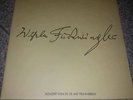
1935 Wilhelm Furtwängler Berlin Philharmonic FREISCHÜTZ Overture Entr'Acte 2x78
$
75


Favourite Auctions
To save auctions to your favourites, please login
If you don't have an account, please register
Description
A series of great Orchestra Records by great conductors on 78 rpm records
Click on this link to see more great Conductors and Orchestral Records!
Great early 30s recording by Wilhelm Furtwaengler and the Berlin Philharmonic
Carl Maria v Weber's famous FREISCHUETZ OVERTURE
COMPLETE IN THREE PARTS/ Interlude Act III
Weber: Der Freischütz Overture/ Zwischenspiel Act III
Berliner Philharmoniker
Wilhelm Furtwängler
Der Freischütz, Overture / Der Freischütz, Prelude, 3. Act
Wilhelm Furtwängler (dir.), Berliner Philharmoniker. Berlin,
October 1935.
78
—Grammophon/ Polydor 67108-67109
It is a noted fact that Furtwaengler needs one more side for his records than any other conductor, in this case to great effect: the dramatic Freischuetz overture slowly unrolls in all its menacing mystery and rollicking jubilation
COMPLETE Orig Issue German Polydor/ Deutsche Grammophon 2x12" 78 rpm records ,
Condition: EXCELLENT close to PRISTINE faint scuffs, Plays quiet faintest hiss rare ticks
A SUPERB COPY
FurtwSngler was born in Berlin into a prominent family.
By the time of FurtwSngler's conducting debut at the age of twenty, he had written several pieces of music. However, they were not well received, and that combined with the financial insecurity a career as a composer would provide led him to concentrate on conducting. At his first concert, he led the Kaim Orchestra (now the Munich Philharmonic Orchestra) in Anton Bruckner's Ninth Symphony. He subsequently held posts at Munich, Lnbeck, Mannheim, Frankfurt, and Vienna, before securing a job at the Berlin Staatskapelle in 1920, and in 1922 at the Leipzig Gewandhaus Orchestra where he succeeded Arthur Nikisch, and concurrently at the prestigious Berlin Philharmonic Orchestra. Later he became music director of the Vienna Philharmonic Orchestra, the Salzburg Festival and the Bayreuth Festival, which was regarded as the greatest post a conductor could hold in Germany at the time.
Towards the end of the war, under extreme pressure from the Nazi Party, FurtwSngler fled to Switzerland. It was during this troubled period that he composed what is largely considered his most significant work, the Symphony No.2 in E minor. Work on the symphony was begun in 1944, and carried on into 1945. It was given its premiere in 1948 by the Berlin Philharmonic Orchestra under FurtwSngler's direction. He resumed performing and recording following the war and remained a popular conductor in Europe, although he was always under somewhat of a shadow. He died in 1954 in Ebersteinburg close to Baden-Baden. He is buried in Heidelberg's Bergfriedhof. FurtwSngler is most famous for his performances of Beethoven, Brahms, Bruckner, and Wagner. However, he was also a champion of modern music, and was known to give performances of thoroughly modern works, such as BTla Bart=k's Concerto for Orchestra. Conducting styleFurtwSngler is noted for his Beethoven recordings. FurtwSngler had a unique conducting technique. He saw symphonic music as creations of nature that could only be realised subjectively into sound. This is why composers such as Beethoven, Brahms and Bruckner were so central to FurtwSngler's repertoire, because he identified them as great forces of nature. He disliked Toscanini's approach to the German repertoire. He walked out of a Toscanini concert once, calling him "a mere time-beater!". Despite, or perhaps because of, this unorthodox style, musicians were mesmerized by his leadership. His best performances are characterized by deep, bass-driven sonorities, soaring lyricism and wrenching extremes of emotion co-existing with logical cogency. Neville Cardus wrote in the Manchester Guardian in 1954 of FurtwSngler's conducting style as follows: "He did not regard the printed notes of the score as a final statement, but rather as so many symbols of an imaginative conception, ever changing and always to be felt and realised subjectively...Not since Nikisch, of whom he was a disciple, has a greater personal interpreter of orchestral and opera music than FurtwSngler been heard." Many commentators and critics regard him as the one of the greatest conductors in history.
price rating




![The Flying Burrito Brothers - The Gilded Palace Of Sin [VINYL]](https://www.popsike.net/php/thumbnail.php?url=https://www.popsike.pics/pix/20220520/275318902329.jpg)