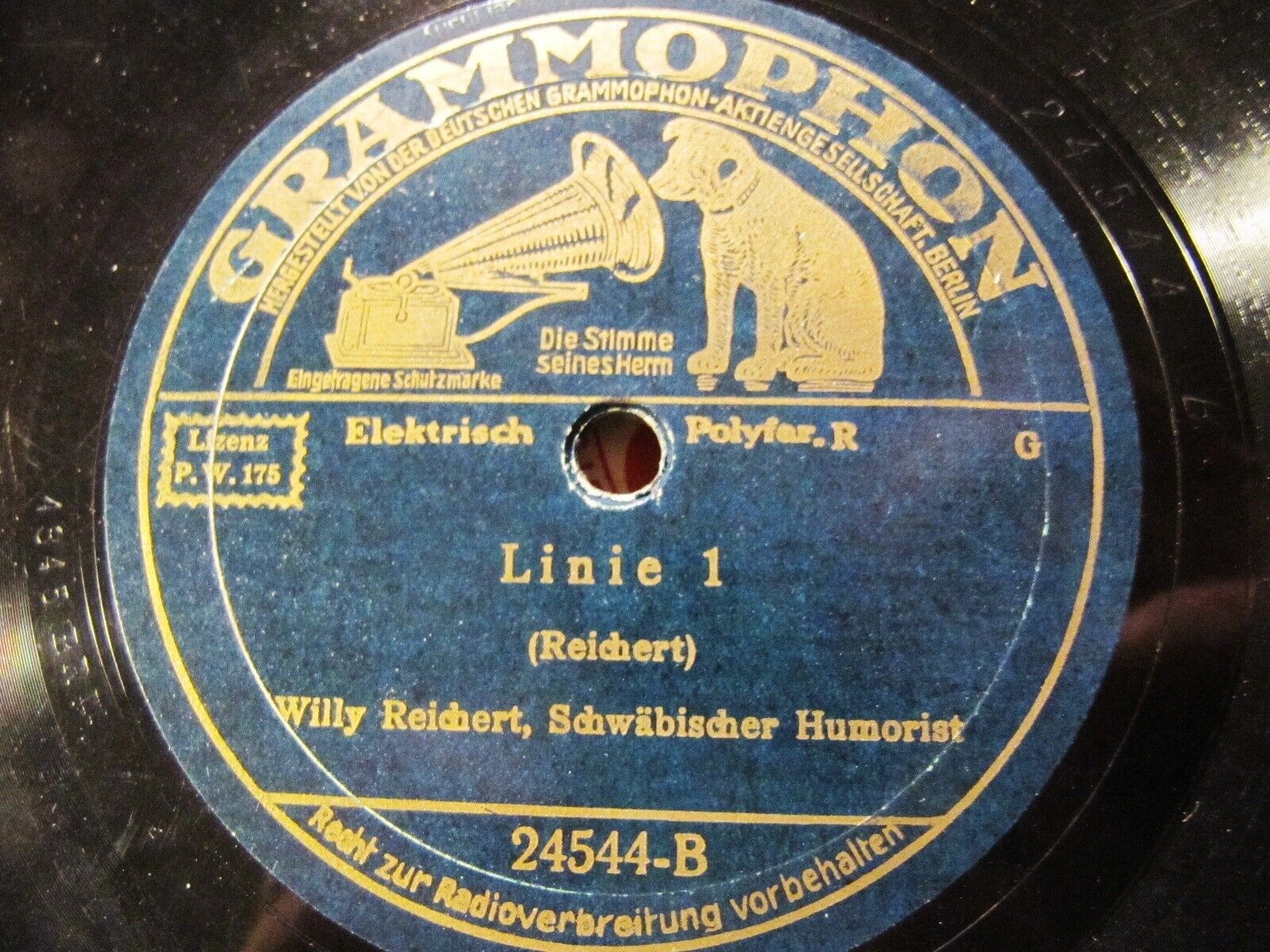
AMERICAN SWABIANS Speak Ha Jes Yes German COMIC Willy Reichert STREET CAR Linie1
$
40




Favourite Auctions
To save auctions to your favourites, please login
If you don't have an account, please register
Description
A series of great German, Swiss and Austrian Marches, Scandinavian Accordion, Folk Band, Humor and Popular recordings
Check out more German and Scandinavian recordings for sale by clicking the link below
More great German and Scandinavian Records in my other listings!
WILLY REICHERT German Swabian Comedian from Stuttgart in two Swabian dialect routines.
The Street Car Sketch Linie 1 follows the same lines as Ferdl Weiss Linie 8 - who was first two German Sketches, the first one Ha Oui und Ha Yes is a parody on Swabian dialect: First in Schwaebisch German, then he talks about the many Swabians in America, who have forgotten to speak Schwaebisch, and cannot yet speak American. Sings a song in mangled English with many Swabian words. Then he parodies a Frenchman from the South of France./ Linie 1 is a sketch about a streetcar conductor dealing with obstinate passengers.
Grammophon 24544. Sprechplatte. Willy Reichert, schwäbischer Humorist. Ha oui, ha oui ond ha jes, ha jes / Linie 1.
Please see top of the page for condition
Willy Reichert (born August 30, 1896 in Stuttgart, † December 8, 1973 in Mietenkam in Chiemgau) was a German comedian, folk actor and singer.
Life
Willy Reichert was born in Stuttgart to a machine operator. After training at the Dr. von Morgenstern in Braunschweig [1] he worked as a sugar technician [2] in a sugar refinery in Hildesheim until he had to engage in 1915 and become a soldier.
After the end of the First World War, he took acting lessons from Max Bing at the Stuttgart State Theater. In 1921 he began his career as an actor at the Stuttgart Schauspielhaus, to which he went after a few years in the province, u. a. at houses in Zwickau, Landsberg, Heilbronn and a detour to the cabaret in Munich, returned in 1926. Here he played theater from 1926 to 1932. In the meantime he had developed from a young comedian with experience in opera and operetta to a high-profile lecture artist. With his own repertoire, Reichert soon made guest appearances not only in the Friedrichsbau in Stuttgart, but at all the larger variety stages in the Reich. [3]
In 1931 he invented the art figures "Häberle and Pfleiderer" together with the Oscar Heiler from Stuttgart. The comedian duo with these Swabian characters had great success on the variety stages in southern Germany until the 1940s. In the 1950s and 1960s, the two artists became popular through regular radio and (later) television programs.
After the war ended, Fritz Kortner brought Reichert back to the theater. He performed again at the Stuttgart Schauspielhaus and in the Stuttgart Comedy. [3]
In the 1950s, Reichert also appeared in numerous home and entertainment films, mostly as an original Swabian. In recent years he has worked on various television series alongside radio work. He had great success in his leading roles in the TV series The Guests of Felix Hechinger, Willy Reichert in ..., Swabian Stories, Chronicle of the Nägele Family and Germany, Your Swabians. In the television game The Bird Does Not Let Singing, which was broadcast on his 70th birthday in 1966, he played the village pastor Michael von Jung.
Willy Reichert was also known as a singer of Swabian songs. The most successful, which are still played today in the concerts of choice, are Where a green broom beckons, Karle Hank, On the Feuerbacher Heide, On the Echterdenger airfield, Dront am Neckar stands a Bänkle, Joggele, mei Bua (I am a soldier, vallera ), M'r muass a lazy, O dees would be nice, if I had enough money and Das Hobellied.
Reichert was regarded as the popular Swabian humorist par excellence. Squidward Troll called him "the best known and most popular Swabia since Theodor Heuss is dead". However, he was not a comedian of loud laughter, but rather a quarter philosopher (Reichert) who silently smiles at his whimsical contemporaries. His sonorous bass organ underscored the cheerful contemplation in his charisma, the "deep amazement, the smile of the wise". [3]
Willy Reichert, who also published numerous books and volumes of poetry in the Swabian dialect, was awarded the Great Cross of Merit in 1956. He lived with his wife Elisabeth and his two children, Thomas and Julia, in Mietenkam in Chiemgau, where he died at the age of 77. Reichert was buried in the old community cemetery in Grassau, district of Traunstein. [5] The Willy-Reichert relay to Karlshöhe in Stuttgart-Süd was named after him.
price rating


