FRIPP ENO NO PUSSYFOOTING 1ST PRESS HELP 16 A1-U B1-U
$
30


Favourite Auctions
To save auctions to your favourites, please login
If you don't have an account, please register
Description
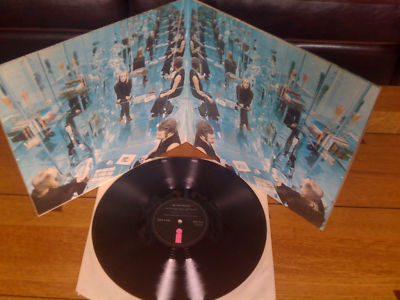
A NM-/EX Copy of BRIAN ENO and ROBERT FRIPP's 1973 masterpiece NO PUSSYFOOTING. 1st UK Pressing on PINK (i) ISLAND HELP 16. The LP is in immaculate condition. ISLAND PINK (i) labels and vinyl NM-. This copy plays beautifully. Inherent to this (HELP 16) pressing is a small amount of faint crackles during the quite moments. My own personal copy has this same small bit of crackles and the labels on my copy are shit! Whenever I pick up a copy of this LP, it is the labels that I notice first (perhaps because of the poor condition on my own). These are the nicest set of Pink (i) labels I have seen. The vinyl very glossy and heavy weight. I would have to say that if you want perfect sound, buy the CD. In my opinion, nothing sounds better than vinyl. I would gladly add this LP to my own collection. The jacket is tight and square with a very minimal bit of rubbing over the title and down near the bottom, consistent with the "Excellent" rating noted below. Please let me know if you have any further questions or concerns.
I have been collecting Roxy Music and Brian Eno since 1972. Whenever I see a nice copy of anything from that trajectory, I like to pick it up and offer it to other collectors.
For anyone who is not familiar with this wonderful recording, here is what I found in Wikipedia:
(No Pussyfooting) is a 1973 ambient music[1] album by the British musicians Robert Fripp and Brian Eno. (No Pussyfooting) was the first of three major collaborations between the musicians, growing out of Eno's early tape recording experiments and Fripp's ability to input music with an electric guitar.
(No Pussyfooting) was recorded in three days over a period of a year. It was released very closely to Eno's own debut solo album Here Come the Warm Jets (1973) and is considered to be one of his early experiments in ambient music.
Production
Brian Eno invited Robert Fripp to his London home studio in September 1972. Eno had developed a tape system using two tape recorders set up so when a sound was played, it would be heard at a lower volume level seconds later, and seconds later again at a lower level. With this method, new sounds could be laid upon each other without overwriting them. Fripp played further material over the top with Eno selectively enabling or disabling the recording. This allowed Eno to remove portions of the loop, or add further new layers on top of the existing material. The result is a dense, multi-layered piece of ambient music.[3][4] This technique later came to be known as "Frippertronics".
(No Pussyfooting) 's first track is a near 21-minute piece titled "The Heavenly Music Corporation". Fripp originally wanted the track titled "The Transcendental Music Corporation", which Eno didn't allow as he feared it would make people "think [they were] serious".[5] Recorded in two takes — first the background looping track, then adding an extended guitar solo over the backing track — the track features the sole sound source as Fripp's electric guitar, played through a tape loop system devised by Eno determining the amount of the time in which each piece of audio would be layered.[4]
The second track "Swastika Girls" was recorded almost a year after "The Heavenly Music Corporation" in August 1973 at Command Studios in London. The track's title refers to an image of nude women doing a nazi salute that was ripped out of a pornographic film magazine that Eno found left in Air studios. Eno stuck the image on the recording console while recording the track with Fripp and it became the title of the track. "Swastika Girls" uses the same technique as "The Heavenly Music Corporation".[6] Fripp and Eno took the tapes of "Swastika Girls" to British record producer George Martin's Air Studios at Oxford Circus to continue mixing and assembling the track there.[7]
Please note: I am always interested in select Eno ephemera and will consider trades.Combining bids lets you save on shipping charges, as you pay a flat fee of $1 shipping for each additional item won. The winning bidder is expected to pay for the item within 5 days from the end of auction.
Domestic S&H is :
For 45 rpm’s (with or without picture sleeves): $3.50
For 12” records: $4.00 (Media Mail) $10 (Priority Mail).
International S&H is:
For 45 rpm’s (with or without picture sleeves) - $6.50 (First Class Airmail)
For 12” records $12.00 (First Class Airmail)
Insurance (for the USA only!!!) is $2.00 , registered mail (international only!!!) is $12.00 EXTRA. If you do not opt for this and you do not receive your item the only thing I can give you then is the date it was shipped and in the case of international packages the Customs Form Number. There will not be a tracking number. 99% of my packages make it without a problem within a week (3-5 days in the US). Another 1% gets there a little later for unknown reasons.
BUYERS FROM ITALY, TURKEY, GREECE AND SOUTH AMERICA MUST PURCHASE THE REGISTERED MAIL OPTION. I cannot declare a different value for customs. Buyer is responsible for any additional customs charges that may occur.
I use safe and strong packaging materials. I may choose to recycle, as I am a collector myself. For multiple records, I use a new Bags Unlimited200# test Brown Corrugated box. If you ask for extra or special packaging, I will have to charge you for that. All PS 7"'s and LPs are stored and mailed with the record removed from the sleeve, put in a paper sleeve, and then the picture sleeve and the record are put in a plastic sleeve. I mail out records twice a week, usually towards the earlier part of the week and then again on Saturday.
Please feel free to email me with any questions before bidding. Do not bid if you don't intend to purchase the item.
If you are not happy with a purchase I will refund you the money for the item after you mail it back, including S&H, no questions asked.
These are the grading guidelines used and are based on Goldmine Grading for Records:
MINT (M): Perfect! This record looks like it has just left the manufacturer, with NO flaws what so ever. It looks as though it had never been handled. No scuffs or scratches, blotches or stains. No stickers address labels, writing on the covers or labels. No tears or seam splits. No wear to the cover or record period! Age of the record has nothing to do with it.
NEAR MINT or NM, M- : this record appears virtually flawless A very minor scuff and very little else can appear on the vinyl. It should play without any noise over the flaw. The flaw is very hard to see. The cover looks as close to perfect with only minor signs of wear and or age. Minor impressions to the cover (due to the outer edge of the vinyl resting inside) may be acceptable, however the artwork is be as close to perfect as can be.
EXCELLENT or EX or VG++ : minor scuffs which are only slightly visible. There may be more than a few scuffs and NO Scratches COVER: Artwork is still as close to perfect as can be. Some impression to the cover (minor outer ring wear) but no ink wear! Some slight creases to the corners, but not wrinkled and obtrusive to the eye. The corners can show white (where the artwork pasted slick was) meaning, slight wear. No seam splits or writing on the cover or taped repairs can make this grade.
VERY GOOD PLUS or VG+ record shows wear, surface scuffs. The vinyl still has a great luster, but the flaws will be noticeable to the naked eye. If the flaws don't cause any surface noise, the vinyl can still make the VG+ grade. COVERS: A virtually clean cover, but may have small writing on it.The artwork looks clean with slightly more aging. The back of the cover usually gives away the age of the cover. Flat white paper will be somewhat yellow yet no stains or mildew from water damage. Some minor wear to the seams or spine, but no tears or holes popping through. The corners will be slightly dog eared yet no crackly bends, defacing the artwork. In essence, a VG+ cover should have no more than 3 flaws mentioned.
VERY GOOD or VG: this record is a record that is good enough. They are not really going to look very good, but it will STILL play very good. there will almost always be some surface noise when they are played. The Dynamics should still be excellent, overpowering the surface noise. A VG record will appear well have been played but still have some luster. VG covers will look worn, used. There may be some seam splitting . There will be some ring wear, where the ink has begun to wear off. Giving the cover a look of snow falling. If the artwork looks snowy all over, it is less than VG condition. There may be some writing on the cover (still, no Large letters in magic marker). It will look aged and more yellowish due to contamination's in the air (sometimes looking like cigarette smoke). Still it should be decent.
GOOD or G A good record will look very well played, dull, grayish and possibly abused. However a Good record should still play. It will have distracting surface noise. Such as crackle that is continuous or some hiss. Will also have some loss of dynamics caused from grooves being worn. It should play without any skips or any obtrusively loud pops or repeated clicks, caused by deep scratches. Good means that it will play with some form of decency, so one can still enjoy the music even though you can still hear noise caused from the wear. A Good cover will have just about everything wrong with it. It will have seam splits (possibly taped repaired, but only with scotch tape. No duct tape or masking tape repairs. These are big turn offs. May have magic marker writing on the cover but still if they are in huge letters, it is a big turn off.In essence, the cover will looked virtually trashed, but some artwork will still be noticed. If the artwork is worn, it is POOR and the cover is worthless.
price rating


![NEW JIMI HENDRIX EXPERIENCE Electric Ladyland [2 LP] Electric Blue Vinyl #/2000](https://www.popsike.net/php/thumbnail.php?url=https://www.popsike.pics/pix/20160522/361566297226.jpg)


![THE SLICKER - JOHNNY TOO BAD / VERSION [ PANTHER ] 7](https://www.popsike.net/php/thumbnail.php?url=https://www.popsike.pics/pix/20230627/175786201678.jpg)