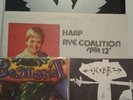
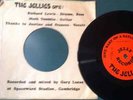
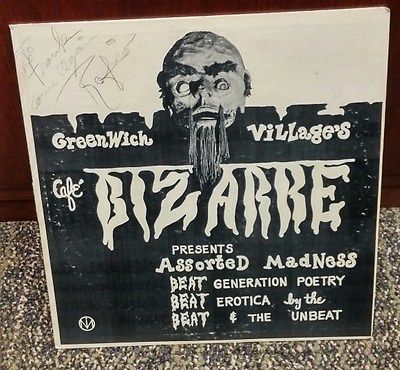
Holy Grail of Beatnik Music Cafe Bizarre LP Auto from 1959 Greenwich Village
$
250


Favourite Auctions
To save auctions to your favourites, please login
If you don't have an account, please register
Description
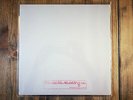
Here is what is considered the Holy Grail of Beatnik Records! Only sold at the Cafe in Greenwich Village.
Autographed by the Mad Monk Himself! Rafio! (Read his story below.)
" Despite its title, .....is one of the more unusual retrospective compilations to be issued in the 21st century. The Cafe Bizarre may have become truly infamous in the late 1960s as an East Village haven for radicals and psychedelic experimenting philosophers. That said, in the later '50s and early '60s it was also a cathedral for the Beat writers and various elements of the jazz scene. This collection features poets reading their works as well musical selections by the Cafe's more famous patrons from the jazz world: Charlie Parker, Lennie Tristano, Roy Eldridge, Gerry Mulligan, Chico Hamilton, and even George Shearing. Most of the poetry on this set is by long-faded personas we never knew, and sounds like it: nostalgic yet reverent and intense imitations of works by their more well-known forebears. In other words, the works of the Mad Monk, Ellie Girl with Seven Beat Sulks, Ringo Angel (who sounds like a professor and might have even become one), Felix Lupus, Stevenson Phillips, and Jamaica Johnny Cayonne are here for either nostalgia or ridicule, but they contain a certain innocence that long ago died in America. There are other musical selections as well, and all of it adds up to a curiosity piece for those obsessed with history or the dregs of Beat-era poetry. "
Rafio the Mad Monk is alive and well and living on Cape Cod
or, how a newspaper man morphed into a beat poet and morphed back to a member of this inky trade
By Walter Brooks, a.k.a. Rafio
I read this week that I had died. It made me recall Mark Twain's famous retort upon reading his obituary, "The reports of my death are greatly exaggerated."
You see, I was once a beat poet and owned a coffeehouse named "Café Rafio" at 165 Bleeker Street in Greenwich Village. In a new book on the Beat Generation there are references to my death in 1964.
I didn't die. My replacement and identity-stealer did.
You, dear reader, probably know me as the editor and publisher of capecodtoday.com or as the Blog Father and as the founder of Best Read Guides, which is among the largest networks of tourism magazines in America.
But my wife and oldest friends still call me Rafio and my grand kids call me Papa Raf.
After Taft School, Culver Military Academy and UConn, I went to work as a newspaperman in 1951 at the Naugatuck, CT Daily News the week a week after my father died at his desk at the Waterbury, CT Republican-American. My next gig was at the Greenwich, CT Time fololwed by a NYC ad agency. However, I had always been an artist and wrote poetry during this period, so by the late 1950s I chucked it all and moved to Greenwich Village in 1957. I always assumed I was rebelling against those four years at Culver coupled withe the usual Brooks' resistence to authority (a forebear fought agaist King George in 1776 as well).
I set up my easel on 6th Avenue and Waverly Place alongside the other street artists and started earning a living sketching portraits of tourists
I tried reading my poetry at several coffeehouses and was given a permanent gig at the Café Bizarre reading my typical beat, protest poems of the era like this:
My country, tears for thee,
Land of mediocrity,
To thee I sing.
Land where my brothers died
On the Red Chinese side,
From every atom fried;
Mediocrity.
In the 1960s Greenwich Village was still an Italian neighborhood. The beatniks hung out at coffeehouses along 4th, McDougall and Bleeker Streets, while the cross streets like Thompson and Sullivan were almost a forbidden Italian territory for us rebels.
"Where the beat meet to eat, and the square dare to compare"
After meeting my wife in Provincetown one summer, we returned to the village where we met a Jewish mobster who offered to partner with us and start Café Rafio. He was well connected with mobster Tony Bender whose patronage and protection was more valuable than any police protection in those years before the famous Knapp commission investigation of NYPD corruption.
I was sated with beat poetry myself by then, and never featured a poet while I ran the café. The entertainment was performed in a front window and featured the The Taylor Trio and stand-up comic Adam Keith when the other coffeehouses limited their entertainment mostly to poetry and folk singers.
In 1960, within weeks of opening, we had a line of people a block long on Fridays and Saturdays waiting to get in despite the cover charge. My slogan was, "Where the beat meet to eat, and the square dare to compare."
After the first year, my mafia partner said we had to expand to accommodate the weekend crowds. Since he knew the landlord, he said we could evict the super whose apartment separated Café Rafio from an open air courtyard in the rear.
The day we inspected the apartment, the ancient Italian super quickly figured out what we were doing and pleaded with my partner and I not to evict him.
With tears streaming down his face he explained that he and his wife had lived there since coming from Italy many decades before, that she had already had one heart attack and he knew that an eviction would surely kill her.
I told Sol Joseph, my partner, "the hell with it. We'll just raise prices or something to make up the difference."
Although no one ever really knows another person's motivation, I think it's safe to say that my refusal to evict led to my partner and I splitting. That was made painfully clear about a week or so after when a local thug named Gazoot came into Café Rafio saying Sol had sent him.
Gazoot beat the crap out of me and threw me out of my own café.
My wife Pat ran out into Bleeker Street screaming for the local policeman who had disappeared. In that neigborhood, the mob was the law back then.
A widow before she was a mother?
Patricia was eight months pregnant at the time with our first son, and I figured it was probably a good time to move on so she wouldn't be a widow before she was a mother.
As it turns out, I really did save my life because my replacement was killed within a year.
By then I shaved had off my beard and mustache and got a job at the New York Post in 1962 when it was the most liberal newspaper of the eight still published daily in New York City.
After getting that on my resume (leaving out the four village years), I stayed a year and moved on to the Amherst, MA Journal-Record before a young publisher named Bill Breisky hired me for his weekly, the Thompsonville, CT Press.
After two years at the Press, I applied at The Cape Codder in 1965 where I stayed for a dozen years, then moved to MPG Communications in Plymouth where I stayed for a decade. In 1988, I started Best Read Guides with Patricia and a friend, Steve Sullivan, both of whom had worked for me at MPG.
Death comes to Rafio at 2am
With me out of the picture, my ex-partner, Sol, needed someone who at least looked something like me to masquerade as Rafio after my swift departure.
Every artistic environment has its groupies, and the small beat movement was no different. In addition to the artists and writers, we harbored many jackals who hung around the herd looking for leftovers when the countless young female acolytes descended upon the village every weekend.
Death at 2am, Greenwich Village, 1962
The bearded hanger-on named Von Ehmsen, whom I hate to admit bears a strong resemblance to me at age 29, was hired by my ex-partner to imitate me.One such jackal was a tall, bearded hanger-on namedVon Ehmsen (on right), whom I hate to admit bears a strong resemblance to me at age 29. Sol hired him to play Rafio and soon the two of them made another tour of the super's small apartment behind the café.
Since he had little else, Von Ehmsen had a Doberman Pincer which he took for a do-do run after closing the coffeehouse after 1am. A few nights after the eviction notice was served, the super accosted Von Ehmsen and his dog, and again begged to be left alone.
Neither history nor the police reports recorded the ersatz Rafio's reply, but knowing the man well, I always assumed it was something along the lines of "get the hell away from me old man."
Whereupon the super pulled out a very old revolver and shot Rafio dead.
I read about his death one lunch break at the New York Post while doing the crossword puzzle.
I guess it pays to be a half decent human being... the real Rafio is alive and well and living on Cape Cod.
VINYL GRADE: As you can see in the photos, the record has numerous scratches but I played both sides and the sound is great, no skips or jumps!!
Cover Grade: Cover is very clean to be this old. Has a couple of small seam splits.
This one doesn't come up for auction very often and the ones that have went for $200-400 without the autograph. Hope this goes to someone who really appreciates the genre and history of this form of expression!
price rating