Ramones Self-Titled Vinyl LP - Rare 1976 Original Pressing - Sire SASD 7520 -
$
260
Favourite Auctions
To save auctions to your favourites, please login
If you don't have an account, please register
Description
I'm selling my personal collection in preparation for moving. We do not ship internationally or to Alaska, Hawaii, US Protectorates or APO/FPO addresses.
You are bidding on a rare, original pressing of the Ramones 1976 self-titled debut album. Punk rock at it's freshest and finest! S/T
Ramones is the debut studio album by American punk rock band Ramones, released on April 23, 1976 by Sire Records. After Hit Parader editor Lisa Robinson saw the band at a gig in New York City, she wrote about them in an article and contacted Danny Fields, insisting that he be their manager. Fields agreed and convinced Craig Leon to produce Ramones, and the band recorded a demo for prospective record labels. Leon persuaded Sire president Seymour Stein to listen to the band perform, and he later offered the band a recording contract. The Ramones began recording in January 1976, needing only seven days and $6,400 to record the album.
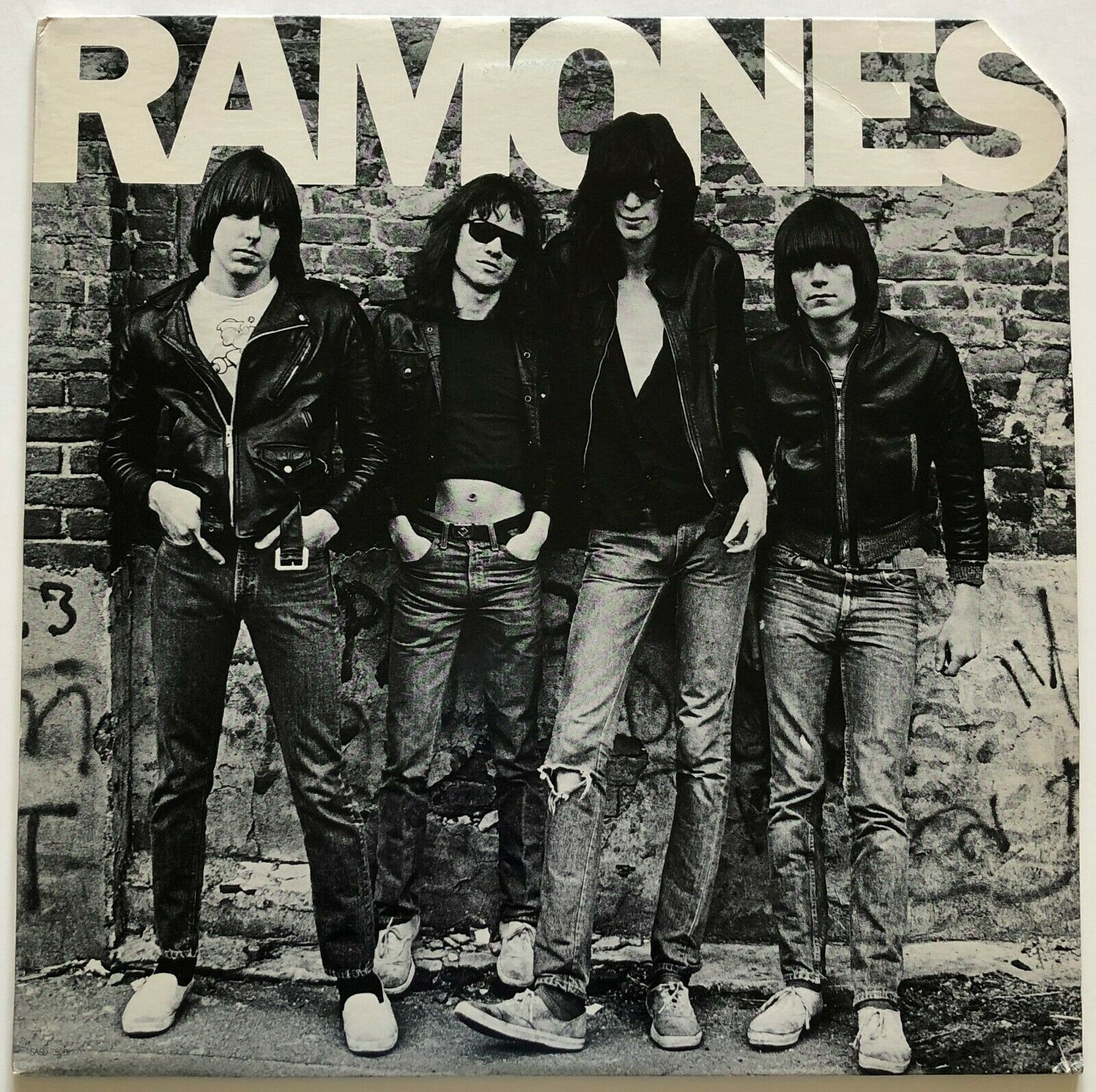
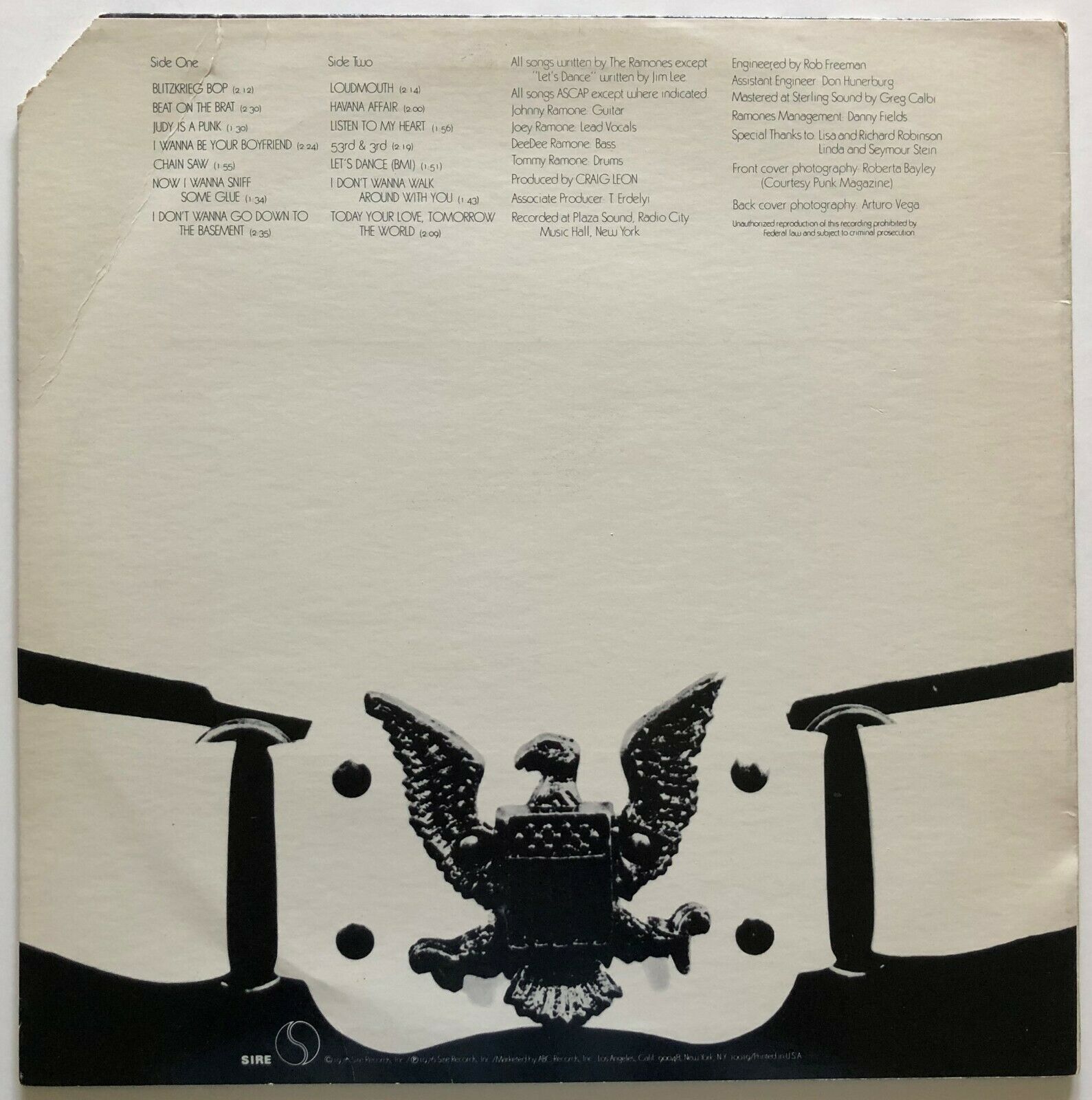
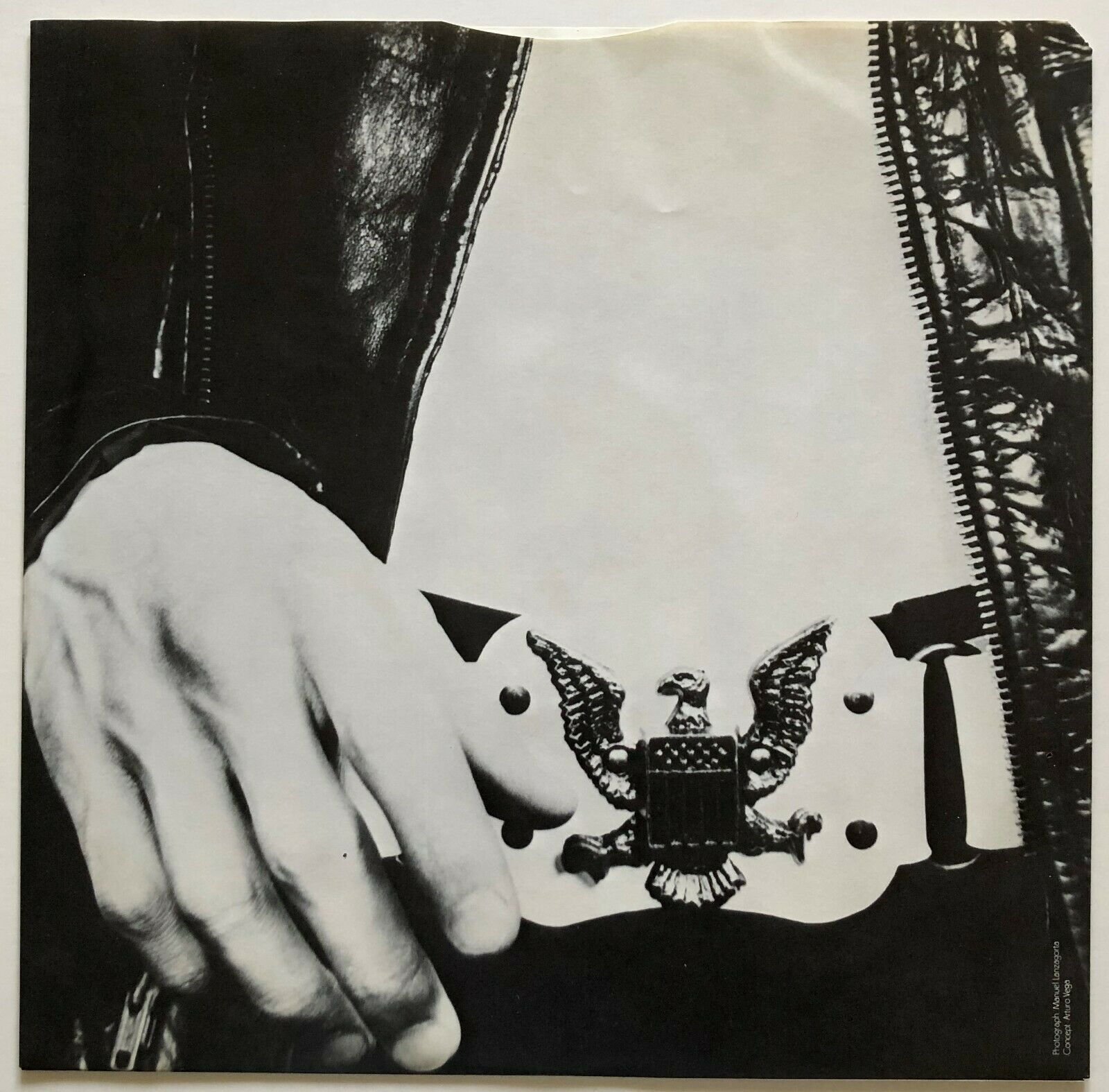
The album cover, photographed by Punk magazine's Roberta Bayley, features the four members leaning against a brick wall in New York City. The record company paid only $125 for the front photo, which has since become one of the most imitated album covers of all time. The back cover depicts an eagle belt buckle along with the album's liner notes. After its release, Ramones was promoted with two singles, which failed to chart. The Ramones also began touring to help sell records; these tour dates were mostly based in the United States, though two were booked in Britain.
Violence, drug use, relationship issues, humor, and Nazism were prominent in the album's lyrics. The album opens with "Blitzkrieg Bop", which is among the band's most recognized songs. Most of the album's tracks are up tempo, with many songs measuring at well over 160 beats per minute. The songs are also rather short; at two-and-a-half minutes, "I Don't Wanna Go Down to the Basement" is the album's longest track. Ramones contains a cover of the Chris Montez song "Let's Dance".
Ramones was unsuccessful commercially, peaking at number 111 on the US Billboard 200, though it received glowing reviews from critics. Many later deemed it a highly influential record, and it has since received many accolades, such as the top spot on Spin magazine's list of the "50 Most Essential Punk Records". Ramones is considered an influential punk album in the US and UK, and had a significant impact on other genres of rock music, such as grunge and heavy metal. The album was ranked at number 33 in Rolling Stone's 2003 list of the 500 Greatest Albums of All Time, maintaining the ranking in a 2012 revision and dropping to number 47 in the 2020 reboot of the list. It was certified gold by the Recording Industry Association of America in 2014.
Ramones began playing gigs in mid-1974, with their first show at Performance Studios in New York City. The band, performing in a style similar to the one used on their debut album, typically performed at clubs in downtown Manhattan, specifically CBGB and Max's Kansas City. In early 1975, Lisa Robinson, an editor of Hit Parader and Rock Scene, saw the fledgling Ramones performing at CBGB and subsequently wrote about the band in several magazine issues. The group's vocalist Joey Ramone related that "Lisa came down to see us, she was blown away by us. She said that we changed her life; she started writing about us in Rock Scene, and then Lenny Kaye would write about us and we started getting more press like The Village Voice. Word was getting out, and people starting coming down." Convinced that the band needed a recording contract, Robinson contacted Danny Fields, former manager of the Stooges, and argued that he needed to manage the band. Fields agreed because the band "had everything [he] ever liked," and became the manager in November 1975.
On September 19, 1975, Ramones recorded a demo at 914 Sound Studios, which was produced by Marty Thau. Featuring the songs "Judy Is a Punk" and "I Wanna Be Your Boyfriend", the band used the demo to showcase their style to prospective labels. Producer Craig Leon, who had seen the Ramones perform in the summer of 1975, brought the demo to the attention of Sire Records' president Seymour Stein. After being persuaded by Craig Leon and his ex-wife Linda Stein, Ramones auditioned at Sire and were offered a contract, although the label had previously signed only European progressive rock bands. Drummer Tommy Ramone recalled: "Craig Leon is the one who got us signed, single handed. He brought down the vice president and all these people—he's the only hip one in the company. He risked his career to get us on the label." The label offered to release "You're Gonna Kill That Girl" as a single, but the band declined, insisting on recording an entire album. Sire accepted their request and agreed to release a studio album instead.
Recording and production
Ramones was recorded on the eighth floor of Radio City Music Hall.In January 1976 the band took a break from their live performances to prepare for recording at Plaza Sound studio. Sessions began later that month and were completed within a week for $6,400; the instruments took three days and the vocal parts were recorded in four days. In 2004, Leon admitted that they recorded Ramones quickly due to budget restrictions, but also that it was all the time they needed.
"Doing an album in a week and bringing it in for $6,400 was unheard of, especially since it was an album that really changed the world. It kicked off punk rock and started the whole thing—as well as us."
—Joey Ramone
The band applied microphone placement techniques similar to those which many orchestras used. The recording process was a deliberate exaggeration of the techniques used by the Beatles in the early 1960s, with a four-track representation of the devices. The guitars can be heard separately on the stereo channels—electric bass on the left channel, rhythm guitar on the right—drums and vocals are mixed in the middle of the stereo mix. The mixing of the production also used more modern techniques such as overdubbing, a technique used by studios to add a supplementary recorded sound to the material. The band also used a technique known as doubling, where the vocal line used is sung twice.
Recording for the album was expanded by Mickey Leigh (Joey's brother) and Leon with percussion effects, which went unmentioned in the liner notes to the album's release. Author Nicholas Rombes said that the production's quality sounded like "the ultimate do-it-yourself, amateur, reckless ethic that is associated with punk," but concluded that they approached the recording process with a "high degree of preparedness and professionalism."
Artwork and packaging
The back cover to the Ramones album was designed by artist Arturo Vega, who produced the photo of a belt buckle in a photo booth.Initially, the Ramones wanted an album cover similar to Meet the Beatles! (1964) and subsequently had pictures taken in that style by Danny Fields but Sire was dissatisfied with the results. The art direction was by Toni Wadler and, according to cartoonist John Holmstrom, the "Meet The Beatles" cover idea came out "horribly". Wadler later chose a photo by Roberta Bayley, a photographer for Punk magazine for the cover. The black and white photograph on the front of the album was originally in an issue of Punk.
The cover photo features (from left to right) Johnny, Tommy, Joey and Dee Dee Ramone, staring at the camera with blank faces. They are all wearing ripped/faded blue jeans and leather jackets, standing upright against the brick wall of a private community garden called Albert's Garden, located in the Bowery neighborhood of New York City between Bowery Street and Second Street. The stance of the group members in the photograph would influence their future cover designs as well, with the majority of their succeeding albums using a picture of the band on the front cover. Music historian Legs McNeil states that "Tommy [is] standing on his tip-toes and Joey [is] hunched over a bit." The back cover art, which depicts a belt buckle with a bald eagle and the band's logo, was designed by Arturo Vega. Liner notes on the back cover fail to acknowledge backing vocalists and additional instrument players. Leigh, who performed backing vocals on several tracks, asked guitarist Johnny why he was not mentioned on the record's credits. Johnny replied: "We didn't want people to get confused with who's in the band or who's not. It's our first album, you know, and we didn't want people to get confused."
The artwork became one of the most imitated album covers in music. The image of a band in front of a brick wall dressed in ripped jeans and leather jackets was copied by Alvin and the Chipmunks in Chipmunk Punk. Ramones's artwork was ranked number 58 on Rolling Stone's 1991 list of 100 Greatest Album Covers.
Lyrics and composition
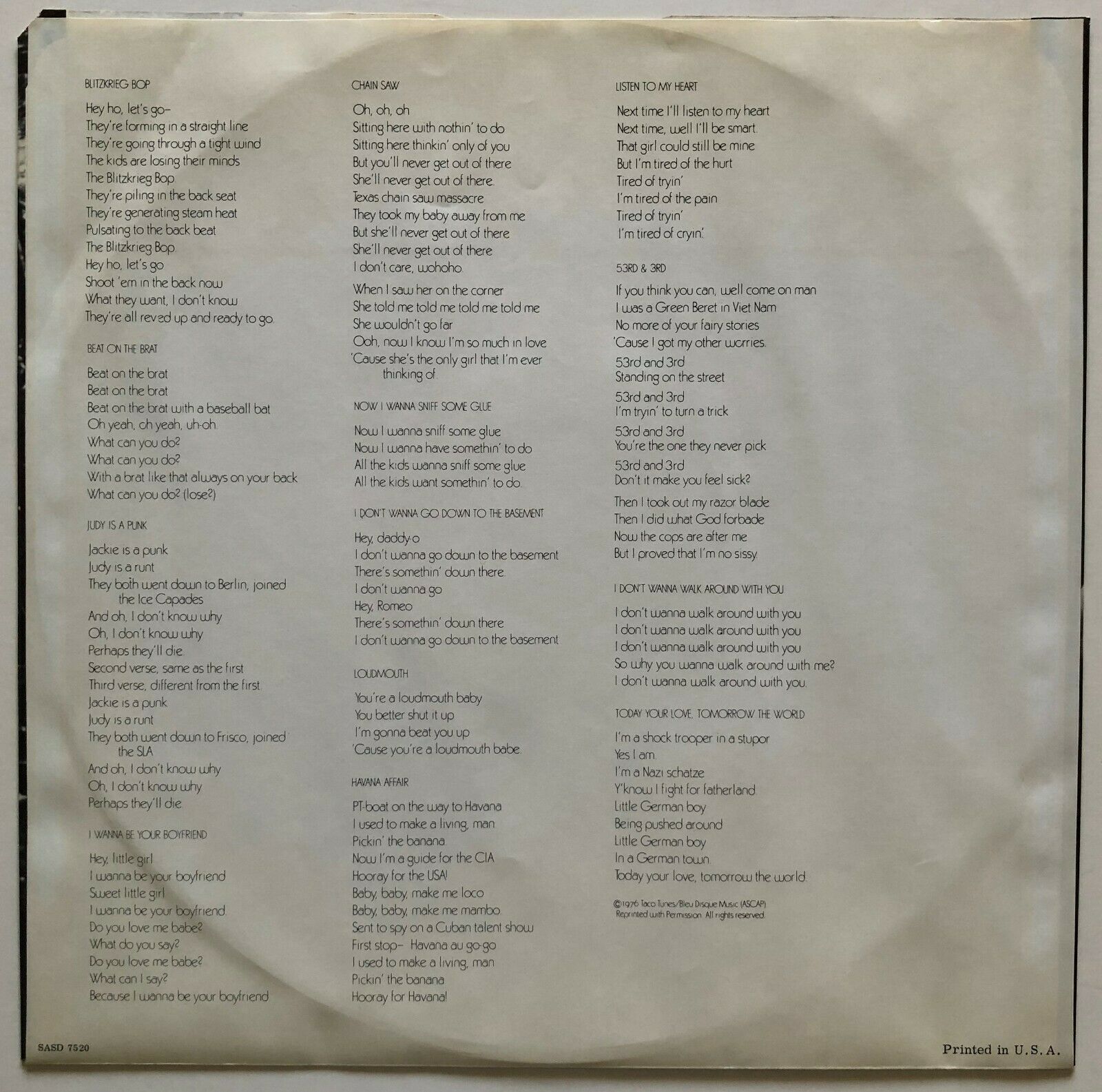
The songs on Ramones addressed several lyrical themes including violence, male prostitution, drug use, and Nazism. While the moods displayed in the album were often dark, Johnny said that when writing the lyrics they were not "trying to be offensive." Many songs from the album have backing vocals from different guests. Leigh sang backing vocals on "Judy Is a Punk", "I Wanna Be Your Boyfriend", and in the bridge of "Blitzkrieg Bop". Tommy sang backing vocals on "I Don't Wanna Walk Around with You", "Judy Is a Punk", and during the bridge of "Chain Saw". The album's engineer, Rob Freeman, sang backing vocals for the final refrain of "I Wanna Be Your Boyfriend". The album's length is 29 minutes and four seconds and it contains 14 tracks. On the original issue of the album, all the original songs were credited to "the Ramones" collectively.
The opening "Blitzkrieg Bop" was written by Tommy, and originally named "Animal Hop". Once Dee Dee reviewed the lyrics, the band changed the wording, the name, and partially the theme. According to Tommy, the song's original concept was about "kids going to a show and having a good time", but the theme became more Nazi-related after its revision. The piece begins with an instrumental interval which lasts about 20 seconds. At the 20th second, the guitar and bass cease, marking Joey's first line, "Hey ho, let's go!" The bass and guitar gradually rebuild and become "full–force" once all the instruments play together in ensemble. The piece resolves by repeating what is played from 0:22–0:33.[46] Stephen Thomas Erlewine from AllMusic described "Blitzkrieg Bop" as a "three-chord assault."
"When I lived in Birchwood Towers in Forest Hills with my mom and brother. It was a middle-class neighborhood, with a lot of rich, snotty women who had horrible spoiled brat kids. There was a playground with women sitting around and a kid screaming, a spoiled, horrible kid just running around rampant with no discipline whatsoever. The kind of kid you just want to kill. You know, 'beat on the brat with a baseball bat' just came out. I just wanted to kill him."
—Joey Ramone on "Beat on the Brat"
"Beat on the Brat" was said by Joey to have origins relating to the upper class of New York City. Dee Dee, however, explained that the song was about how Joey saw a mother "going after a kid with a bat in his [apartment building's] lobby and wrote a song about it."
"Judy Is a Punk" – written around the same time as "Beat on the Brat" — was written by Joey after he walked by Thorny Croft, an apartment building "where all the kids in the neighborhood hung out on the rooftop and drank." The song's lyrics are fictional and refer to two juvenile offenders in Berlin and San Francisco and their possible deaths at the conclusion of the song. "Judy Is a Punk" is the original album's shortest track at 1:39; it is partially derived from the Burl Ives 1953 folk song, “There Was An Old Lady Who Swallowed A Fly”.
"I Wanna Be Your Boyfriend" – the album's slowest song – was solely written by Tommy and pays homage to love songs by pop music acts of the 1960s. The song used a 12-string guitar, glockenspiel, and tubular bells in its composition, and was said by author Scott Schinder to be an "unexpected romantic streak".
"Chain Saw" opens with the sound of a running circular saw and was influenced by the 1974 horror film The Texas Chain Saw Massacre. At nearly 180 beats per minute, "Chain Saw" had the fastest tempo of the album's songs and, according to Rombes, is the most "home-made" sounding.
"Now I Wanna Sniff Some Glue" contains four lines of minimalist lyrics that depict youthful boredom and inhaling solvent vapors found in glue. "I hope no one thinks we really sniff glue," said Dee Dee. "I stopped when I was eight [years old]." Dee Dee also explained that its concept came from adolescent trauma. After several songs by the Ramones whose titles began with "I Don't Want to ...", Tommy said that "Now I Want to Sniff Some Glue" is the first positive piece on the album. The song served as an inspiration for one of the first punk fanzines, Mark Perry's Sniffin' Glue.
"I Don't Wanna Go Down to the Basement" is also minimalist, and inspired by horror movies. The entire text is composed of three lines, and the composition was based on three major chords. With a playing time of 2:35, it is the longest piece on the album. (Asked about the bathroom at CBGB, Debbie Harry remarked: "I think that song from the Ramones is partially about that: 'I don't wanna go down to the basement ... ' As kids, we never wanted to go down to the basement cos it was so dark and scary. And that toilet was certainly very scary.")
"Loudmouth" has six major chords and is harmonically complex. The song's lyrics are — depending on the reading and punctuation — a single row or four very brief lines.
"Havana Affair" has a lyrical concept incorporating the comic strip Spy vs. Spy by Cuban-born illustrator Antonio Prohias. At roughly 170 beats per minute, "Loudmouth" and "Havana Affair" proceed at about the same tempo.
"Havana Affair" segues into "Listen to My Heart" – the first of many Ramones songs to voice an ironic and pessimistic perspective on a failing or failed relationship.
Street signs at the intersection of East 53rd Street and Third Avenue in Midtown Manhattan. The song "53rd and 3rd" is based on the street's reputation for male prostitution.Written solely by Dee Dee, the lyrics of "53rd and 3rd" concern a male prostitute ("rent boy"), waiting at the corner of 53rd Street and Third Avenue in Midtown Manhattan. When the prostitute gets a customer, he kills the customer with a razor to prove he is not a homosexual. In interviews, Dee Dee described the piece as autobiographical. "The song speaks for itself," Dee Dee commented in an interview. "Everything I write is autobiographical and written in a very real way, I can't even write." Johnny insisted that the song is about "Dee Dee turning tricks." The half-sung and half-shouted bridge in "53rd and 3rd" are performed by Dee Dee, whose voice is described by author Cyrus Patell as what "breaks the deliberate aural monotony of the song and emphasizes the violence of the lyric."
"Let's Dance" is a cover version of the hit song by Chris Montez, featuring Leon playing Radio City's large Wurlitzer pipe organ.
"I Don't Want to Walk Around with You" consists of two lyric lines and three major chords. One of the group's earliest compositions, written at the beginning of 1974, it was the opener on their first demo.
"I Don't Wanna Walk Around with You" segues into the closing track "Today Your Love, Tomorrow the World", which refers to a Hitler Youth member. Seymour Stein complained about its original lyrics — "I'm a Nazi, baby, I'm a Nazi, yes I am. I'm a Nazi Schatze, y'know I fight for the Fatherland" — insisting the track was offensive. When he threatened to remove the track from the album, the band put together alternate lyrics: "I'm a shock trooper in a stupor, yes I am. I'm a Nazi Schatze, y'know I fight for the Fatherland." Stein accepted the revision and it was duly released.
Track listing
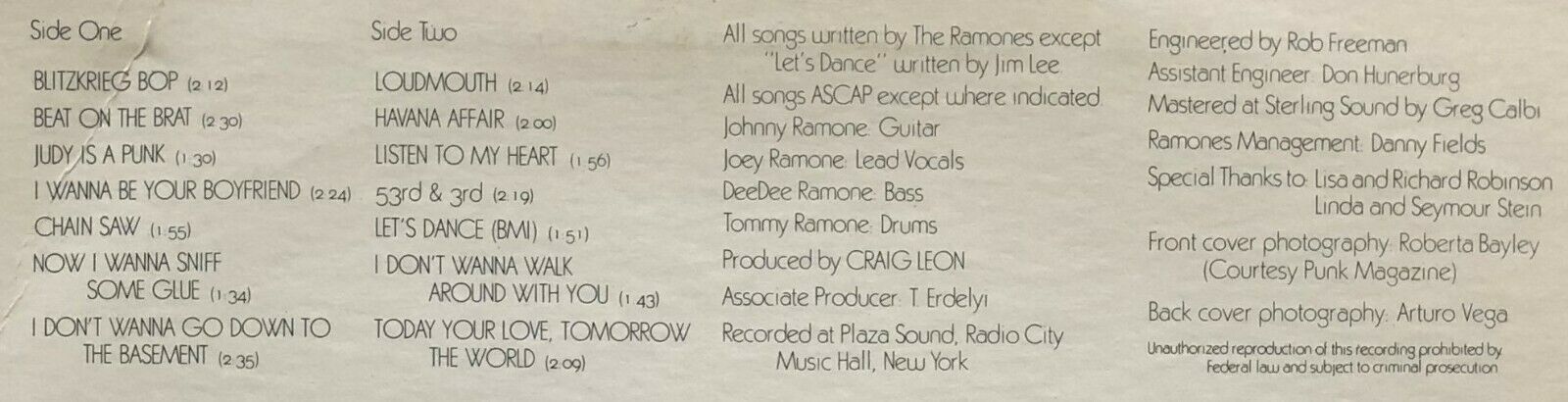
Side one No. Title Writer(s) Backing vocals Length 1. "Blitzkrieg Bop" Tommy Ramone, Dee Dee Ramone Mike Leigh 2:12 2. "Beat on the Brat" Joey Ramone 2:30 3. "Judy Is a Punk" Joey Ramone Leigh, Tommy 1:30 4. "I Wanna Be Your Boyfriend" Tommy Ramone Craig Leon, Rob Freeman 2:24 5. "Chain Saw" Joey Ramone Tommy 1:55 6. "Now I Wanna Sniff Some Glue" Dee Dee Ramone 1:34 7. "I Don't Wanna Go Down to the Basement" Dee Dee Ramone, Johnny Ramone 2:35 Side two No. Title Writer(s) Backing vocals Length 8. "Loudmouth" Dee Dee Ramone, Johnny Ramone 2:14 9. "Havana Affair" Dee Dee Ramone, Johnny Ramone 2:00 10. "Listen to My Heart" Dee Dee Ramone 1:56 11. "53rd & 3rd" Dee Dee Ramone 2:19 12. "Let's Dance" (Chris Montez cover) Jim Lee 1:51 13. "I Don't Wanna Walk Around With You" Dee Dee Ramone Tommy 1:43 14. "Today Your Love, Tomorrow the World" Dee Dee Ramone 2:09Total length: 29:04
Personnel
Credits adapted from AllMusic.
Ramones
- Joey Ramone – lead vocals
- Johnny Ramone – guitar
- Dee Dee Ramone – bass guitar, backing vocals, co-lead vocals in "53rd & 3rd"
- Tommy Ramone – drums, backing vocals on "I Don't Wanna Walk Around with You", "Chain Saw" and "Judy Is A Punk", associate producer
Production
- Craig Leon – producer, organ on "Let's Dance", backing vocals on "I Wanna Be Your Boyfriend"
- Greg Calbi – mastering
- Roberta Bayley – photography, cover photo
- Don Hunerberg – assistant engineer
- Rob Freeman – engineer
- Arturo Vega – photography, back cover
- Ramones Studio album by the Ramones Released April 23, 1976 Recorded February 2–19, 1976 Studio Plaza Sound, Radio City Music Hall in New York Genre Punk rock Length 29:04 Label Sire Producer
- Craig Leon
- Tommy Ramone (associate producer)
price rating