JILALA Rare Private Press Moroccan Sufi Trance Records LP 1966 Gysin Bowles
$
50


Favourite Auctions
To save auctions to your favourites, please login
If you don't have an account, please register
Description
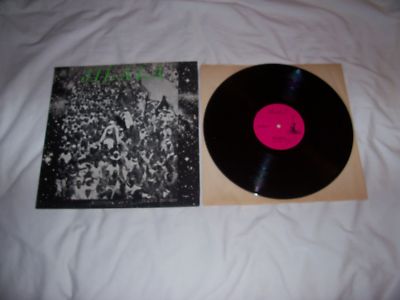
Up for bid is an extremely rare self titled LP by Jilala. Here is some extra info and reviews from the internet:
Jilala
Label: Trance Records – TRR 1225 Format:Vinyl, LP
Country: US Released: 1966 Genre: Folk, World, & Country Style: Folk
Tracklist:
A1
Untitled
A2
Untitled
A3
Untitled
B1
Untitled
B2
Untitled
B3
Untitled
Notes (these are printed on the back of the jacket):
Abu Yazid Al-Bestami, a noted Sufi Saint, once asked Moulay Abdelkader to call a tree which stood between them in the road-Call the tree three times in the name of the Prophet, and then I too will call the tree. Then we shall see for whom the tree will move. After calling three times with no result, Moulay Abdelkader waited for Bestami to make his call and Lo! on the third attempt the tree began to move until it came to Bestami. Moulay Abdelkader cried out-I am not yet close enough to Allah-and he went up into the mountains where he stood for forty years on one foot in an attitude of prayer and waiting. One day an angel came down to him and said: Moulay Abdelkader, put your foot down. And Moulay Abdelkader replied: For whom should I do this? "For those who are living and for those who are not yet living," answered the angel. And then did Moulay Abdelkader put his foot down to the ground. But so many years of holding his foot up caused it to rise again from the ground as soon as it touched and as his foot bounced up, all the disciples of Moulay Abdelkader rushed around him in great joy beating their drums and joined him in the celestial dance of his deliverance. And this the Jilala say was the beginning of their ritual of ecstatic dancing.
The Jilala, like the other religious brotherhoods of Morocco, is probably rooted in pre-Islamic ritual and celebration, but it is at the same time definitely a part of the great Sufi tradition of the Middle East. An off-shoot of the Kadiree order which was begun in Baghdad in the twelfth century by Moulay Abdelkader Ghailani or Jilali as hi is often called in the Maghreb-the Jilala is an order of dervish musicians known for their practice of trance dancing and spiritual healing. They are called upon to exorcise evil spirits and to purify the heart. The Jilala are particularly useful in curing cases of epilepsy and hysteria, controlling the spirits or demons in possession of the subject through their music and the ritualized gestures of the dance. But mainly the dances are dances of exaltation. Paul Bowles writes in a short story, The Wind at Beni Midar, "A Jilali can do only what the music tells him to do. When the musicians play the music that has the power, his eyes shut and he falls on the floor. And until the man has shown proof and drunk his own blood the musicians do not begin the music that will bring him back to the world."
The dancers come as they are called by the music; and their number varies with the size of the gathering and the place, including both men and women, the very old and the very young. Incense is burned throughout the evening; and the smell of black jowee or benzoin heightens the trance state and is often used to revive a dancer who has passed out. The women characteristically weave and bob back and forth to the music, spreading their arms and then crossing them over their breasts. As the tempo increases they throw their heads back, their faces showing mingled ecstasy and pain, harder and faster, their long blueblack hair unloosened and flying across their faces. The men more typically bounce from one foot to the other slashing at the air with their hands, or with arms outstretched gliding in circles moving from one leg to the other until fingertips nearly touch the floor. The highest moments proceed from the reciting of the zikr or repetition of the name of Allah and his epithets. At the very peak of intensity special acts are done as part of the dance. Slashing arms and legs with sharp knives, or laying down hard with a heavy belt on an extended forearm or across the back are an accepted part of the ritual. Sometimes a dancer will take off his turban and wind the cloth around his waist, giving each end to a fellow Jilali who then pulls as hard as he can until the dancer is lifted off his feet and begins to turn in the air. Live animals are known to be devoured in the trance state, and red hot coals are often handled without injury as a proof of faith and power. One member of the group once pressed his bare foot down into a heap of flaming coals for several minutes before dancing a special number devoted to their lame patron saint, Moulay Abdelkader Ghailani. During the first selection on the second side of this recording Farato, the fire-eater, drank a kettle of boiling water, eliciting from the women a wild burst of yu-yus.
The instruments used are the shebaba, a long transversal cane flute, which leads the way; the bendir, a handheld drum resembling a tambourine without cymbals; and the karkabat which is a double castanet made of metal. On this record there are usually three flutes, six drums and one pair of castanets. The musicians come mostly from the Gharb, but currently live in and around Tangier. This recording was made at 9 Rue Rabah, Dar Baroud, Tangier. Side 1 and the last track on side 2 were recorded by Brion Gysin on a portable Martel. The other selections were recorded by Paul Bowles on the Uher. Thanks to Mohammed Targuisti without whom it would not have been possible.
- Matrix / Runout: TRR 1225A K682
- Matrix / Runout: TRR-1225B K681
"The Jilala brotherhood of Morocco is one of many sects of Sufi Islam. Originating in 12th century Baghdad, it still retains vestiges of pre-Islamic healing rituals and ecstatic dance. On these lovingly packaged raw field recordings from 1965, you can follow the members' journey to the ecstatic and feel the power of this primeval music.Sufi religious music has an intent similar to that of Native American drum circles, Tibetan chanting and qawwali singing-to create an atmosphere that transcends the mundane world, enabling the dancer to reach for the divine. Incense and special foods and drinks help establish the mood, while the shebaba (reed flute) states the theme. Bendir (hand drum) tempos rise and fall, as intricate percussion from double castanets, together with chanting and vocalizations, drives the dancers on." - Rhythm Magazine
This is not a cut out item, has no holes, notches, or cut corners. LP is VG++, with light scuffs on either side and no spindle wear. Interior labels are extremely clean. LP is extremely clean and retains a nice gloss. This is a beautiful copy of this original LP! Jacket is a solid VG+, with no seam splits. All seams and corners show light wear. There is a small abrasion at the top of the spine which affects the surface layer only (see pictures). There is light ring wear on the front and back of the jacket. Don't miss out of this very hard to find gem! We will pack this securely for safe delivery - this will weigh more heavy than average due to the amount of LP inserts we put in the LP mailer. Domestic Delivery will be via Media Mail including delivery confirmation. International delivery is First Class International, REGISTERED (PLEASE WAIT FOR AN UPDATED INVOICE REFLECTING THE CORRECT AMOUNT FOR SHIPPING (INCLUDING REGISTERED MAIL) BEFORE PAYING). Return Policy: If items are not exactly as described, buyer may return the items. Items must be in the same exact shape as when they were shipped. Upon receipt by the seller of the package, buyer will then be refunded amount of purchase and the original cost of shipping - BUYER PAYS FOR RETURN SHIPPING.
WE DO NOT SHIP ITEMS TO P.O. BOXES. WE DO NOT SHIP TO ITALY, SPAIN, OR MEXICO!
WINNING INTERNATIONAL BIDDERS MUST PAY AN EXTRA $10 FOR REGISTERED MAIL TO ENSURE DELIVERY OF THIS ITEM. PLEASE DO NOT PAY UNTIL YOU RECEIVE AN UPDATED INVOICE REFLECTING CORRECT SHIPPING COST!
HAPPY HOLIDAYS !
price rating