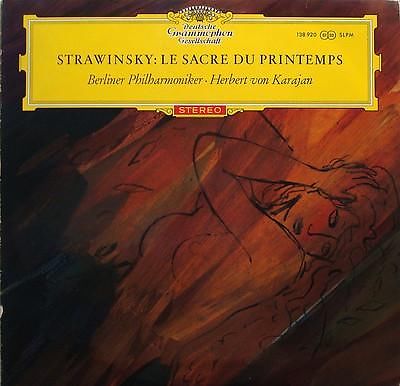
Karajan/BPO: Le sacre du printemps - DG SLPM 138 920 (Red Stereo)
$
35


Favourite Auctions
To save auctions to your favourites, please login
If you don't have an account, please register
Description
redgarnett Store
ITEM DESCRIPTION:
This beautiful LP – rare in the "red stereo" incarnation – from Deutsche Grammophon (SLPM 138 920) features Herbert von Karajan and the Berlin Philharmonic Orchestra's first taping of Stravinsky's Le sacre du printemps (version 1943), recorded in the rich acoustics of the Jesus-Christus-Kirche, Berlin on 17 October 1963, a remarkable performance, albeit one that drew the ire of its composer. For this recording, the production director was Otto Gerdes, the artistic supervisor Hans Weber, and the recording engineer Günter Hermanns. Note: On the back of the jacket the pressing / publication date is indicated as June 1964.
Wrote the critic J.N. in his review for the December 1964 issue of The Gramophone: "The first thing to be admired about this newest record of Sacre is its efficiency. It is a splendidly drilled performance that Karajan gets from his Berlin players, with scarcely any of the momentary untidinesses that tend to afflict even the best accounts of this taxing score. Perhaps the strings just occasionally react a little sluggishly to Stravinsky's cross-rhythms (for example in those rushing fanfare-like figures just before the woodwind melody that ushers in the "Rondes printanières") but the wind and brass are excellent; only Bernstein's version with the New York Philharmonic, for instance, can boast such a good D trumpet. The recorded sound too, though it does not have the breathtaking clarity that Decca gave Ansermet, is wide and handsome, and superior in the very heavily scored tuttis to that which CBS provided for Stravinsky's own most recent version. (In all fairness it should be pointed out that CBS devote more than half of their first side to a talk by Stravinsky, while DGG reserve the whole of it for the first of the ballet's two tableaux: I see that in America the Stravinsky recording is pressed without the speech, which might well result in improved clarity and dynamic range.) The balance is very natural, and my only complaint is that just occasionally certain details seem to be spotlit, notably the solo 'cello's pizzicato C's just before figure 8 in the Prelude and the doublebass's held B flat immediately after it.
"Clearly, then, this version deserves to be rated among the two or three best, and yet I have to admit that I personally find it less attractive (if that is the word) than some performances that are technically inferior to it. There is no question that Karajan, absolute master of his craft, gets what he wants: the question is whether what he wants is what the score really demands, and this I doubt. There are two general ways in which he has conspicuously imposed his own style on the music. The first is in the slow music—the Prelude, the woodwind melodies that frame the "Rondes printanières", the whole first section of the second tableau and the "Action rituelle" that precedes the orgiastic final dance. Here he tends to take the music rather slower than most conductors, and with a care for melodic nuance that seems to me out of place: admittedly Stravinsky marks the close-harmony violas at the beginning of the "Cercles mysterieux des adolescentes", to be played molto cantabile, but Karajan surely phrases them in far too sophisticated and self-conscious a manner, and in doing so lets the music's inner tension slacken. If something of the same lack of tension makes itself felt in the quicker dances, though, it is for a different reason. Karajan takes these well up to speed, indeed better than many conductors manage to, but what he doesn't seem willing to demand from his players is a real staccato. Take the famous repeated chords that start immediately the Curtain goes up on the first scene of the ballet; instead of bouncing, they thud relentlessly, and the same thing happens many times later in the course of the score. I'm not certain whether this is a general German characteristic or a particular Karajan one, but I know that it does much to rob this performance of the sense of sheer physical exhilaration that it ought by rights to produce; instead of exhilarating it manages, by a hair's breadth, to sound at times merely brutal.
"And yet, it must be said, there's nothing remotely coarse about the skill and subtlety with which Karajan manages to blend and balance sonorities (in the opening of the second tableau, for example) and to control dynamics (as in the accompaniment to the "Action rituelle"). If there is brutality in this performance it is of a completely calculated kind—and I suspect that what I ultimately dislike is a certain coldness, a certain lack of the sheer animal high spirits without which the violence of Sacre can sound repellent. But of course this is a very personal judgement, and you may well feel quite differently about this performance. At any rate I hope I've indicated that it is not to be dismissed lightly, even if you eventually come down on the side of the less technically perfect but to me more genuinely exciting version made by the composer himself with the Columbia Symphony Orchestra."
There are fine liner notes on the reverse side of the jacket (printed in German, English, and French) by Heinz Becker.
CONDITION:
The gradations of condition I use are as follows: MINT, Near-Mint, Excellent, Very Good, Good, Fair, Poor.
The condition of the jacket is VERY GOOD. There is some edgewear, more so to the spine and corners, slight creasing, and mild discoloration to the rear panel. However, there are no seamsplits, bends, or owners' markings and the jacket remains, solid, bright, glossy, and highly attracive – overall, this rates as a very good collector's copy.
The condition of the LP itself is EXCELLENT. Although there is some occasional light surface noise, in general the playback is quite fine. However, those wanting a flawless or near-MINT copy are kindly advised to look elsewhere. Overall, this rates as an excellent collector's copy.
PLEASE NOTE:
The images I've provided are of the actual item you are potentially bidding on - these are not stock images or images I've taken from other sites. Bid with confidence!
PAYMENT:
Payment by PayPal is greatly preferred. Payment should be made within 5 days.
SHIPPING:
Shipping is free to anywhere in the world; this is true regardless of the number of LPs you buy, be it 1 or a 100. All LPs will be sent via standard airmail (7-10 days delivery). Note: There is no tracking number provided with standard airmail. Should you wish to have your item(s) sent via certified airmail (i.e., with a tracking number), please contact me. The fee for this $5.00 USD.
FEEDBACK:
I will promptly leave feedback for all buyers. Please do not leave negative, or even neutral, feedback without first giving me an opportunity to resolve any dissatisfaction you might have with an item or transaction. I do understand that, on occasion, a buyer might believe the item description to be inaccurate or that a buyer may be disappointed in some other way regarding the sale. I promise I will do my very best to resolve any unhappiness you've experienced in your buying experience with me to your complete satisfaction. Thank you.
REFUNDS:
Returns are honored, and any buyer you makes a return will be refunded in full. Please contact me before making a return.
Please see my other classical LP and CD auctions, and feel free to write with any questions, I'll be glad to help.
price rating



![Steve Earle - Live at Austin City Limits [Blue Vinyl] NEW Vinyl](https://www.popsike.net/php/thumbnail.php?url=https://www.popsike.pics/pix/20240821/286022541021.jpg)