PINK FLOYD THE FINAL CUT LP 1st UK PRESSING A-1
£
26
$
34


Favourite Auctions
To save auctions to your favourites, please login
If you don't have an account, please register
Description
PINK FLOYD THE FINAL CUT LP 1st UK PRESSING A-1 RARE ORIGINAL IN AMAZING CONDITION TRUE 1st PRESSING Hi my name is Steve and I have been collecting LP's and 7" singles for nearly 30 years, and until just recently I have had emails from bidders that have emailed me stating that their records have some surface noise when played.
Now I’m not here to have an open debate or argument with anyone in the Ebay community, whether they be professional or amateur seller but I have purchased sealed audiophile heavyweight pressings that have suffered from surface noise and in the odd case were totally unplayable.
I have purchased sealed records straight from the factory and these have suffered some degree of surface noise.
The records that I put onto Ebay are 2nd hand records either my own or have been given to me and have in many cases been played, some more than others. But I will always highlight this fact when grading, if the vinyl has surface marks these will be pointed out also.
I’m sorry but i don’t always have time to play grade every single item, and my grading is done by purely visual means, so please view my feedback and you will see that I try to give the best account on the condition of any item I put up for auction.
I will though play LP’s, singles that are very collectable to get a better insight to the playing condition of the item being sold for auction.
Now I accept that the above may differ from any winning bidders perception of what I have graded. But I cannot always vouch for whether the record plays all the way through in total black silence with no noise. If you have any doubts then please email me or again just view my feedback.
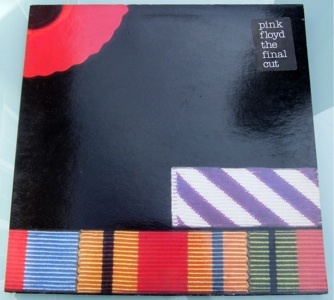
PINK FLOYD: The Final Cut. Rare Original 1st Pressing 1983 UK 12-track vinyl LP with picture labels, gatefold picture sleeve with lyrics printed inside. Both sleeve & vinyl are in great condition! SHPF1983. .
The Final Cut is a rock album by Pink Floyd recorded at various studios in the UK from July to December 1982. It is the final Pink Floyd studio album to feature the band's bassist and primary songwriter Roger Waters. The album is predominantly the work of Waters, this being the only Pink Floyd album on which the composers' credit on every track is given to Waters alone, with no songwriting credits given to any other member of the band. Keyboardist Rick Wright played no part in the recording of The Final Cut having been sacked by Waters during recording of The Wall, meaning that this is the only Pink Floyd album on which Wright does not feature at all. David Gilmour meanwhile sings lead vocals on only one of the album's twelve songs, the rest being sung entirely by Waters. The recording of The Final Cut was marred by tension between Waters and his bandmates, particularly Gilmour, who has since expressed his dislike for much of the album. For these and other reasons, it is sometimes regarded as a Roger Waters solo album rather than a true Pink Floyd album. None of the album's songs has ever been performed live by Pink Floyd, though some have been performed live by Waters during solo tours. Waters' dominance on the album is most clearly seen on the back cover, which reads: The Final Cut: A Requiem for the Post-War Dream - by Roger Waters, performed by Pink Floyd.
History
The Final Cut was originally scheduled to be nothing more than a film soundtrack album for the band's 1982 movie The Wall. The album was originally to be entitled Spare Bricks and would have featured songs from The Wall which had been re-recorded for the film, such as 'Mother', 'Bring the Boys Back Home', 'Another Brick in the Wall (Part 3)', 'Outside the Wall' and the new versions of 'In the Flesh?' and 'In the Flesh' with the film's lead actor Bob Geldof on lead vocals, as well as two songs included in the film but not on the original album ('When the Tigers Broke Free (Parts 1 and 2)' and 'What Shall We Do Now?'). Roger Waters also planned to record a small amount of 'new' material for inclusion on the album (actually old songs he had intended for the Wall album but which the band had rejected at that point) which would further flesh out The Wall narrative, such as 'Your Possible Pasts' (part of the lyric of which was recited by Geldof during the film), 'One of the Few', 'The Hero's Return' and 'The Final Cut'.
At some point during the period when the album was still planned as a The Wall soundtrack LP, the working title was changed to The Final Cut, in reference to both the title of one of the songs scheduled for inclusion and also to the album's purpose as a film soundtrack and to it being the last product of the long running The Wall multimedia project. When 'When the Tigers Broke Free' was issued as a single with the re-recorded film version of 'Bring the Boys Back Home' on the B-side, the label on both sides of the single claimed the tracks to be taken from the forthcoming Final Cut album - however neither song ultimately ended up being included on the album due to Roger Waters' decision to radically change the content and purpose of the album.
His decision came after the Falklands War between the United Kingdom and Argentina in summer 1982. Waters was so enraged by the war, which he considered as Margaret Thatcher wasting the young British lives to improve her own political standing, and especially the sinking an Argentine cruiser bearing hundreds of teenage Argentine conscripts, that he quickly wrote a large batch of new material, attacking Thatcher's supposed war-mongering, which he deemed a betrayal of the hopes and dreams of those who had earlier fought in the Second World War. Waters decided that The Final Cut should not be merely a The Wall soundtrack album after all but a proper, new Pink Floyd studio album. He elected to ditch the re-recordings of songs from The Wall and the previously released 'When the Tigers Broke Free', while retaining the old songs previously rejected from The Wall album as they fitted well with the new material thanks to their appropriate subject matter and also established a conceptual and thematic link between the new album and The Wall. The rest of the album was to be taken up with Waters' new material.
However the recording sessions for the album, taking place at various studios around England, including Abbey Road Studios and Waters' own Billiard Room Studios, did not run smoothly. Both David Gilmour and Nick Mason were unenthusiastic about Waters' ideas for the new album, with Gilmour in particular expressing strong reservations about both the material Waters wanted to record and also the general direction Waters' writing was taking. Gilmour objected to Waters' plans to include old songs on a new Pink Floyd studio album that had years before been rejected from The Wall, asking Waters "if these songs were not good enough then, why are they good enough now?". Gilmour also felt that the old and new material alike was mostly weak or uninteresting musically and that the band were losing the "balance" between the music and lyrics. In addition Gilmour also argued that Waters' lyrics had become too "specific" as opposed to his earlier, more "nebulous" lyrics that were open to multiple interpretations - he particularly objected to Waters' direct references to Thatcher and other world leaders, which he felt was an unsuitable form of lyric writing for a Pink Floyd album. Gilmour claims that Waters seemed to regard his complaints and suggestions as "interference" and, unlike in the past, he was unwilling to allow other band members to have their say. Gilmour has suggested that the reason for this change in Waters' attitude towards him personally was due to a breakdown in their relations during the making of the Wall movie, caused by Gilmour going over Waters' head to coax director Alan Parker back to the film set to continue directing the movie after he had previously walked out and left Waters to take over.
With Rick Wright out of the band having been sacked by Waters, keyboards on the album were played by Michael Kamen and Andy Bown. Aside from playing rhythm guitar on most of the tracks, Gilmour is restricted to four, relatively short guitar solos and provides lead vocals on only one of the album's twelve songs. Mason does play drums on most of the tracks, though Waters hired renowned session drummer Andy Newmark to play drums on 'Two Suns in the Sunset' due to his dissatisfaction with Mason's attempts at handling the song's time signature changes. Mason also created most of the holophonic sound effects heard on the album, spending several weeks making field recordings at various locations in the U.K., including a RAF base (Waters however insisted that Mason receive no credit on the album sleeve for any of his work creating sound effects, nor any additional royalties). Waters himself plays bass and sings on every track, as well as providing various acoustic and rhythm guitar parts. Other musicians brought in to contribute included renowned percussionist Ray Cooper and saxophonist Raphael Ravenscroft, who was best known for playing the iconic saxophon solo on Gerry Rafferty's Baker Street. Kamen, in addition to playing keyboards, arranged the orchestrations on the album. Gilmour initially started out co-producing the album with Waters and James Guthrie, but eventually agreed to have his production work go uncredited on the album (although he still received a share of the producers' royalties).
The Final Cut was recorded using "Holophonics" - an audio processing technique used to enhance the aural three-dimensional 'feel' of the recording. Holophonics was used to make sound effects on the album appear more three-dimensional to the listener - sound effects, particularly when heard on headphones, appear to pass not just from left to right in the stereo spectrum but also from in front to behind of the listener and around them. Perhaps the most notable use of holophonics on the album is on the song 'Get Your Filthy Hands Off My Desert' - during the intro, an aeroplane is heard to fly swiftly overhead, passing from in front of the listener to behind them, before a huge explosion from the bomb it has dropped is heard surrounding the listener both in front and behind them and to either side of the stereo picture. The use of this technique was in keeping with Pink Floyd's long standing interest in using atmospheric sound effects combined with advances and innovations in audio technology to enhance the listener's experience of their music. It was also claimed that this process could not be duplicated if one made a copy of the recording i.e., copying from the vinyl record to tape cassette.
Relations between Roger Waters and the rest of the band effectively broke down during the sessions. Waters dominated proceedings, furthering the tension between himself and his bandmates, particularly Gilmour. Gilmour reported that Mason "wasn't around very much" and, when he was, Waters repeatedly criticised the drummer and told him he was "crap", destroying his confidence as a musician. Gilmour states that with Mason beginning to attend the studio infrequently, Waters then "started on me", leading to many severe arguments between them. Mason has stated that one exchange in the studio became so heated that it erupted into violence, with Gilmour and Waters coming to blows before being separated by himself and James Guthrie. Both Gilmour and Waters have always denied this. Gilmour has said that relations eventually became so strained that he effectively walked out on the sessions and left Waters to it, telling him "look, if you need a guitar solo, phone me" before leaving. Waters himself has suggested that his singing suffered on the album due to the arguments and in-fighting causing so much tension that he felt unable to truly "express myself", and that he realised during the sessions that Pink Floyd effectively no longer existed as a functioning band. Waters stated that, because of his bandmate's objections to the content of the work, he ultimately offered to release The Final Cut as a solo album crediting Gilmour and Mason only as session players, but Gilmour refused and requested the album be released as a Pink Floyd record due to pressure from the band's record company EMI, who wanted a Pink Floyd album, not a Roger Waters solo album. However, in his book Inside Out: A Personal History of Pink Floyd, Nick Mason disputed this account, writing that Roger never offered to release The Final Cut as a solo album, something he has also stated in the past. Regardless, the album cover clearly spelled out Waters' domination on the work by the subtitle "A Requiem for the Post War Dream by Roger Waters, performed by Pink Floyd".
The Final Cut LP was released by Harvest/EMI in the U.K. on 21 March 1983, then on Columbia Records in the U.S. on April 2. The Final Cut reached #1 on the UK album charts - something that both Dark Side of the Moon and The Wall had failed to do - but was less successful in the U.S. in this regard, peaking at number 6 in the U.S. on the Billboard album charts. The Final Cut went Gold and Platinum in the U.S. in May of 1983 with a million copies in sales and then Double Platinum on 31 January 1997. The Final Cut was however the lowest selling Pink Floyd studio album since Meddle (released in 1971) in both the U.S. and worldwide. Gilmour would later claim that this relative commercial "failure" proved that he was correct to assert that much of the material on the album was weak.
'Not Now John' was released as a single worldwide to promote the album, with the lyric "f**k all that" overdubbed as "stuff all that" (the lyrics on the sleeve of the 7" single contain that phrase "stop all that") in order to attain radio airplay. The single featured an extended version of 'The Hero's Return' on the B-side which included an additional verse.
The Final Cut was to be the only Pink Floyd album not to have a concert tour in support of the album as the band simply went their separate ways after completing the album, with Roger Waters diving head first into the recording of The Pros and Cons of Hitchhiking while David Gilmour recorded his own solo album About Face. Reportedly some preliminary plans were made for a Final Cut tour but it seems that the idea of any live performances promoting the album was quickly abandoned, presumably due to the breakdown in relations between the band members and also possibly Gilmour and Mason's dislike of much of the material. No songs from the album have ever been performed live by Pink Floyd since, although Roger Waters has played a number of the songs live on all of his subsequent solo tours, starting with his very first such tour promoting The Pros and Cons of Hitchhiking in 1984.
With the album finished and released, the band went their separate ways, with Gilmour and Waters both embarking on solo projects. The status of the band was unclear, with Waters having decided that Pink Floyd was no longer a functioning unit and with Gilmour apparently largely in agreement and determined to try and establish a career for himself outside of Pink Floyd. Conversely however, the band publicly denied that The Final Cut would be their last album together, as had been rumoured. In 1985, after Gilmour had attempted to persuade Waters to begin work on a new Pink Floyd project after the guitarist's own solo outings had met with a mixed response, Waters announced that he had left the band and that Pink Floyd were a "spent force creatively", with Waters intimating that his departure meant the band no longer existed. To Waters' shock and disapproval, Gilmour and Mason announced that they intended to continue with Pink Floyd regardless of his departure and, along with former keyboardist Rick Wright hired as a session player, later released a new Floyd album, A Momentary Lapse of Reason, in 1987 and, with Wright eventually restored as a full time member of the band, continued to tour and record as a trio.
Themes
The Final Cut is an anti-war concept album, though it is usually perceived to be extremely dark and pessimistic in tone. The album was inspired by the rise of Margaret Thatcher and Britain's involvement in the Falklands War. Waters' lyrics explore what he regards as the betrayal of the British servicemen, such as his own father, who sacrificed their lives in the Second World War in the hope that victory would allow successor generations to build a better, more humane society based on progressive, humanist values, where political leaders would heed the lessons of the past and no longer be so readily prepared to resort to war as a means of settling disputes or furthering their aims (this being the 'Post-War Dream' referred to on the album sleeve). The album is heavily critical of Thatcher, who Waters apparently regards as the chief architect of this betrayal.
Musically, much of The Final Cut has little connection with the familiar Pink Floyd sound, featuring little in the way of synthesisers or extended instrumental passages and with many of the arrangements focused around acoustic instruments such as acoustic guitars, piano, brass, string quartets and full orchestrations, although the album does also feature some heavier, hard rock songs which have arrangements and an overall sound similar to many tracks on The Wall.
The Final Cut was Pink Floyd's lowest selling album since Meddle (although it still sold three million copies, and reached number 1 in the British album charts). Opinion on The Final Cut remains divided - while the album has on occasion been voted the worst Pink Floyd album in fan polls and is held in low regard by some fans and critics, others have suggested that the album contains some of the most powerful and moving songs in the band's catalogue.
THE COVER: The cover shows faint wear to the top and bottom edges. There is also a small amount of wear to the corners of this LP. The corners are slightly rounded. The cover remains free though of any writing splits or tears.
I have graded the cover in Excellent++ condition.
THE BACK COVER: The back cover remains in the same condition as the front.
I have also graded this in Excellent condition.
THE INNER SLEEVE: Original lyric inner showing no damage or writing to any part of the inner sleeve.
THE VINYL: The lp's vinyl still retains a fantastic shine to both playing surfaces and shows only some very faint marks viewed under strong light where the LP has been taken from its paper sleeve. There are no scratches to either side of this LP. I have graded the LP in Near Mint condition.
THE LABELS: Picture label.
Text around the bottom edge of the label says:
All rights of the producer and of the owner of the recorded work reserved. Unauthorized copying, hiring, renting, public performance and broadcasting of this record prohibited. Manufactured in the U.K. by EMI Records Limited.
Both labels show no spindle marks and look unplayed. Both labels are in excellent condition with no writing on either surface.
THE SOUND:
Played and listened to on a Elite Rock II, Linn Ittok with Clearaudio Sigma cartridge.
Amplification. Lavadin amp.
Speakers Horn loaded hand made by Resolution Speakers.
SIDE 1: Played all the way through without skipping or jumping the sound was solid, tight, in focus and crystal clear with no distortion.
There is the odd faint surface pop but this doesn't spoil the pleasure of listening to this classic LP. There is again some very faint surface noise in between tracks but again not excessive. A listening pleasure on this holophonic pressing.
SIDE 2: Again played all the way through with no skips or jumps the sound once again sounding solid, sharp in focus and crystal clear with no evidence of distortion.
Surface noise was heard once again on the run in groove to the first track.
With the odd occasional light tick.
Again inbetween tracks some faint surface noise was heard but again it did not interrupt or detract from the listening pleasure of this holophonic pressing .
Overall the the sound of this LP is truly stunning concidering its age and i can only grade it as Near MInt .
Spine tingling sound quality.
MATRIX NUMBERS:
SIDE 1 SHPF 1983 A-1U-1-3-1 TML-S
SIDE 2 SHPF 1983 B-2U-1-2- TML-M
Tracklisting:
Side one
1. "The Post War Dream" – 3:02
2. "Your Possible Pasts" – 4:22
3. "One of the Few" – 1:12
4. "The Hero's Return" – 2:56
5. "The Gunner's Dream" – 5:07
6. "Paranoid Eyes" – 3:40
Side two
1. "Get Your Filthy Hands Off My Desert" – 1:19
2. "The Fletcher Memorial Home" – 4:11
3. "Southampton Dock" – 2:13
4. "The Final Cut" – 4:46
5. "Not Now John" – 5:01
Lead vocals: David Gilmour and Roger Waters
6. "Two Suns in the Sunset" – 5:14
All songs composed by Roger Waters. All lead vocals performed by Roger Waters unless otherwise stated.
Year of Release: 1983 - 25 years old
Artist: Pink Floyd
Title: TheFinal Cut
Format: LP
Record Label: Harvest
Catalogue No: SHPF1983
Additional info: Deleted
Country of Origin: UK
POSTAGE
Delivery First Class to a UK address (Recorded Delivery will be extra)
Delivery to a Europe or Worldwide address via Standard Air Mail (Insurance and International Signed for optional)
I will always obtain proof of postage this is by receipt from post office and can be emailed as a jpeg. I offer postal insurance / Recorded Delivery (This is payable by you as an optional extra).
I will only send items by First class or Airmail unless the buyer indicates differently please email to discuss what best suits you. ALL Records are packed separately to the sleeves to avoid seam-splitting stiffeners and padding will be added where necessary.
IT IS YOUR CHOICE TO PAY FOR RECORDED OR POSTAL INSURANCE, I WILL NOT ACCEPT RESPONSIBILITY FOR THE ITEM AFTER I HAVE POSTED IT IF YOU DO NOT.
PLEASE NOTE THE FOLLOWING PAYMENT TERMS:
Payment must be made in British Pounds Sterling only (GBP)
Accepted methods of payment: PayPal, Postal Order, Cheque.I will only accept cheques in GBP against UK Banks all items are sent out as soon as the cheque have cleared.
ALL PAYMENTS MUST BE RECEIVED WITHIN 14 DAYS OF THE CLOSE OF AUCTION.
I will always try to be very careful and honest when grading, and all feedback is appreciated if you are not entirely happy with your item that you have won, I will gladly refund all monies on return of item. If you have any questions regarding this item please e-mail me before placing any bids.
PLEASE DO NOT checkout and assume you know the postal cost of the item you have won until you have received an email from me regarding total payment instructions.
This will speed up the process. Many thanks!
PLEASE CONSIDER THE ABOVE TERMS CAREFULLY BEFORE BIDDING.
Bid with confidence and good luck. Before you leave why not take a peek at my other auctions, go on you know it makes sense.
Or why not add me to your favourite sellers list.
Otherwise you’ll never know when i’m about to sell any other interesting records from my collection!
PEACE.
Please see description. 236 (GS 5.0.3 (236))
price rating