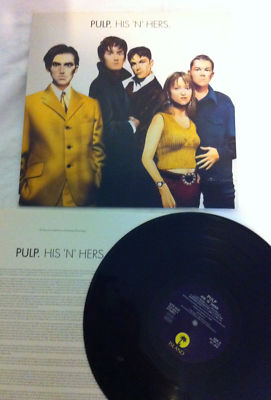
PULP - His 'N' Hers LP (Vinyl, 1994, Island Records, with Lyrics Inner)
£
47
$
62


Favourite Auctions
To save auctions to your favourites, please login
If you don't have an account, please register
Description
Nice condition copy of Pulp's must own LP from 1994, 'His 'n' Hers'. With Lyrics inner.
FORMAT: Vinyl LP, 33rpm
RECORD LABEL: Island
COUNTRY OF ORIGIN: Europe
RELEASE DATE: 21st June 1994
CATALOGUE NO: ILPS 8025
(NOTE: I am now play-grading all my vinyl. I can't promise to play everything all the way through, but will be checking for any curving or warping and/or excessive surface noise - hiss, snap, crackles & pops. And if there are any dodgy looking areas with gouges, scratches, pit marks etc. I will double check that there is no skipping or sticking, and that playback is not adversely affected)
LP: Excellent
OUTER SLEEVE: Excellent (but with 2cm seam split to outer layer of sleeve at the top)
INNER SLEEVE: Excellent
POSTAGE: £3.00 UK. £4.00 EUROPE. £7.00 THE REST OF THE WORLD.
STORED OUT OF SUNLIGHT IN VERTICAL POSITION. FROM A PET, DAMP AND SMOKE FREE HOME.
ANY QUESTIONS OR REQUESTS FOR MORE DETAILED PHOTOS ETC, PLEASE DO NOT HESITATE TO CONTACT ME.
I TRY & GRADE ALL SLEEVES AND VINYL AS FAIRLY & ACCURATELY AS POSSIBLE, BUT IF YOU FEEL I HAVE GRADED THIS RECORD INCORRECTLY, OR IF ANY OF THE ABOVE INFORMATION IS INCORRECT PLEASE TELL ME.
ALL VINYL WILL BE POSTED IN A GLASS CLEAR, VERY BEST QUALITY 450G PVC SLEEVE, IN A CARDBOARD RECORD MAILER, WITH CARDBOARD STIFFENERS, REMOVING ALL INNERS TO PREVENT SPLITTING TO THE SEAMS IN TRANSIT.
RECORD WILL BE REMOVED FROM ORIGINAL INNER & PLACED IN GENERIC PAPER SLEEVE FOR SHIPMENT.
Tracklisting
A1 Joyriders
A2 Lipgloss
A3 Acrylic Afternoons
A4 Have You Seen Her Lately?
A5 She's A Lady
B1 Happy Endings
B2 Do You Remember The First Time?
B3 Pink Glove
B4 Someone Like The Moon
B5 David's Last Summer
LP Review (courtesy of Allmusic.com)
Pulp had been kicking around since 1981, but for all intents and purposes, their 1994 major-label debut, His 'n' Hers is their de facto debut: the album that established their musical and lyrical obsessions and, in turn, the album where the world at large became acquainted with their glassy, tightly wound synth pop and lead singer Jarvis Cocker's impeccably barbed wit. This was a sound that was carefully thought out, pieced together from old glam and post-punk records, assembled in so it had the immediacy (and hooks) of pop balanced by an artful obsession with moody, dark textures. It was a sound that perfectly fit the subject at hand: it was filled with contradictions -- it was sensual yet intellectual, cheap yet sophisticated, retro yet modern -- with each seeming paradox giving the music weight instead of weighing it down. Given Pulp's predilection for crawling mood pieces -- such effective set pieces as the tense "Acrylic Afternoons," or the closing "David's Last Summer" -- and their studied detachment, it might easy to over-intellectualize the band, particularly in these early days before they reached stardom, but for all of the chilliness of the old analog keyboards and the conscious geek stance of Cocker, this isn't music that aims for the head: its target is the gut and groin, and His 'n' Hers has an immediacy that's apparent as soon as "Joyriders" kicks the album into gear with its crashing guitars. It establishes Pulp not just as a pop band that will rock; it establishes an air of menace that hangs over this album like a talisman. As joyous as certain elements of the music are -- and there isn't just joy but transcendence here, on the fuzz guitars that power the chorus of "Lipgloss," or the dramatic release at the climax of "Babies" -- this isn't light, fizzy music, no matter how the album glistens on its waves of cold synths and echoed guitars, no matter how much sex drives the music here. Cocker doesn't tell tales of conquests: he tells tales of sexual obsession and betrayal, where the seemingly nostalgic question "Do You Remember the First Time?" is answered with the reply, "I can't remember a worst time." On earlier Pulp albums he explored similar stories of alienation, but on His 'n' Hers everything clicks: his lyrics are scalpel sharp, whether he's essaying pathos, passion, or wit, and his band -- driven by the rock-solid drummer Nick Banks and bassist Steve Mackey, along with the arty stylings of keyboardist Candida Doyle and violinist/guitarist Russell Senior -- gives this muscle and blood beneath its stylish exterior. The years etching out Joy Division-inspired goth twaddle in the mid-'80s pay off on the tense, dramatic epics that punctuate the glammy pop of the singles "Lipgloss," "Babies," and "Do You Remember the First Time?" And those years of struggle pay off in other ways too, particularly in Cocker's carefully rendered observations of life on the fringes of Sheffield, where desperation, sex, and crime are always just a kiss away, and Pulp vividly evokes this world with a startling lack of romanticism but an appropriate amount of drama and a surplus of flair. It's that sense of style coupled with their gut-level immediacy that gives His 'n' Hers its lasting power: this was Pulp's shot at the big time and they followed through with a record that so perfectly captured what they were and what they wanted to be, it retains its immediacy years later.
Band Profile (courtesy of Allmusic.com)Most bands hit the big time immediately and fade away, or they build a dedicated following and slowly climb their way to the top. Pulp didn't follow either route. For the first 12 years of their existence, Pulp languished in near total obscurity, releasing a handful of albums and singles in the '80s to barely any attention. At the turn of the decade, the group began to gain an audience, sparking a remarkable turn of events that made the band one of the most popular British groups of the '90s. By the time Pulp became famous, the band had gone through numerous different incarnations and changes in style, covering nearly every indie rock touchstone from post-punk to dance. Pulp's signature sound is a fusion of David Bowie and Roxy Music's glam rock, disco, new wave, acid house, Europop, and British indie rock. The group's cheap synthesizers and sweeping melodies reflect the lyrical obsessions of lead vocalist Jarvis Cocker, who alternates between sex and sharp, funny portraits of working class misfits. Out of second-hand pop, Pulp fashioned a distinctive, stylish sound that made camp into something grand and glamorous that retained a palpable sense of gritty reality.
Jarvis Cocker formed Pulp in 1978, when he was 15 years old. Originally called Arabicus Pulp, the first lineup consisted of schoolmates of Cocker. After a year, the band's name was truncated to Pulp. While they were in school, Pulp performed a handful of gigs. The band recorded a demo sometime in 1980-1981, giving the tape to John Peel at one of his traveling shows. Peel liked the tape and invited the band to appear on his show. Pulp had their first Peel Session in November 1981. Instead of leading to record deals and pop stardom, Pulp's appearance on Peel led nowhere. Discouraged by the band's lack of success, every member but Cocker left the band in 1982 to go to university. The following year, Cocker assembled a new lineup which featured eight members, including keyboardist Simon Hinkler, who would later join the Mission. In this incarnation, Pulp had distinct folk overtones, as well as new wave underpinnings. The group landed their first record contract, releasing their debut album, It, in 1984. It didn't make much of an impact and the band fell apart again. After the second incarnation of Pulp disintegrated, Jarvis Cocker formed another version of the band, with guitarist/violinist Russell Senior, who became Cocker's first full-fledged collaborator. Cocker and Senior added drummer Magnus Doyle and bassist Peter Mansell to the group, as well as Tim Allcard, who did nothing but read poetry. Musically, Pulp backed away from the folky inclinations of It, adding keyboardist Candida Doyle in 1985, which led to a darker sound; shortly after her arrival, Allcard left the group. In 1985, Pulp released a series of singles on Fire Records. Just as their fortunes were looking up, Cocker became injured severely. As he was trying to impress a girl, he fell 30 feet out of a window, injuring his pelvis, foot, and wrist. For two months, he was confined to a wheelchair, but he performed concerts anyway.
Released in 1986, Pulp's second album, Freaks, was a dense, dark affair. Following its release, the band split during the filming of the video for "They Suffocate at Night." All of the members, except Cocker and Senior, left the group. For a year, the band was dormant, but Candida Doyle returned in 1987, with drummer Nick Banks and bassist Steven Havenhand joining shortly afterward. Havenhand was soon replaced by Anthony Genn, who was soon replaced by Steve Mackey. Although the group had a stable lineup, they weren't gaining much of a following. In 1988, Cocker moved to London with Mackey and began studying filmmaking at St. Martin's College. While he was studying, Pulp was offered the chance to record another album. The resulting album, Separations, was recorded in 1989 and reflected Cocker's newfound obsession with acid house but it also boasted some full-fledged pop songs. Separations was released nearly three years after it was completed. Cocker was prepared to stake out a career in film when a single from the album, "My Legendary Girlfriend," was released. NME named the song Single of the Week in 1991 and Pulp's career suddenly took off.
In early 1992, Pulp left Fire Records for Gift, and began releasing a series of singles that consolidated the success of "My Legendary Girlfriend." In particular, "Babies" earned the band a great deal of attention. "Babies" led to a contract with Island Records, their first major-label deal. Island released Pulpintro, a compilation of the Gift singles, as the band recorded its major-label debut, His 'n' Hers. Upon its spring 1994 release, His 'n' Hers earned positive reviews and became an unexpected success, reaching the British Top Ten; it was also nominated for the 1994 Mercury Award. For the rest of 1994 and the early part of 1995, Jarvis Cocker suddenly became omnipresent on British television. These suave, humorous television appearances became legendary, making Cocker somewhat of a national hero, as well as a sex symbol.
No matter how popular Jarvis Cocker had become, the band didn't break into the big time until they released "Common People." The single became a massive hit upon its May 1995 release, debuting at number two on the U.K. charts. In July, Pulp accepted a last-minute headlining slot at Glastonbury Festival when the Stone Roses had to cancel. Pulp's set was rapturously received, launching the band into superstar status in England and conveniently setting the stage for their forthcoming album, Different Class. During the recording of the album, guitarist Mark Webber -- the president of Pulp's fan club -- became a full-time member of the group. The first record to feature Webber was the double A-sided single, "Mis-Shapes" and "Sorted for E's & Wizz," which was released in August, two months before Different Class. The single became a number two hit, despite a major tabloid controversy over the lyrics to "Sorted."
Different Class arrived in late October to rave reviews throughout the British press. The album entered the charts at number one, going gold within its first week and platinum within the second. At the end of the year, the album topped many best-of-the-year lists. In February of 1996, Different Class was released in the United States to positive reviews. The massive fame and attention that Different Class brought Pulp influenced the direction of their follow-up, 1998's world-weary, paranoid This Is Hardcore. The album's troubled sound and somewhat mixed reception led some to speculate whether or not the group would continue; the band's members took some time to pursue side projects such as DJ-ing at various nightclubs and remixing tracks for artists like Black Box Recorder and Death in Vegas. Meanwhile, they continued to play live, performing at various festivals, including the Meltdown festival curated by Scott Walker. Walker proved such an inspiration for the group that Pulp hired him on as the producer of their new material after recording with Chris Thomas went unsatisfactorily. The resulting album, We Love Life -- its name inspired by the September 11 terrorist attacks -- was released in the fall of 2001 in the UK and in the spring of 2002 in the US to critical acclaim. In 2006, Cocker released a solo album entitled Jarvis.
price rating
![Private Dancer [Remaster] [LP] by Tina Turner (Vinyl, Capitol/EMI Records)](https://www.popsike.net/php/thumbnail.php?url=https://www.popsike.pics/pix/20230525/394643004446.jpg)