The Beatles "The Beatles" Apple Records ?PCS 7067/8 g/f +photos/poster reissue
£
20
$
27
Favourite Auctions
To save auctions to your favourites, please login
If you don't have an account, please register
Description
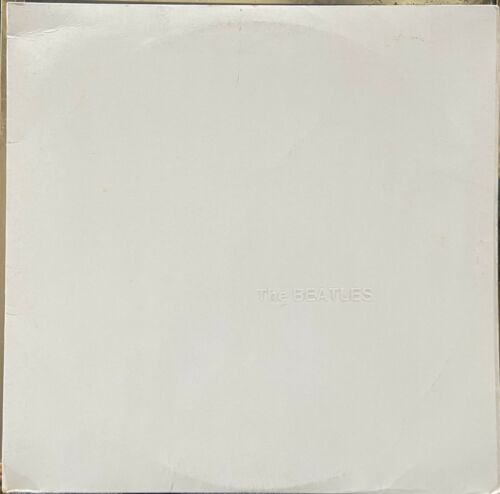
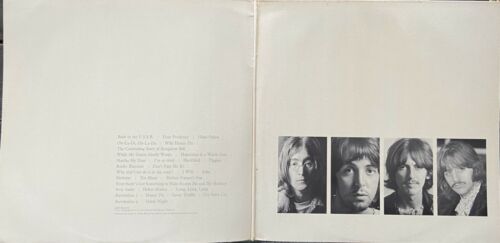
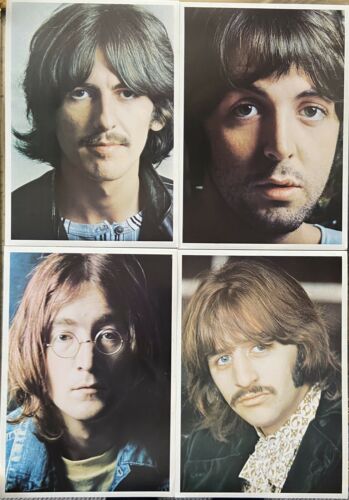
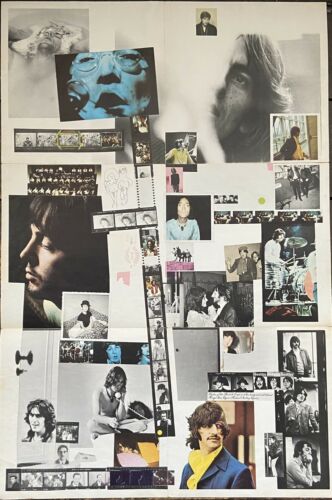
The Beatles ? "The Beatles" Apple Records ?PCS 7067/8 UK reissue 2 × Stereo Vinyl, LPs, reissued in 1980 with 4 glossy photographs and a double-sided poster. Commonly known as ''The White Album'', this issue has an unnumbered, embossed sleeve, which opens on right.
Both LPs appear to have been lightly played and are in lovely condition. They played through beautifully on my elderly stereo - no hop, stick or jump. They are housed in a gate-fold sleeve which shows minimal signs of wear and which is also in great shape - no rips or writing. The spine is intact and legible.The photos are in good shape, but the poster is a little more worn, although it is still intact - no rips or writing. Matrix / Runout Side 1 : 1 YEX 709-1 HRM Matrix / Runout Side 2 : 2 YEX 710-5 136 Matrix / Runout Side 3 : 3 YEX 711-1 393 Matrix / Runout Side 4 : 4 YEX 712-2 364
"The Beatles", also known as "The White Album", is the Beatles' ninth studio album and their only double album, originally released on 22 November 1968. Its plain white sleeve has no graphics or text other than the band's name embossed, which was intended as a direct contrast to the vivid cover artwork of the band's previous LP "Sgt. Pepper's Lonely Hearts Club Band". "The Beatles" is recognised for its fragmentary style and diverse range of genres, including folk, British blues, ska, music hall and the avant-garde. It has since been viewed by some critics as a postmodern work, as well as among the greatest albums of all time.
Most of the songs on the album were written during March and April 1968 at a Transcendental Meditation course in Rishikesh, India. There, the only western instrument available to the band was the acoustic guitar; some of these songs remained acoustic on "The Beatles" and were recorded solo, or only by part of the group. The production aesthetic ensured that the album's sound was scaled-down and less reliant on studio innovation, relative to all their releases since 1966's "Revolver". "The Beatles" also broke with the band's recent tradition of incorporating several musical styles in one song by keeping each piece of music consistently faithful to a select genre.
At the end of May 1968, the Beatles returned to EMI Studios in London to commence recording sessions that lasted through to mid-October. During these sessions, arguments broke out among the foursome over creative differences and John Lennon's new partner, Yoko Ono, whose constant presence subverted the Beatles' policy regarding wives and girlfriends in the studio. After a series of problems, including producer George Martin taking a sudden leave of absence and engineer Geoff Emerick suddenly quitting, Ringo Starr left the band briefly in August. The same tensions continued throughout the following year and led to the band's break-up.
Upon release, "The Beatles" received favourable reviews from the majority of music critics; detractors found its satirical songs unimportant and apolitical amid the turbulent political and social climate of 1968. Nonetheless, "The Beatles" topped record charts in Britain and the United States. Although no singles were issued in either territories, the songs "Hey Jude" and "Revolution" originated from the same recording sessions and were issued on a single in August 1968. Other leftover songs were reworked for "Abbey Road" (1969), "Let It Be" (1970) and the Beatles' solo records, including Lennon's "Jealous Guy" (1971).
In a 2003 appraisal of the album, for Mojo magazine, Ian MacDonald wrote that "The Beatles" regularly appears among the top 10 in critics' "best albums of all time" lists, yet it was a work that he deemed "eccentric, highly diverse, and very variable [in] quality". Rob Sheffield, writing in The Rolling Stone Album Guide (2004), said that its songs ranged from the Beatles' "sturdiest tunes since Revolver" to "self-indulgent filler". He derided tracks including "Revolution 9" and "Helter Skelter", but said that picking personal highlights was "part of the fun" for listeners. Writing for MusicHound in 1999, Guitar World editor Christopher Scapelliti described the album as "self-indulgent and at times unlistenable" but identified "While My Guitar Gently Weeps", "Happiness Is a Warm Gun" and "Helter Skelter" as "fascinating standouts" that made it a worthwhile purchase.
According to Slant Magazine's Eric Henderson, "The Beatles" is a rarity among the band's recorded works, in that it "resists reflexive canonisation, which, along with society's continued fragmentation, keeps the album fresh and surprising". In his review for AllMusic, Stephen Thomas Erlewine said that because of its wide variety of musical styles, the album can be "a frustratingly scattershot record or a singularly gripping musical experience, depending on your view". He concludes: "None of it sounds like it was meant to share album space together, but somehow "The Beatles" creates its own style and sound through its mess."
Among reviews of the 2009 remastered album, Neil McCormick of The Daily Telegraph found that even its worst songs work within the context of such an eclectic and unconventional collection, which he rated "one of the greatest albums ever made". Writing for Paste, Mark Kemp said "The Beatles" had been wrongly described as "three solo works in one (plus a Ringo song)", saying it "benefits from each member's wildly different ideas" and offers "two of Harrison's finest moments". In his review for The A.V. Club, Chuck Klosterman wrote that the album found the band at their best and rated it "almost beyond an A+".
It was voted number 5 in Colin Larkin's All Time Top 1000 Albums 3rd Edition (2000). In 2003, Rolling Stone ranked "The Beatles" at number 10 on its list of the 500 greatest albums of all time, maintaining the rating in a 2012 revised list. On the 40th anniversary of the album's release, Vatican newspaper L'Osservatore Romano wrote that it "remains a type of magical musical anthology: 30 songs you can go through and listen to at will, certain of finding some pearls that even today remain unparalleled". In 2011, Kerrang! placed the album at number 49 on a list of "The 50 Heaviest Albums Of All Time". The magazine praised the guitar work in "Helter Skelter". The album was also included in the book 1001 Albums You Must Hear Before You Die.
price rating