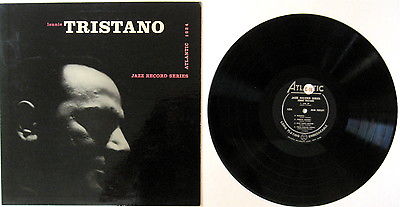
Tristano Self Titled LP Atlantic 1224 Jazz Record Series Hi Fi MONO 1955
$
25


Favourite Auctions
To save auctions to your favourites, please login
If you don't have an account, please register
Description
The Front of Album Cover is Good to Very Good Back of Cover is marked see picture. Record is in Very Good to Excellent Condition. There are some faint hairlines but these can only be seen under strong light but are otherwise hardly noticeable. Side one label has Rolodex Dot C-16 half inch white dot. See Picture .This was the 1955 Release.
L eonard Joseph Tristano (19 March 1919 – 18 November 1978) was a jazz pianist, composer and teacher of jazz improvisation. He performed in the cool jazz, bebop, post bop and avant-garde jazz genres. He remains a somewhat overlooked figure in jazz history, but his enormous originality and dazzling work as an improviser have long been appreciated by knowledgeable jazz fans. In addition, his work as a jazz educator meant that he has exerted a substantial influence on jazz through figures such as Lee Konitz and Bill Evans.
Tristano was born in Chicago into an Italian immigrant family from Aversa. He was blind from infancy and studied piano and music theory from pre-teen years, graduating from his home town's American Conservatory of Music in 1943.
Tristano's interest in jazz inspired a move to New York City in 1946. His advanced grasp of harmony pushed his music beyond even the complexities of the contemporary bebop movement, though Tristano was always explicit about acknowledging his enormous debt to Charlie Parker and Bud Powell. Other key ingredients in his style were Nat King Cole and Art Tatum, influences most audible in his early drummerless trio recordings. Though he and his followers remained at something of a slant to mainstream bebop, Tristano did on occasion play and record with bebop's preeminent figures such as Dizzy Gillespie and Charlie Parker, and Tristano was a pallbearer at Parker's funeral.[1] Often the "Tristano school" has been contrasted with bebop, however, by being labelled "cool jazz",[2] though this risks lumping his music in with unrelated styles like the West Coast cool jazz of the 195
Among Tristano's most important earlier recordings was a 1949 sextet session with his students, saxophone players Lee Konitz and Warne Marsh. After recording a number of conventionally structured compositions, Tristano had the group record "Intuition" and "Digression." Both pieces were completely improvised, with no prearranged melody, harmony or rhythm.[3] These two songs are often cited as the first recorded examples of free jazz or free improvisation.
His 1953 recording Descent into the Maelstrom is especially significant: an experiment in overdubbing which in its harsh atonality anticipates the much later work of players like Cecil Taylor[4] and Borah Bergman (who has specifically mentioned the piece as an important influence on his work).
Tristano released two important albums on Atlantic Records, which remain his best-known work. Lennie Tristano, from 1955, is famous for including innovative experiments with overdubbing ("Requiem" and "Turkish Mambo") and altered tape-speed ("Line Up" and "East 32nd").[5] The second side is a straightforward club gig in the company of Lee Konitz. "Requiem," a tribute to the late Charlie Parker, is notable for its deep blues feeling – a style not usually associated with Tristano. However, perhaps the most significant work lies in the composition "Line Up", a spiralling linear improvisation based on the changes to "All of Me".
The New Tristano (1962) remains a landmark in solo jazz piano.[6] Though on this occasion no overdubbing was used, the music is just as densely conceived, especially the classic "G Minor Complex," an improvisation on the changes of "You'd Be So Nice to Come Home To". Tristano's mimicking of a jazz bassist's accompaniment with his left hand on these recordings is distinctive and often imitated. The combination of this line with the dazzling line-spinning of his right hand also gives the music a contrapuntal flavour explicitly paying homage to Bach.
Tristano's distrust of jazz record labels and increasingly infrequent public performances meant that his recordings are comparatively scarce, and many of them are concert recordings of very variable fidelity. Some of his live performances were recorded and have been released, including those from the Half Note Club in New York from the 1950s, and concerts in Europe from the 1960s. He was one of the first musicians to start his own record label, Jazz Records, which is still in existence and is run by his daughter, the drummer Carol Tristano. The label Inner City released a compilation of various Tristano recordings, Descent into the Maelstrom.
Posted with eBay Mobile
price rating




![Smashing Pumpkins - Mellon Collie and the Infinite Sadness [4-LP Deluxe Box Set]](https://www.popsike.net/php/thumbnail.php?url=https://www.popsike.pics/pix/20181214/173690399650.jpg)