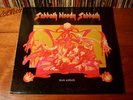
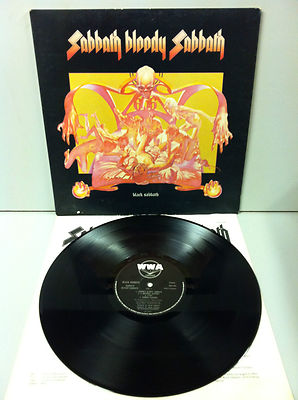
BLACK SABBATH- SABBATH BLOODY SABBATH 1973 WWA005 WITH LYRIC INNER EX- VINYL
£
30
$
40


Favourite Auctions
To save auctions to your favourites, please login
If you don't have an account, please register
Description
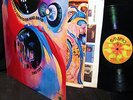
BLACK SABBATH- SABBATH BLOODY SABBATH 1973 WWA005 WITH LYRIC INNER! VG GATEFOLD SLEEVE EX- VINYL ONLY A FEW VERY LIGHT MARKS THAT DO NOT AFFECT PLAY
VINYL ALBUM GRADING/CONDITION
Guidelines for assessing the grading / condition of used records (based on Goldmine Grading for Records)
MINT (M): Perfect! This record looks like it has just left the manufacturer, with NO flaws what so ever. It looks as though it had never been handled. No scuffs or scratches, blotches or stains. No stickers address labels, writing on the covers or labels. No tears or seam splits. No wear to the cover or record period! Age of the record has nothing to do with it.
NEAR MINT or NM, M- : this record appears virtually flawless A very minor scuff and very little else can appear on the vinyl. It should play without any noise over the flaw. The flaw is very hard to see. The cover looks as close to perfect with only minor signs of wear and or age. Minor impressions to the cover (due to the outer edge of the vinyl resting inside) may be acceptable, however the artwork is be as close to perfect as can be.
EXCELLENT or EX or VG++ : minor scuffs which are only slightly visible. There may be more than a few scuffs and NO Scratches COVER: Artwork is still as close to perfect as can be. Some impression to the cover (minor outer ring wear) but no ink wear! Some slight creases to the corners, but not wrinkled and obtrusive to the eye. The corners can show white (where the artwork pasted slick was) meaning, slight wear. No seam splits or writing on the cover or taped repairs can make this grade.
VERY GOOD PLUS or VG+ record shows wear, surface scuffs. The vinyl still has a great luster, but the flaws will be noticeable to the naked eye. If the flaws don't cause any surface noise, the vinyl can still make the VG+ grade. COVERS: A virtually clean cover, but may have small writing on it.The artwork looks clean with slightly more aging. The back of the cover usually gives away the age of the cover. Flat white paper will be somewhat yellow yet no stains or mildew from water damage. Some minor wear to the seams or spine, but no tears or holes popping through. The corners will be slightly dog eared yet no crackly bends, defacing the artwork. In essence, a VG+ cover should have no more than 3 flaws mentioned.
VERY GOOD or VG: this record is a record that is good enough. They are not really going to look very good, but it will STILL play very good. there will almost always be some surface noise when they are played. The Dynamics should still be excellent, overpowering the surface noise. A VG record will appear well have been played but still have some luster. VG covers will look worn, used. There may be some seam splitting . There will be some ring wear, where the ink has begun to wear off. Giving the cover a look of snow falling. If the artwork looks snowy all over, it is less than VG condition. There may be some writing on the cover (still, no Large letters in magic marker). It will look aged and more yellowish due to contamination's in the air (sometimes looking like cigarette smoke). Still it should be decent.
GOOD or G A good record will look very well played, dull, grayish and possibly abused. However a Good record should still play. It will have distractingsurface noise. Such as crackle that is continuous or some hiss. Will also have some loss of dynamics caused from grooves being worn. It should play without any skips or any obtrusively loud pops or repeated clicks, caused by deep scratches. Good means that it will play with some form of decency, so one can still enjoy the music even though you can still hear noise caused from the wear. A Good cover will have just about everything wrong with it. It will have seam splits (possibly taped repaired, but only with scotch tape. No duct tape or masking tape repairs. These are big turn offs. May have magic marker writing on the cover but still if they are in huge letters, it is a big turn off.In essence, the cover will looked virtually trashed, but some artwork will still be noticed. If the artwork is worn, it is POOR and the cover is worthless.
Sabbath Bloody Sabbath
From Wikipedia, the free encyclopedia
Jump to: navigation, search
Sabbath Bloody Sabbath Studio album by Black Sabbath Released 1 December 1973 (Vertigo)28 December 1973 (WWA)
1 Jan 1974 (US, Warner Bros.) Recorded September 1973 at Morgan Studios (Studio 4), London Genre Heavy metal Length 42:35 Label World Wide Artists
Vertigo
Warner Bros. (US/Canada) Producer Black Sabbath Black Sabbath chronology Black Sabbath Vol. 4
(1972) Sabbath Bloody Sabbath
(1973) Sabotage
(1975)
Sabbath Bloody Sabbath is the fifth studio album by the British heavy metal band Black Sabbath, released in December 1973.
Contents
[hide]
- 1 Recording
- 2 Music and lyrics
- 3 Artwork
- 4 Release and reception
- 5 Track listing
- 5.1 Original LP
- 6 Covers
- 7 Personnel
- 8 Production
- 9 Sales accomplishments
- 10 See also
- 11 References
Recording[edit source | editbeta]
Following the 1972–1973 world tour in support of their Volume 4 album, Black Sabbath again returned to Los Angeles, California to begin work on its successor. Pleased with Volume 4, the band sought to recreate the recording atmosphere, and returned to the Record Plant Studios with new producer and engineer Tom Allom. Although the band's then-manager Patrick Meehan received credit as co-producer, guitarist Tony Iommi said years later that Meehan had virtually no actual involvement in the album's production, saying "Meehan's ego got involved, and he stuck his name down as producer".[1]
The band were disappointed to discover that the room they had used previously at the Record Plant had been replaced by a "giant synthesizer" by Stevie Wonder, who had recently recorded there. The band rented a house in Bel Air and began writing in the summer of 1973, but due in part to substance abuse and fatigue, were unable to complete any songs. "Ideas weren't coming out the way they were on Volume 4 and we really got discontent" Iommi said. "Everybody was sitting there waiting for me to come up with something. I just couldn't think of anything. And if I didn't come up with anything, nobody would do anything."[1]
After a month in Los Angeles with no results, the band opted to return to the UK, where they rented Clearwell Castle in The Forest of Dean, Gloucestershire, England. "We rehearsed in the dungeons and it was really creepy but it had some atmosphere, it conjured up things, and stuff started coming out again".[2] While working in the dungeon, Iommi stumbled onto the main riff of "Sabbath Bloody Sabbath", which set the tone for the new material.[3]
Close friends of the band, Led Zeppelin showed up in the studio during Sabbath Bloody Sabbath's recording.[4] Drummer John Bonham wanted to play on "Sabbra Cadabra" but Sabbath wanted to play material other than their own for the occasion.[4] In the end, the two bands had an improvised jam session which was recorded but never released.[4]
Recording was completed at Morgan Studios in Willesden, North London in 1973. Keyboardist Rick Wakeman of the band Yes (who was recording Tales from Topographic Oceans with Yes in the next studio) was brought in as a session player, appearing on "Sabbra Cadabra".[5] Wakeman refused payment from the band and was ultimately compensated with beer for his contribution.[4] Allom used phasing effects at the end of "Sabbra Cadabra" to conceal Ozzy Osbourne's foul language.[4]
Osbourne has said that Sabbath Bloody Sabbath was "the beginning of the end" for Black Sabbath's original lineup.[6] Fueled by rampant drug and alcohol use within the band, tensions began to mount. Iommi began to resent doing the lion's share of songwriting and studio work, thus having no social life.[6] Bassist Geezer Butler also began complaining that vocalist Osbourne had become too reliant on him for lyrics.[6]
Music and lyrics[edit source | editbeta]
Building off the stylistic changes introduced on Volume 4, new songs incorporated synthesizers, strings, keyboards and more complex arrangements. Vocalist Osbourne purchased a Moog synthesizer; though he "didn't know how to use it" according to Iommi, he was still able to compose the song "Who Are You?" with it.[4] Iommi experimented with sitar and bagpipes in the studio but wasn't able to master the instruments to his satisfaction.[4]
"A National Acrobat" and "Killing Yourself to Live" were Butler compositions.[4] "Killing Yourself to Live" was written while he was in hospital for kidney problems caused by heavy drinking. Drummer Bill Ward was also drinking heavily, and the song reflects the problems caused by their "extreme" lifestyles. An early incarnation of the song can be heard on the live albums Live at Last and Past Lives. The instrumental piece "Fluff" was composed by Iommi and named after BBC radio disc jockey Alan "Fluff" Freeman.[4] Freeman was one of the few radio personalities in Britain to play Black Sabbath's music on-air.[4]
Artwork[edit source | editbeta]
Drew Struzan (who created the iconic cover to Alice Cooper's Welcome to My Nightmare LP) was the artist requested to do the cover painting, under the direction of Ernie Cefalu. It depicts a man on a bed, seemingly having a nightmare or a vision of being attacked by demons in human form. At the top of the bed is a large skull with long, outstretched arms and 666 (the Number of the Beast) written below it. The other side of the album features the opposite of the front cover, as shown here. Inside the gatefold sleeve there is a photo of the band members shown over a photo of a bedroom.
Release and reception[edit source | editbeta]
Professional ratings Review scores Source Rating Allmusic [7] Rolling Stone favourable[8] The Rolling Stone Album Guide [9]Black Sabbath released Sabbath Bloody Sabbath on 1 December 1973. For the first time in their career, the band began to receive favourable reviews in the mainstream press, with Rolling Stone calling the album "an extraordinarily gripping affair", and "nothing less than a complete success".[8] Later reviewers such as All Music's Eduardo Rivadavia cite the album as "a masterpiece, essential to any heavy metal collection", while also displaying "a newfound sense of finesse and maturity".[7] The album marked the band's fifth consecutive platinum selling album in the United States. It reached number four on the UK charts,[10] and number eleven in the US.[11]
In the UK, it was the first Black Sabbath album to attain Silver certification (60,000 units sold) by the British Phonographic Industry, achieving this in February 1975.
The band began a world tour in January 1974, which culminated at the California Jam festival in Ontario, California on 6 April 1974. Attracting over 200,000 fans, Black Sabbath appeared alongside other '70s rock giants, such as Emerson, Lake & Palmer, Deep Purple, Earth, Wind & Fire and The Eagles. Portions of the show were telecast on ABC Television in the US, exposing the band to a wider American audience.
Track listing[edit source | editbeta]
- All songs by Tony Iommi, Ozzy Osbourne, Geezer Butler and Bill Ward.
Original LP[edit source | editbeta]
Side 1 No. Title Length 1. "Sabbath Bloody Sabbath" 5:45 2. "A National Acrobat" 6:16 3. "Fluff" (instrumental) 4:11 4. "Sabbra Cadabra" 5:59 Side 2 No. Title Length 1. "Killing Yourself to Live *" 5:41 2. "Who Are You" 4:11 3. "Looking for Today" 5:06 4. "Spiral Architect" 5:29- *"Killing Yourself to Live" comprises a suite of three songs: "Killing Yourself to Live," "You Think That I'm Crazy" and "I Don't Know If I'm Up or Down." While the second and third titles are not referenced on the album, the songs were separately copyrighted by Black Sabbath, and sheet music for them distributed as individual titles.
The Castle Communication edition CD release (1986) also featured a live version of "Cornucopia" as bonus track.
Covers[edit source | editbeta]
Sabbath Bloody Sabbath- Bruce Dickinson covered the song with American band, Godspeed on the tribute album Nativity in Black.
- Swedish pop band The Cardigans covered this song on their 1994 album, Emmerdale (album).
- The thrash metal band Anthrax covered the song on their 1987 EP I'm the Man.
- Bluegrass band Iron Horse covered "Sabbath Bloody Sabbath" on their album Black & Bluegrass: A Tribute to Ozzy Osbourne & Black Sabbath.
- Melbourne, Australia-based group bZARK covered "Sabbath Bloody Sabbath" on their 1998 EP, "I Don't Know How It Is (But I'm Gonna Tell You Anyway)."
- Covered by Today Is the Day on the Hydra Head seven inch tribute In These Black Days. Included as a hidden bonus track on their album Temple of the Morning Star.
- Horror metal band Ripper has covered the song for their upcoming album 'Third Witness' to be released in 2012 by Black Widow Records
- The heavy metal band Metallica covered this song and "A National Acrobat" on their Garage, Inc. cover album in one condensed song entitled "Sabbra Cadabra".
- American punk rock band Hed PE covered "Sabbra Cadabra" for the tribute album Nativity in Black II.
- It was covered by the band Anal Cunt on Masters of Misery-Black Sabbath: The Earache Tribute and on seven inch vinyl on the Hydra Head tribute In These Black Days.
- Covered by Goatsnake on the compilation album, 1 + Dog Days.
- Covered by OLD on the tribute album, Tribute To Black Sabbath: Eternal Masters.
- This song was covered by Finnish cello metal band Apocalyptica for a free tribute CD issued by Metal Hammer magazine, as well as the Deluxe Edition of their album 7th Symphony.
Personnel[edit source | editbeta]
- Ozzy Osbourne – vocals, synthesiser
- Tony Iommi – all guitars, piano, synthesiser, organ, flute
- Geezer Butler – bass guitar, synthesiser, mellotron
- Bill Ward – drums, timpani, bongos in "Sabbath Bloody Sabbath"
- Rick Wakeman – piano & mini moog on "Sabbra Cadabra"
- Will Malone – conductor, arranger
Production[edit source | editbeta]
- Produced by Black Sabbath for Excellency Productions
- Engineered by Mike Butcher
- Coordination: Mark Forster Biatch
- Direction: Patrick Meehan
- Tape Operator: George Nicholson
Sales accomplishments[edit source | editbeta]
RIAA certification[12] (United States)
Date Designation Total Sales 20 March1974 Gold 500,000 13 October
1986 Platinum 1,000,000
BPI certification[13] (United Kingdom)
Date Designation Total Sales 1 February1975 Silver 60,000
CRIA certification[14] (Canada)
Date Designation Total Sales 1 September1977 Gold 50,000
price rating