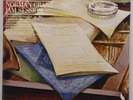
Sealed LP: Charlie Parker: The Verve Years (1950-51)
$
25


$ 25
Sold For
May 3, 2010
Sold Date
Apr 26, 2010
Start Date
1
Number Of Bids
USA
Country Of Seller
eBay
Sold at
Favourite Auctions
To save auctions to your favourites, please login
If you don't have an account, please register
Description
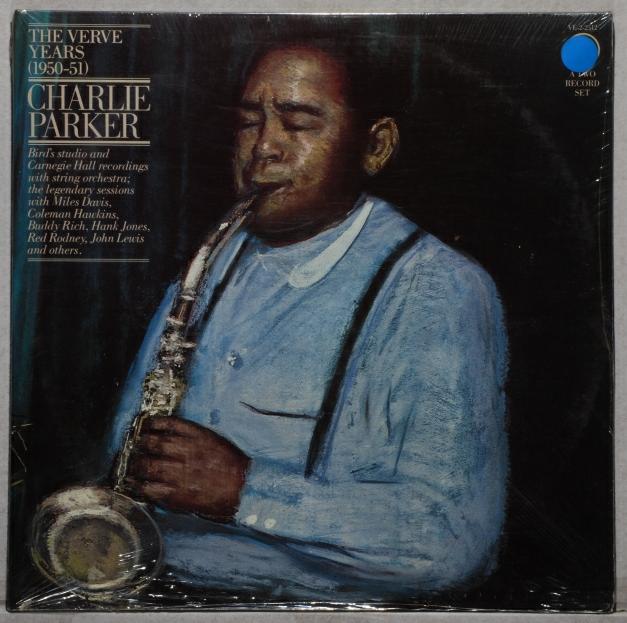
Charlie Parker: The Verve Years (1950-51)
FACTORY SEALED LP
Format: Sealed LPRecord Company/Release Number: Verve Records/Polydor: VE-2-2512
Bar Code: NONE
Original release date: 1976
Country: U.S.A.
Condition of the cover: Mint
Condition of the record: Sealed - Assumed Mint
Shipping Weight: 1 pounds, 7 ounces
Opening bid: 24.99
Inventory number: 208683A
Notes: 2 LPs in a gatefold cover. Please contact me if you have any difficulty viewing the photos.
Songs: Dancing In The Dark
- Laura
- They Can’t Take That Away From Me
- Out Of Nowhere
- East Of The Sun (West Of The Moon)
- Easy To Love
- I’m In The Mood For Love
- I’ll Remember April
- Repetition
- What Is This Thing Called Love
- April In Paris
- Easy To Love
- Rocker
- Celebrity
- Ballade
- Au Privave
- She Rote
- K. C. Blues
- Star Eyes
- My Little Suede Shoes
- Un Poquito De Tu Amor
- Tico Tico
- Fiesta
- Why Do I Love You
- Blues For Alice
- Si Si
- Swedish Schnapps
- Back Home Blues
- Lover Man
- Charlie Parker: Alto Saxophone, Strings
- Hank Jones: Piano
- Ray Brown: Bass
- Budy Rich: Drums
- Coleman Hawkins: Tenor Saxophone
- Miles Davis: Trumpet
- Walter Bishop: Piano
- Teddy Kotick: Bass
- Max Roach: Drums
- Roy Haynes: Drums
- Jose Manguel: Bongos
- Luis Miranda: Conga
- Red Rodney: Trumpet
- John Lewis: Piano
- Kenny Clarke: Drums
- 1950-1951. This authoritative twin set nicely compiles and covers two prime Parker years.
- One of a handful of musicians who can be said to have permanently changed jazz, Charlie Parker was arguably the greatest saxophonist of all time. He could play remarkably fast lines that, if slowed down to half speed, would reveal that every note made sense. "Bird," along with his contemporaries Dizzy Gillespie and Bud Powell, is considered a founder of bebop; in reality he was an intuitive player who simply was expressing himself. Rather than basing his improvisations closely on the melody as was done in swing, he was a master of chordal improvising, creating new melodies that were based on the structure of a song. In fact, Bird wrote several future standards (such as "Anthropology," "Ornithology," "Scrapple from the Apple," and "Ko Ko," along with such blues numbers as "Now's the Time" and "Parker's Mood") that "borrowed" and modernized the chord structures of older tunes. Parker's remarkable technique, fairly original sound, and ability to come up with harmonically advanced phrases that could be both logical and whimsical were highly influential. By 1950, it was impossible to play "modern jazz" with credibility without closely studying Charlie Parker.
- Born in Kansas City, KS, Charlie Parker grew up in Kansas City, MO. He first played baritone horn before switching to alto. Parker was so enamored of the rich Kansas City music scene that he dropped out of school when he was 14, even though his musicianship at that point was questionable (with his ideas coming out faster than his fingers could play them). After a few humiliations at jam sessions, Bird worked hard woodshedding over one summer, building up his technique and mastery of the fundamentals. By 1937, when he first joined Jay McShann's Orchestra, he was already a long way toward becoming a major player.
- Charlie Parker, who was early on influenced by Lester Young and the sound of Buster Smith, visited New York for the first time in 1939, working as a dishwasher at one point so he could hear Art Tatum play on a nightly basis. He made his recording debut with Jay McShann in 1940, creating remarkable solos with a small group from McShann's orchestra on "Oh, Lady Be Good" and "Honeysuckle Rose." When the McShann big band arrived in New York in 1941, Parker had short solos on a few of their studio blues records, and his broadcasts with the orchestra greatly impressed (and sometimes scared) other musicians who had never heard his ideas before. Parker, who had met and jammed with Dizzy Gillespie for the first time in 1940, had a short stint with Noble Sissle's band in 1942, played tenor with Earl Hines' sadly unrecorded bop band of 1943, and spent a few months in 1944 with Billy Eckstine's orchestra, leaving before that group made their first records. Gillespie was also in the Hines and Eckstine big bands, and the duo became a team starting in late 1944.
- Although Charlie Parker recorded with Tiny Grimes' combo in 1944, it was his collaborations with Dizzy Gillespie in 1945 that startled the jazz world. To hear the two virtuosos play rapid unisons on such new songs as "Groovin' High," "Dizzy Atmosphere," "Shaw 'Nuff," "Salt Peanuts," and "Hot House," and then launch into fiery and unpredictable solos could be an upsetting experience for listeners much more familiar with Glenn Miller and Benny Goodman. Although the new music was evolutionary rather than revolutionary, the recording strike of 1943-1944 resulted in bebop arriving fully formed on records, seemingly out of nowhere.
- Unfortunately, Charlie Parker was a heroin addict ever since he was a teenager, and some other musicians who idolized Bird foolishly took up drugs in the hope that it would elevate their playing to his level. When Gillespie and Parker (known as "Diz and Bird") traveled to Los Angeles and were met with a mixture of hostility and indifference (except by younger musicians who listened closely), they decided to return to New York. Impulsively, Parker cashed in his ticket, ended up staying in L.A., and, after some recordings and performances (including a classic version of "Oh, Lady Be Good" with Jazz at the Philharmonic), the lack of drugs (which he combated by drinking an excess of liquor) resulted in a mental breakdown and six months of confinement at the Camarillo State Hospital. Released in January 1947, Parker soon headed back to New York and engaged in some of the most rewarding playing of his career, leading a quintet that included Miles Davis, Duke Jordan, Tommy Potter, and Max Roach. Parker, who recorded simultaneously for the Savoy and Dial labels, was in peak form during the 1947-1951 period, visiting Europe in 1949 and 1950, and realizing a lifelong dream to record with strings starting in 1949 when he switched to Norman Granz's Verve label.
- But Charlie Parker, due to his drug addiction and chance-taking personality, enjoyed playing with fire too much. In 1951, his cabaret license was revoked in New York (making it difficult for him to play in clubs) and he became increasingly unreliable. Although he could still play at his best when he was inspired (such as at the 1953 Massey Hall concert with Gillespie), Bird was heading downhill. In 1954, he twice attempted suicide before spending time in Bellevue. His health, shaken by a very full if brief life of excesses, gradually declined, and when he died in March 1955 at the age of 34, he could have passed for 64.
- Charlie Parker, who was a legendary figure during his lifetime, has if anything grown in stature since his death. Virtually all of his studio recordings are available on CD along with a countless number of radio broadcasts and club appearances. Clint Eastwood put together a well-intentioned if simplified movie about aspects of his life (Bird). Parker's influence, after the rise of John Coltrane, has become more indirect than direct, but jazz would sound a great deal different if Charlie Parker had not existed. The phrase "Bird Lives" (which was scrawled as graffiti after his death) is still very true.
FINE PRINT
- All pictures are of the exact item being sold.
- This record came from a record store called "Phantasmagoria" which was located in Allentown, Pennsylvania. Phantasmagoria went out of business in 1978. I purchased most of their leftover inventory some years later when I owned a new & used record store in Catasauqua called "Music Madness".
- Phantasmagoria used round colored stickers to indicate the price of the albums. They had a sign on the wall with the color sticker combinations for the customers to use so they knew the price of the albums. Most of the albums still have these stickers on them, and in some rare cases, the stickers are written on. Some of the records have prices on them. This is the price you would have paid for the record in 1978 if you would have bought it at Phantasmagoria. Please don't confuse these prices with their current value.
- Your item(s) will be shipped within two business days after I receive your payment.
- I always leave feedback before your item ships. Please consider leaving feedback for me after you have had a chance to inspect and enjoy this record.
- Please avoid questions on the last day of the auction. I might not have enough time to give you an answer before the auction ends.
- Payment by PayPal is preferred. Other payment methods can be discussed. Local pick-ups will require cash at the time of pick-up.
- Almost all album reviews, credits and artist biographies are from All Music Guide. If you haven't been to their web site, you should check it out. It's one of the most comprehensive music references on the internet. In some cases, the above credits may include reissue (CD) information. Obviously any credits referenced to CDs do not apply to these album releases.
- All sealed albums are being sold as collector's items and cannot be returned due to manufacturer's defects. It may be almost impossible to replace many of the sealed albums that I am selling.
I DO NOT END ANY OF MY AUCTIONS EARLY. PLEASE DON'T ASK (unless you offer enough to pay off my mortgage).
IT IS NOT MY INTENTION TO MAKE A PROFIT ON THE POSTAGE. ANY ACCIDENTAL OVERCHARGE GREATER THAN $1 WILL BE REFUNDED TO YOU. (I've been know to refund less than $1 overcharges too.)
Shipping
Domestic (U.S.A.) buyers:- Priority Mail will be the only option available if you are the winning bidder. If you want your purchase shipped by Media Mail, you will have the option to request a revised invoice.
- Priority Mail: Buyer pays the actual USPS cost.
- Pick-up is fine with me. Just be prepared to pay by cash. No shipping fees apply. E-mail me to setup a time that is convenient for the both of us.
- All uninsured and underinsured shipments are the responsibility of the buyer.
- Foreign buyers must pay with US dollars through PayPal only. Please do not send cash - it's too risky.
- SHIPPING: I will send an invoice with options for the cost of shipping after the auction ends. You will have the choice of the following two options:
- USPS First Class International: Estimated delivery time to most countries is about 10-30 days. (Customs may delay delivery)
- USPS Priority Mail International: Estimated delivery time to most countries is about 6-10 days. (Customs may delay delivery)
- All uninsured and underinsured shipments are the responsibility of the buyer.
- The buyer is responsible for all customs regulations and fees in their own country.
- I will value all records at $5 on the Customs Form. Please let me know if you want the actual winning bid price listed on the Customs Form.
This only applies to the winning bidder. If I have multiple copies of this record, and you are interested in buying any extras, let me know. I will sell you as many copies that I can (it depends on how many I have), and every additional extra will be discounted 10% less than your winning bid. I'm sorry, but I cannot disclose if I have any extra copies until after the auction ends.
If you are interested in extra copies, please ask before making your payment, otherwise the discount will be void. I collect Grand Funk Railroad's music and memorabilia. If you think that you might have something to trade for this record, let me know well before the auction ends. I normally do not end an auction early, but I will make an exception if we can work out some sort of trade for something that I can add to my Grand Funk collection.
If you also collect Grand Funk, let me know if you have anything that you might want to sell or trade. I am always looking to add something new to my collection.
price rating